
Choosing the right glass for your windows isn't just a tick-box exercise. It's one of the most important investments you'll make in your home's comfort, security, and running costs. The main types of glass in windows you'll come across are annealed (the standard stuff), toughened, laminated, and insulated glass units (IGUs), and each one does a very different job.
When you're looking out at the famously unpredictable Yorkshire weather, you probably don't give the glass in your windows a second thought. But that transparent barrier is working incredibly hard to keep you warm, dry, and safe. It’s easy to think of glass as just a simple pane, but modern glazing is a piece of highly engineered technology.
The choice you make has a direct impact on everything, from the size of your heating bills to how peaceful your living room feels. This guide is here to cut through the jargon and explain the options, from basic glass to the advanced units that are now the standard. We’ll show you how modern glazing does so much more than just let you see outside; it actively improves how your home performs.
Getting to grips with the key differences is the first step to making a smart decision for your property, whether it’s a terrace in Leeds, a listed building in York, or a brand new home in Newcastle.
By the time you've finished reading, you'll have a solid understanding of the most common types of glass used in UK homes. We'll break down what each option offers, helping you match the right glass to what you actually need. You’ll learn about:
Think of your window glass not as a passive sheet, but as an active part of your home’s fabric. The right type works tirelessly behind the scenes to save you money, protect your family, and make your home a better place to be. It’s absolutely fundamental to creating a modern, high-performing house.
Picking the right type of glass for your windows means weighing up a few key things: your budget, your property's age and style, and what you’re trying to achieve. Are you fed up with huge energy bills? Need to block out the noise from a busy road? Or do you simply need to meet safety regulations for a new set of patio doors?
This guide will give you the knowledge you need. We'll provide practical, real-world insights to help you navigate the choices, so you can speak confidently to glazing professionals and pick a product that delivers genuine, long-term value. From dealing with conservation area rules to just wanting a warmer front room, the journey to better windows starts right here, with the glass itself.
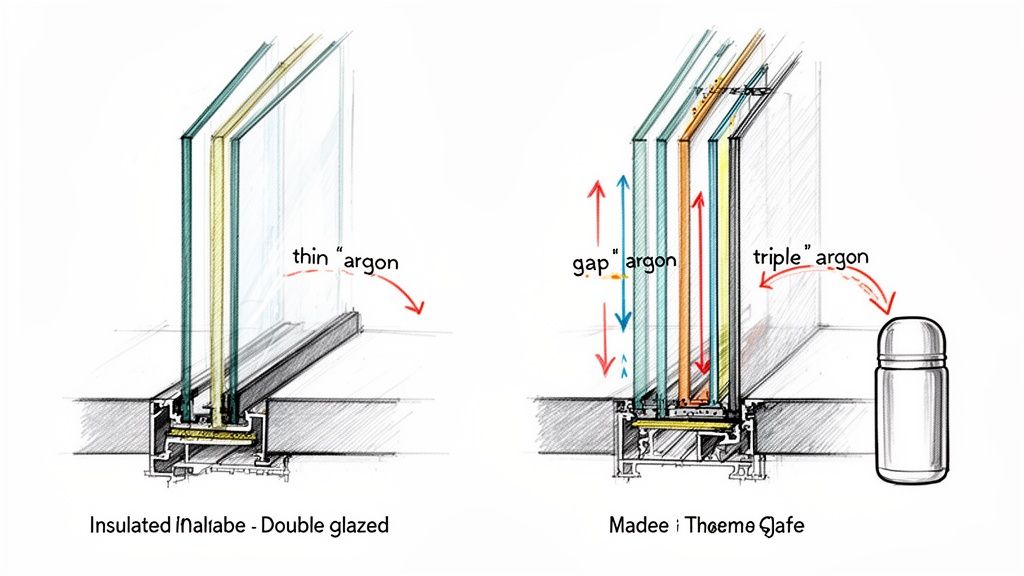
Without a doubt, the single biggest upgrade for UK homes in recent decades has been the switch to Insulated Glass Units (IGUs). You probably know them as double or triple glazing, and this technology has completely changed how our homes perform, especially up here in the cooler climate of the North of England.
Think of an IGU as a thermos flask for your window. Instead of a single flimsy pane of glass standing between you and the elements, an IGU has two or three panes sealed together with a crucial gap in between. That gap is the secret sauce.
It isn't just empty space, either. It’s filled with a harmless, inert gas like argon. Because argon is denser than air, it’s a terrible conductor of heat. This creates a powerful thermal barrier that dramatically slows down heat escaping your home in winter and stops unwanted heat from getting in during summer.
The move from single panes to multi-pane windows is one of the most significant shifts in UK housing in the last 40 years, driven by soaring energy costs and much stricter building regulations. In the past, most homes had single glazing, but rule changes back in 2002 made double glazing the standard for all new and replacement windows.
For homes across Yorkshire and the North East, this means households can slash heat loss through their windows by up to 60%, which translates into serious savings on your heating bills. Whether you’re in York or Newcastle, that means a warmer, more comfortable home without constantly fiddling with the thermostat.
When you're looking at windows, you’ll constantly hear the term U-value. It sounds a bit technical, but the idea behind it is incredibly simple.
A U-value just measures how good a window is at stopping heat from getting through it. The only thing you really need to remember is that a lower U-value means better insulation.
An old, draughty single-glazed window might have a U-value of 5.0 W/m²K or even higher. By contrast, a standard modern double-glazed unit sits around 1.2 W/m²K, while a top-tier triple-glazed unit can get below 0.8 W/m²K. The difference is massive and has a direct impact on your home's warmth and your wallet.
While quality double glazing is now the benchmark, triple glazing takes performance to another level entirely. By adding a third pane of glass and a second gas-filled cavity, it pushes the U-value even lower. But is it worth it for every home?
For many properties, the value for money offered by modern, A-rated double glazing is spot on. However, if your property is listed or in a conservation area where new windows are a no-go, you might want to explore our guide on secondary glazing. It’s an incredibly effective way to boost insulation without altering the original character of your windows.
When it comes to certain areas of your home, the glass in your windows isn't just about the view; it's a critical safety feature governed by law. For any glass in doors, nearby side panels, low-level windows (anything below 800mm from the floor), and especially overhead installations like skylights, standard glass simply won't do. UK Building Regulations demand the use of safety glass. This is where toughened and laminated glass enter the picture.
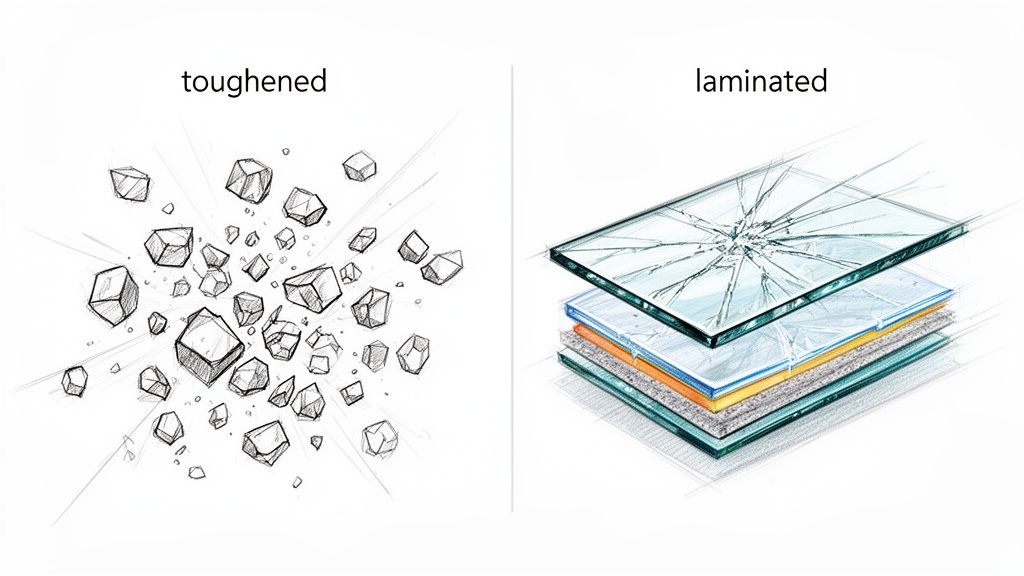
They both protect you, but they achieve it in completely different ways. Getting to grips with how they work is the key to making sure your home is both safe and secure, whether you're fitting a new patio door in Harrogate or planning a loft conversion in Newcastle.
Toughened glass, which you might also hear called tempered glass, is all about brute strength. It starts life as a standard pane of annealed glass but then goes through an intense process of heating and rapid cooling. This treatment completely changes the internal stresses of the glass, making it incredibly resilient.
The result? A pane of glass that's four to five times stronger than the ordinary stuff. It can take a serious knock, which is why you’ll find it in high-traffic areas where accidents are more likely to happen.
But its most important safety feature only reveals itself when it finally breaks. Instead of shattering into dangerous, jagged shards, toughened glass crumbles into thousands of small, blunt, cube-like pieces. Think of how a car's side window breaks—those little fragments are far less likely to cause a serious injury. This predictable break pattern is what makes it a true safety glass.
Laminated glass takes a different approach to safety. The easiest way to think of it is as a 'glass sandwich'. It’s made by bonding a tough, clear plastic interlayer—usually Polyvinyl Butyral (PVB)—between two sheets of ordinary glass using heat and pressure.
This clever construction means that even when the glass breaks, the shards stick firmly to that plastic interlayer. The pane will crack, often in a spider-web pattern, but it stays held together in the frame. This not only prevents dangerous pieces from falling but also creates a barrier that’s tough for an intruder to get through, adding a brilliant layer of security.
The core difference is simple: Toughened glass is designed to break safely into harmless pieces. Laminated glass is designed not to fall apart when it breaks, keeping the pane intact.
So, which one do you need? It really depends on the specific spot and what job you need the glass to do.
Toughened Glass is ideal for:
Laminated Glass is essential for:
The move towards high-performance glazing is undeniable, particularly for overhead windows. In fact, industry analysis shows that double glazing now makes up over 55% of the UK roof window market. These units often cleverly combine a toughened outer pane for impact resistance with a laminated inner pane for overhead safety. You can read more about the growth of the UK roof window market to see these trends. This combination gives homeowners in the North East the best of both worlds: safety and excellent insulation.
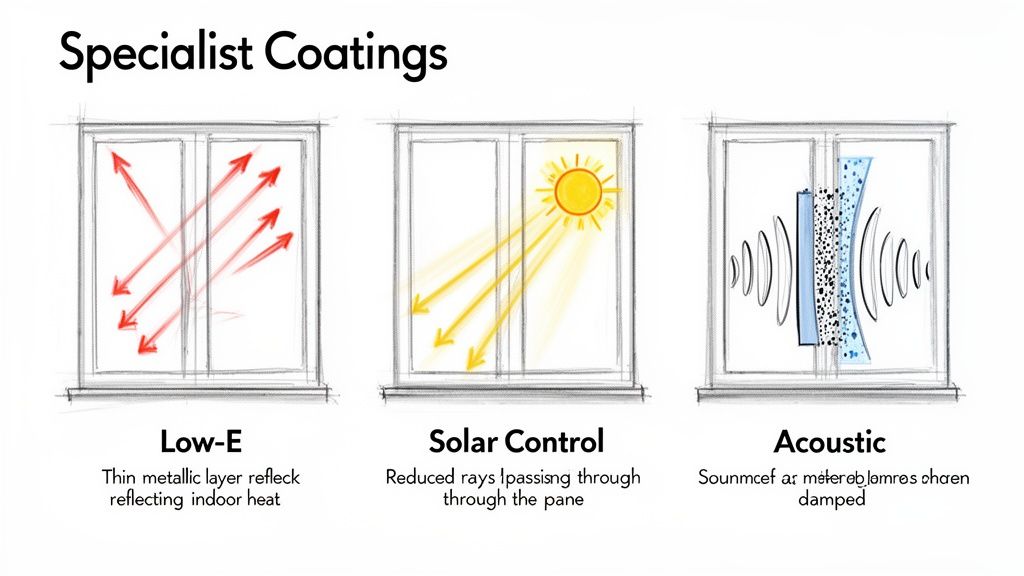
Once you’ve got the right foundation with a solid insulated glass unit, you can really start to fine-tune your window’s performance. This is where specialist coatings and interlayers come in, designed to solve those common headaches homeowners face, from eye-watering energy bills to relentless road noise.
Think of it as the final touch that transforms a good window into the perfect window for its exact spot. These technologies let you tailor your glazing to your home’s specific needs, whether that’s a south-facing conservatory in Leeds that gets far too hot, or a city-centre flat needing a bit of peace and quiet. Getting to grips with these coatings is the key to unlocking maximum comfort and efficiency.
One of the biggest game-changers in modern glazing is the Low-Emissivity (Low-E) coating. It's an incredibly thin, totally transparent layer of metal oxide applied to one of the glass surfaces inside the sealed unit. You can't see it, but you'll certainly feel the difference it makes to your home's warmth.
The best way to think of a Low-E coating is as a thermal mirror. In winter, it reflects the heat from your radiators and even body heat back into the room, stopping it from escaping through the glass. This simple but brilliant bit of science dramatically improves your window's insulating power, keeping your home cosy and your heating bills in check.
With the chilly winters we get across Yorkshire, Low-E glass is no longer a luxury—it's an essential feature in any high-quality double or triple-glazed unit. It’s one of the most effective ways to boost your home’s energy efficiency without sacrificing an ounce of natural light.
While keeping heat in is vital during winter, stopping too much of it from getting in is just as important in summer. This is where solar control glass really shines. It’s built specifically for those large, south-facing windows, conservatories, and glazed extensions that can feel more like a greenhouse in direct sunlight.
Solar control glass has a special coating that reflects a huge chunk of the sun's heat while still letting plenty of visible light pour through. This helps keep your indoor temperature comfortable without you having to live with the blinds drawn or the air conditioning on full blast. It’s a must-have for creating living spaces you can actually use all year round.
A brilliant side-effect of both Low-E and solar control coatings is their ability to block a huge amount of damaging UV radiation. This helps protect your furniture, carpets, and artwork from fading over time, preserving your home's interior. To learn more, you can explore the science and benefits of UV blocking window tinting.
For homes near busy roads, railway lines, or just noisy urban centres, acoustic glass offers a welcome slice of tranquillity. It’s a type of laminated glass, but with a special acoustic interlayer that’s engineered to disrupt and absorb sound vibrations.
This specialist interlayer is softer and more elastic than the one used in standard safety glass. It’s particularly good at dampening those annoying mid-to-high frequency sounds like traffic, sirens, and voices that can really get on your nerves.
Choosing acoustic glass can make a phenomenal difference to your home's atmosphere. The reduction in outside noise creates a much more peaceful and relaxing environment, which is priceless for bedrooms and home offices. For any homeowner in a bustling part of York or Manchester, it’s an investment in pure calm.
Your windows should do more than just let in light; they should add character to your home and protect your privacy where it matters most. This is exactly where decorative glass comes into its own, striking that perfect balance between beautiful design and practical seclusion, all without sacrificing the natural light that makes a house feel like a home.
These specialised options go far beyond simple, clear panes. They give you the power to control visibility in sensitive areas like bathrooms and front doors, add a real touch of personality, and solve common headaches like screen glare. Critically, you don't have to compromise – these decorative finishes can be built right into our high-performance double or triple-glazed units, so you get privacy and thermal efficiency.
Think of tinted glass as sunglasses for your home. It’s made by adding tiny amounts of metal oxides to the glass mix, which gives the pane a subtle, even colour – usually bronze, grey, or blue. Its main job is to cut down on solar glare and heat gain, which makes it a brilliant choice for sunny, south-facing rooms or a home office where you're battling reflections on a screen all day.
But it’s not just practical. A tint adds a very sleek, contemporary look to the outside of a property. It also provides a good level of daytime privacy, making it harder for people to see in from the street and helping you create a comfortable, private space inside.
When you need total privacy without resorting to blinds, frosted and obscured glass are the undisputed champions. People often use the terms interchangeably, but they’re actually made in different ways and create distinct visual effects.
Frosted Glass: This gets its classic, smooth look from either sandblasting or acid-etching one side of the glass. The process creates a silky, translucent finish that completely blurs the view by scattering light. You still get a lovely, soft, diffused glow flooding the room, but nobody can see in. Its clean, minimalist appearance is perfect for a modern home in Hull or Leeds.
Obscured Glass: This type of glass has a pattern or texture physically rolled onto its surface while it's being made. The patterns can be anything from traditional stippled or floral designs to more modern geometric shapes. This makes it a fantastic option for complementing a period property in York, where you can find a style that fits the building's historic character perfectly.
Both frosted and obscured glass are the ideal solution for front doors, bathroom windows, and any ground-floor room that looks out onto a street or a neighbour's garden. They deliver the highest level of privacy while keeping the space feeling bright and welcoming.
The versatility of these options doesn't stop at windows, either. If you’re looking to create truly unique interior features, we can help design and install a whole range of bespoke glass projects, from stylish patterned partitions to elegant shower screens.
If you're looking for an alternative to replacing the glass itself, window films offer another route to privacy. To see what's out there, it's worth reading a good UK guide on the best window film for privacy, which breaks down the different types available.
Trying to work out which type of glass is right for your windows can feel a bit overwhelming. But it doesn't have to be. The best way to make the right call is to simply think about what you need from each room and your home's unique situation.
First things first, think about how you use each space. Is your bedroom or home office right on a busy Newcastle road? If so, acoustic glass is a game-changer, genuinely turning a noisy room into a peaceful retreat. Or maybe you've got a beautiful conservatory in Harrogate that gets so hot in summer it’s basically unusable. That’s a classic case where solar control glass is a must-have to keep temperatures comfortable.
Next up, consider your property itself. A lovely old period home in a York conservation area has a completely different set of needs to a new-build house on the windy coast. You'll likely need to find that sweet spot between modern thermal performance and preserving the building's heritage character, maybe by using special slimline units that mimic traditional glass.
Making a confident choice is so much easier when you have a simple framework. Just ask yourself a few straightforward questions to point you in the right direction:
This little decision tree can help simplify the process, walking you through the choices based on what matters most to you, like privacy or style.
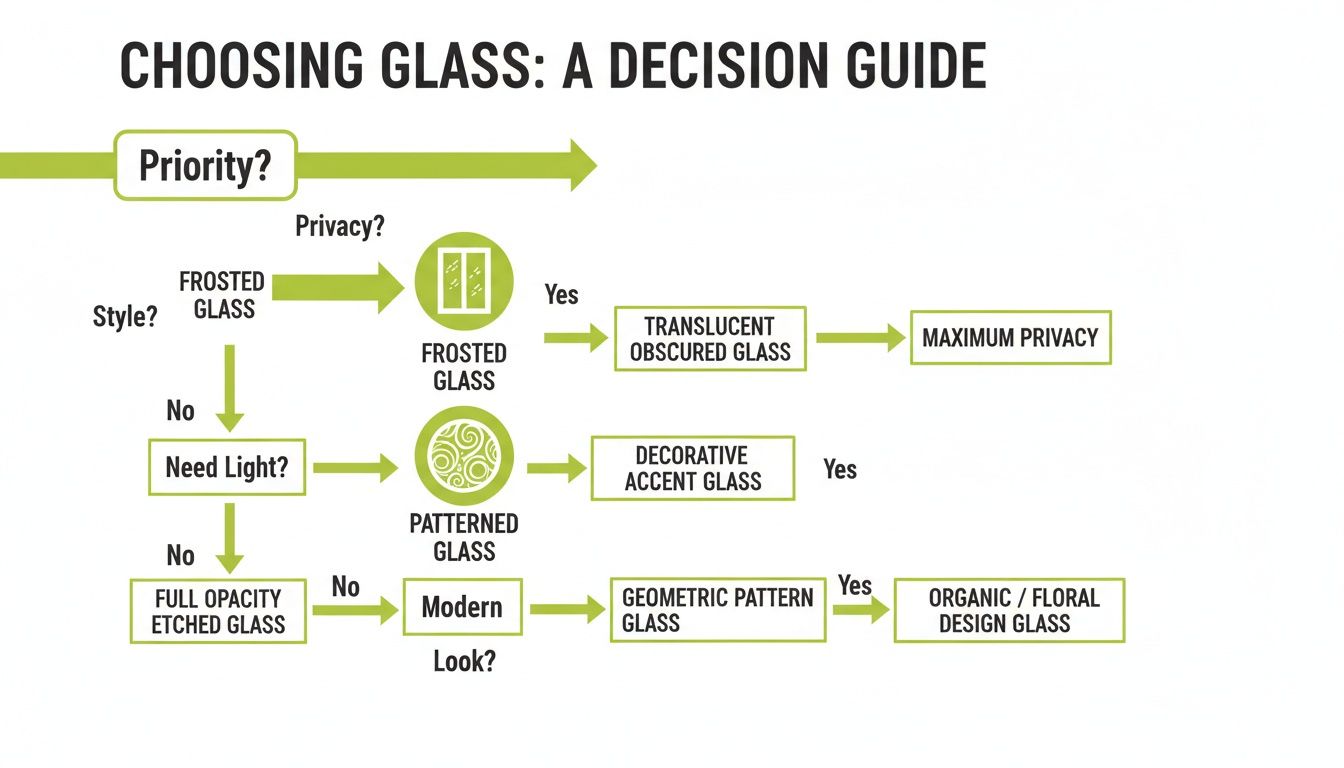
As you can see, the flowchart shows how starting with just one priority—say, boosting privacy—can quickly lead you to the perfect options, like frosted or patterned glass.
Swapping out your old window glass for something better is one of the most effective upgrades you can make to your home. The benefits aren't subtle; they’re powerful and you'll feel them straight away, completely changing how your home feels and performs.
Upgrading isn't just a maintenance chore; it’s an opportunity to boost your home’s energy efficiency, strengthen its security, and increase its value. Modern glazing simply works harder, looks better, and delivers a real return for years to come.
As your local glass experts across Yorkshire and the North East, we know the specific challenges homeowners face in our corner of the country. Whether it’s battling the coastal weather or navigating conservation area rules, our team has the hands-on experience to guide you. If your current windows are foggy, cracked, or just not cutting it anymore, our efficient glass replacement service can restore clarity and performance without the expense of brand-new frames.
At Glass Tech, we’re here to help you make the right choice. We bring decades of practical experience and a real commitment to quality, making sure your investment is one that truly improves your home for the long haul.
To help you make the best choice, we've tackled some of the most common questions we hear from homeowners across Yorkshire. Here are some quick, clear answers to clear up any confusion about the different types of glass for your windows.
For many homes in colder, northern spots like Yorkshire, triple glazing can be a game-changer. While you'll see a higher upfront cost compared to double glazing, the performance boost is significant, giving you far superior thermal insulation (a much lower U-value) and noticeably better soundproofing.
It really comes into its own for north-facing windows or homes in very exposed locations where heat loss is a constant battle. Ultimately, the decision comes down to balancing your budget against the long-term energy savings and the simple day-to-day comfort of a warmer, quieter home.
The key difference is all about how they behave when they break. Toughened glass is heat-treated to make it incredibly strong, but when it does break, it shatters into thousands of small, blunt cubes – much like a car's side window. It’s designed to prevent serious injury from sharp shards.
Laminated glass, on the other hand, is more like a glass sandwich. It’s made of two panes of glass bonded to a tough plastic interlayer. If it breaks, the glass fragments stick firmly to this layer, keeping the pane intact and preventing dangerous shards from falling out.
In short: Toughened glass is your go-to for doors and low-level windows where someone might accidentally bump into it. Laminated glass is essential for overhead glazing and is a fantastic choice for boosting security on ground-floor windows and doors.
That’s a good question, because Low-E coatings are microscopically thin and totally invisible to the naked eye. But there’s a simple trick you can try at night, often called the 'flame test'.
Carefully hold a lit match or a lighter flame near the inside of your window. In a standard double-glazed unit, you’ll see four reflections of the flame. If you have a Low-E coating, one of those four reflections will be a slightly different colour—often a subtle pinkish or purplish hue. The position of that discoloured flame even tells you which surface the coating is on.
Absolutely, and in fact, it’s a very common way to create a high-performance window that does everything you need it to. We often build insulated glass units (IGUs) using different types of glass to solve specific problems.
For example, a popular combination for a ground-floor patio door in a Leeds home might include:
This layering approach lets us design custom glazing solutions that are perfectly matched to any window in your home, from a bathroom needing privacy in York to a large bay window in Hull that needs to be extra warm. By combining technologies, you get a window that’s safe, secure, and incredibly energy-efficient.
Ready to upgrade your home with the right type of glass? The experts at Glass Tech have over two decades of experience helping homeowners across Yorkshire and the North East make the perfect choice. Contact us today for a no-obligation consultation and discover how new glazing can transform your property.

A professional team of experts providing glass and glazing solutions covering the whole of Yorkshire & more...
Whether it's Leeds, York, North Yorkshire, Birmingham, Hull, Liverpool, Machester, Newcastle or Nottingham, get in touch to find out how we can help you with your bespoke glass project.