
At first glance, toughened and laminated glass might seem similar, but the real story lies in how they’re made and, more importantly, how they react under pressure. It's a simple but critical distinction: toughened glass shatters into small, blunt pieces for safety, while laminated glass cracks but holds together, thanks to a tough plastic interlayer. This one difference changes everything when it comes to safety, legal compliance, and how the glass performs in your home.
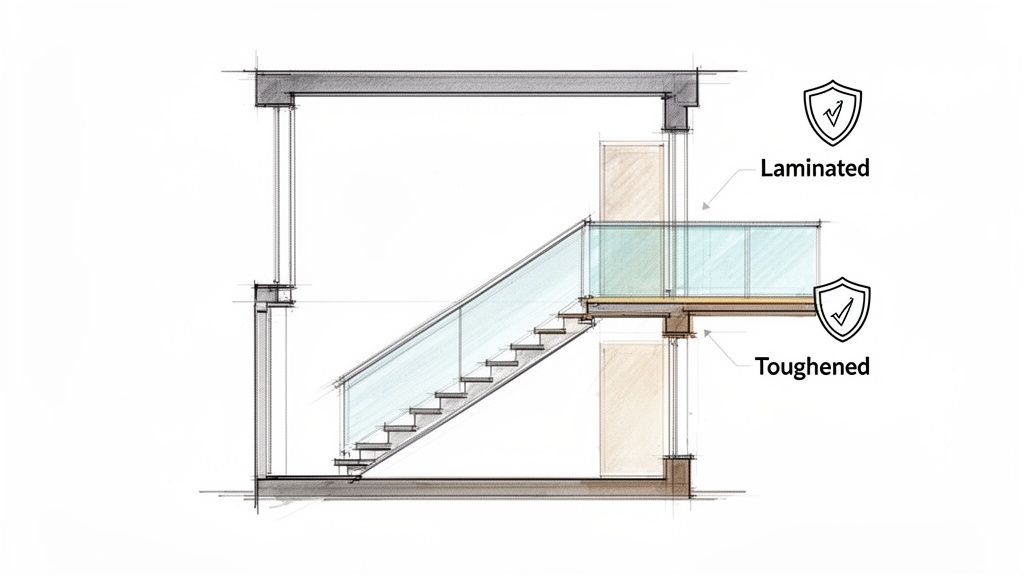
If you're planning a project that involves glass—especially something structural like a balustrade—you’ll hear the terms ‘laminated’ and ‘toughened’ come up constantly. They’re both classed as safety glass, but they aren't interchangeable. Getting this choice right isn't just about the final look; it’s about the fundamental safety of your home and family.
For homeowners across the North of England, whether you're in Leeds, York, or Newcastle, knowing the specific strengths of each type is the first step to getting your installation spot on. Whether you’re dreaming of a sleek, modern staircase or a minimalist balcony, the glass you select will define the project's safety profile and how well it lasts.
To get straight to the point, here’s a quick rundown of what sets them apart.
| Feature | Toughened Glass | Laminated Glass |
|---|---|---|
| Breakage Pattern | Shatters into small, blunt cubes | Cracks but stays in one piece |
| Manufacturing | A single pane of glass, heat-treated | Two or more panes bonded by an interlayer |
| Primary Strength | High resistance to impact and heat | Holds together after breaking |
| Common Use | Shower screens, internal doors | Balconies, overhead glazing, walk-on floors |
This guide will walk you through a proper comparison, covering everything from the factory process to how each performs under impact. Our goal is to give you the clarity you need to pick the perfect glass for your home, guaranteeing a result that’s both beautiful and secure.
You can also see these materials in action and learn more about our stunning glass balustrade systems.
The unique personalities of laminated and toughened glass are born from completely different manufacturing methods. One is forged in fire, relying on intense thermal treatment to build incredible internal strength. The other is a precisely engineered composite, designed to hold together even when it fails.
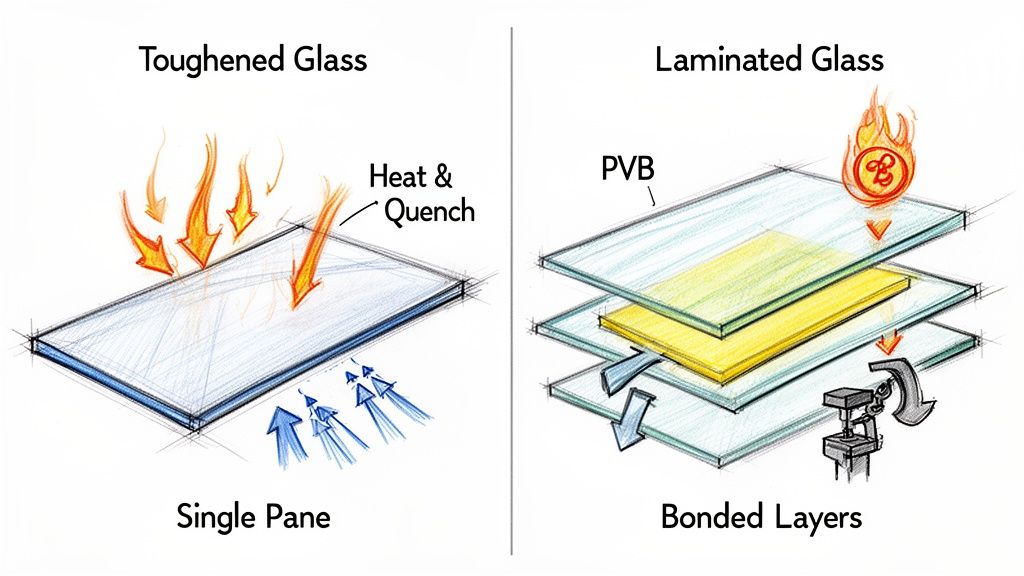
Understanding these two processes is the key to knowing why one shatters into safe pieces and the other holds firm when damaged. This fundamental difference begins on the production line, and it dictates exactly how each glass will perform in a real-world setting, whether it's a shower screen in Leeds or a modern staircase in York.
Toughened glass begins its life as a standard pane of float glass. Nothing special yet. The magic happens during a carefully controlled thermal tempering process.
First, the glass is moved into a furnace and heated to an extreme temperature, typically over 600°C. This takes it past its softening point. The moment it reaches this uniform temperature, it’s hit with high-pressure jets of cold air in a process we call ‘quenching’.
This sudden, rapid cooling forces the outer surfaces of the glass to solidify much faster than the centre. As the molten inner core eventually cools and contracts, it pulls against the now-rigid outer surfaces. The result is a pane of glass with a highly compressed surface and a core held in permanent tension.
This locked-in stress is what gives toughened glass its superpowers—making it four to five times stronger than ordinary glass. It's also this stored energy that causes it to crumble into small, blunt cubes when it finally breaks.
Laminated glass isn't a single pane at all; it’s more like a high-tech glass sandwich. Its creation involves bonding two or more layers of glass together with a tough, flexible interlayer.
The most common interlayer is Polyvinyl Butyral (PVB), a durable polymer resin. The process is meticulous:
This last stage permanently fuses the glass and the PVB into a single, incredibly robust panel. When laminated glass is struck hard, the glass layers might crack, but the fragments stay firmly glued to the interlayer. This prevents the glass from falling apart and ensures it maintains a protective barrier, a crucial feature for many of our bespoke glass projects.
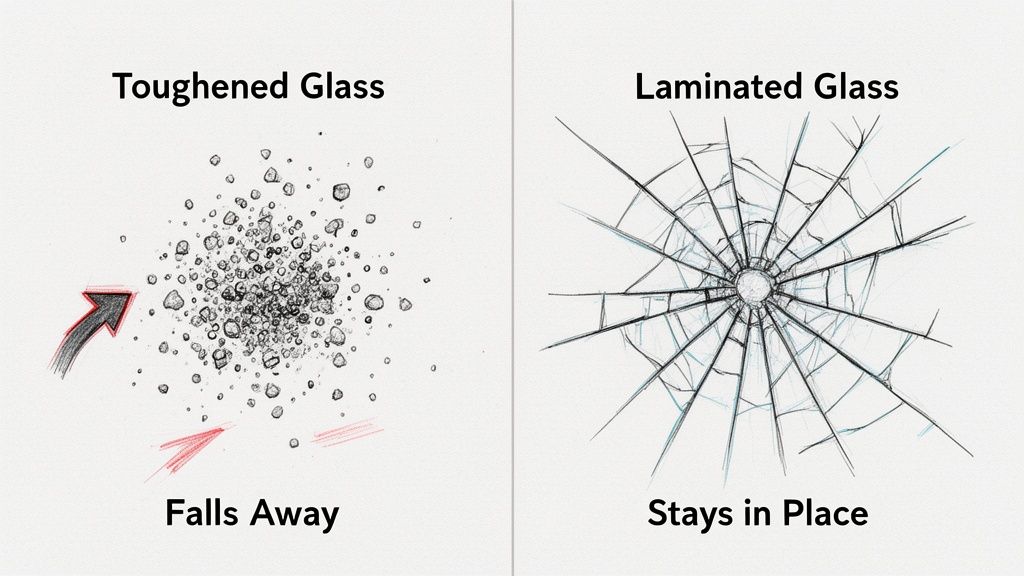
While both glass types are officially classified as 'safety glass', their reactions to a sudden, forceful impact are worlds apart. It's this fundamental difference—what we call post-breakage behaviour—that really matters when deciding where to use them. How each one fails has a direct and serious impact on the safety of your home.
When toughened glass breaks, the immense internal stress packed into it during manufacturing is released in a split second. The result is dramatic: it completely shatters into thousands of small, granular, dice-like pieces. These fragments are relatively blunt, making them far less likely to cause deep cuts compared to the lethal shards from ordinary annealed glass.
But there’s a trade-off. This explosive shattering means the glass vacates the opening entirely, leaving a gaping hole. While this is safer in some situations, it creates a massive fall hazard if that glass was acting as a barrier. It’s a crucial point to consider for any project, from Glass Balustrades Yorkshire to a Juliet balcony in Newcastle.
Laminated glass behaves in a completely different way. When it takes a heavy blow, the glass layers will crack, often spreading out in a distinctive ‘spider-web’ pattern. But here’s the key difference: those cracked fragments remain firmly bonded to the tough plastic interlayer.
This remarkable property ensures the panel stays put, holding its position within the frame. It continues to act as a protective barrier even after it has broken, preventing a person or object from falling through.
This ‘fail-safe’ characteristic is precisely why building regulations often mandate laminated glass for any critical safety application. This includes overhead glazing like skylights, walk-on glass floors, and most importantly, balustrades that protect a significant drop.
To help you see the differences at a glance, here’s a quick breakdown of their core attributes.
| Attribute | Toughened Glass | Laminated Glass |
|---|---|---|
| Breakage Pattern | Shatters into small, blunt cubes | Cracks in a spider-web pattern |
| Post-Breakage State | Vacates the frame, leaving an opening | Stays in place, held by the interlayer |
| Primary Safety Function | Prevents serious cuts from sharp shards | Prevents falls by maintaining a barrier |
| Common Uses | Shower screens, internal doors, table tops | Balustrades, skylights, glass floors, shopfronts |
| Strength | 4-5 times stronger than standard glass | Similar strength to standard glass (per layer) |
| Security | Offers minimal security once broken | Provides high security, resisting entry |
Ultimately, the choice comes down to one crucial question: is it more important for the glass to break into harmless pieces, or for it to remain in place as a barrier?
Toughened glass is designed to break safely to prevent injury from the glass itself. Laminated glass is designed to stay together to prevent a fall. This single distinction guides every decision about where each type should be installed to ensure maximum safety and compliance.
Understanding this behaviour is essential for anyone considering a glass upgrade or replacement. To learn more about how we apply these principles in our work, take a look at our professional glass replacement services.
So, which glass is right for your project? The answer always comes down to two simple things: where it’s going and what you need it to do. For homeowners we work with across the north of the UK, from Leeds to Newcastle, the application nearly always dictates the choice. It’s all about matching the inherent safety features of the glass to the level of risk in that specific location.
Getting this right isn't just about ticking a box. It's about making sure your beautiful new glass installation is safe, fully compliant, and perfectly suited to your home, whether it’s a bustling family space or a sleek, modern retreat.
For many applications, toughened glass is a brilliant, cost-effective workhorse. It’s ideal for areas that need high strength and good thermal resistance but aren't acting as a critical barrier to a fall. Its ability to handle impacts and temperature swings makes it a go-to for several common household features.
You’ll find it’s the perfect material for:
When you absolutely cannot have a barrier fail, laminated glass is not just the best choice—it's often the only one. Its magic lies in its ability to stay in one piece even when broken, maintaining a protective shield when you need it most.
Laminated glass gives you that crucial 'fail-safe' quality. Even when cracked, the plastic interlayer holds the panel together. It stops a fall and contains the danger, which is a non-negotiable feature for any glass protecting a drop.
This makes it the only responsible option for:
Laminated glass has become a cornerstone of safety in UK construction, with the UK flat glass market valued at USD 4,786.2 million in 2023. For our clients seeking bespoke glass commissions in Leeds or staircase renovations in Newcastle, it delivers that perfect blend of high-end aesthetics and superior safety.
But its benefits don't stop there. The interlayer adds a layer of security against forced entry and offers noticeable sound insulation—a real bonus for creating a tranquil home. For homes in areas prone to extreme weather, understanding various hurricane window protection options reveals that many impact-resistant solutions rely on this very technology. It even provides better UV protection, helping to stop your furniture and flooring from fading in the sun.
Budget is always a deciding factor in any home improvement project. When you're weighing up laminated versus toughened glass, it’s crucial to look past the initial quote and think about the lifetime value each option brings to your home.
Generally speaking, toughened glass is the more affordable option upfront. Its simpler, single-stage manufacturing process is more efficient. In contrast, the multi-layered construction of laminated glass is more involved, which naturally means a higher cost per square metre. But a true cost analysis means understanding exactly what you get for that extra investment.
When you're planning, the initial outlay is often front and centre.
This is where laminated glass really starts to justify its higher price tag. It offers tangible, day-to-day benefits that add real value over many years. For homeowners installing a glass balustrade in Yorkshire or a feature staircase in Manchester, these extras can genuinely improve how you live in your space.
For a start, laminated glass provides an incredible level of UV filtering, blocking nearly 99% of harmful ultraviolet rays. This is a huge benefit, as it protects your interior furnishings—sofas, carpets, and artwork—from fading and sun damage over time, preserving their colour and value.
Then there’s the superior acoustic insulation. That central PVB interlayer is a fantastic sound dampener, significantly reducing noise from the outside world. This can completely transform a living space, creating a far more tranquil home, especially for properties on busy streets or in bustling areas like Newcastle.
While toughened glass is strong, laminated glass offers a multi-layered value proposition. The upfront cost is higher, but the built-in UV protection and soundproofing provide long-term functional and financial benefits that toughened glass simply cannot match.
Fortunately, when it comes to keeping them clean, there’s no difference at all. Maintenance for both glass types is simple and identical—a quick wipe with a standard glass cleaner and a soft cloth is all that’s needed to keep them looking pristine. You won’t need any special treatments or costly products.
In terms of lifespan, both toughened and laminated glass are exceptionally durable materials designed to last for decades. As long as they're professionally specified for the right job and installed correctly—whether it’s a balcony in Harrogate or a landing in Leeds—their longevity is comparable. The real key here is a high-quality installation, which prevents common issues like water ingress or frame failure, allowing the glass to perform perfectly for its entire lifespan.
Ultimately, choosing between laminated and toughened glass comes down to a practical decision. You're balancing UK building regulations, how you'll be using the glass, the final look you're after, and your budget. Getting this right means your installation will not only look stunning but will also be completely safe and compliant for years to come.
A simple way to think about it is to assess the risk. Imagine a ground-floor patio balustrade in a Yorkshire garden where there's no significant drop. In this scenario, strong and cost-effective toughened glass is often a perfectly sensible and safe choice. It gives you all the strength you need without the extra cost of lamination.
But change the location, and the entire calculation changes. For a first-floor frameless balcony overlooking the Tyne in Newcastle, safety and compliance will almost certainly demand laminated glass. Its ability to stay in one piece even after breaking is critical—it prevents a dangerous gap from opening up, making it the only responsible option where a fall from height is a real danger.
To strip it back to the essentials, this decision tree shows the single most important factor that should guide your choice.
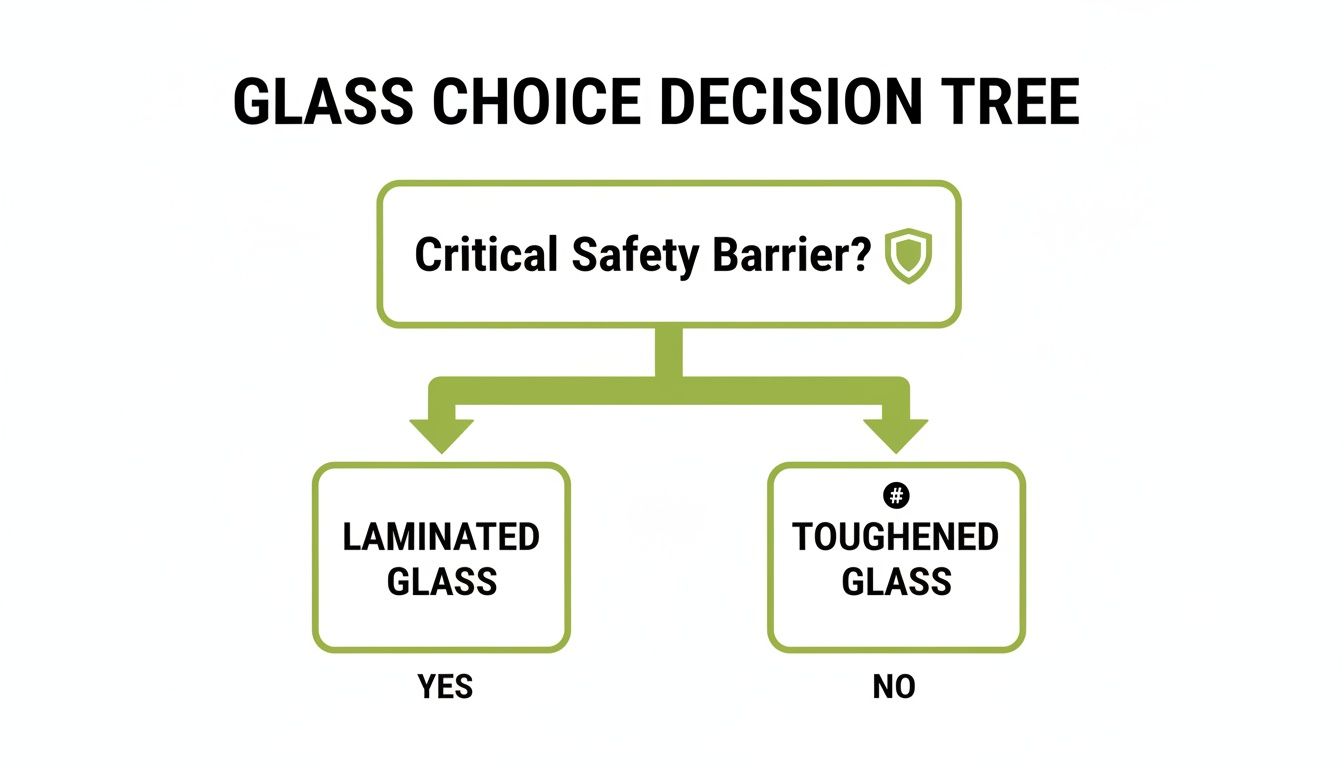
The takeaway is clear: if the glass is acting as a critical safety barrier against a fall, you need laminated glass. If it isn't, toughened glass usually provides a strong, economical solution.
Of course, other factors play a part. Laminated glass offers better sound insulation and UV protection, which could be a big plus for a quiet living space or a south-facing room. On the other hand, being a single pane, toughened glass can sometimes provide a slightly crisper, clearer optical quality.
Your project's location and function are the most important guides. Ask yourself one critical question: If this glass panel breaks, could someone fall and be seriously injured? If the answer is yes, laminated glass is your answer.
Given the complexities of building regulations and just how important it is to get it right, a professional consultation is always the best way forward. An expert can assess your specific needs on-site, whether you're planning Glass Balustrades Yorkshire or a new staircase in Newcastle. They will make sure your final installation meets all safety standards while perfectly matching your design vision, giving you both peace of mind and fantastic style for your home.
Even after getting to grips with how these glass types are made and how they perform, it’s natural to have a few lingering questions before making a final decision. Here are some of the most common queries we hear from our clients across Yorkshire and beyond.
This is a great question, and the answer really hinges on what you mean by 'strength'.
If we're talking about resisting a direct hit, then a single panel of toughened glass is the clear winner. It's manufactured to be four to five times stronger than standard annealed glass of the same thickness, meaning it can take a much bigger knock before it fails.
But the real strength of laminated glass shines through after it breaks. It's engineered to stay in one piece, held together by its plastic interlayer, maintaining a safe barrier. This post-breakage integrity is something toughened glass just can't offer, making laminated glass 'stronger' in any situation where preventing a fall is the absolute priority.
In a word, no—toughened glass absolutely cannot be cut or worked on once it leaves the furnace. The tempering process locks an incredible amount of stress into the panel. Any attempt to drill or cut it will instantly release that tension, causing the entire sheet to explode into those familiar tiny, granular chunks. Every hole, notch, and cut has to be done before it's toughened.
Laminated glass, on the other hand, can be cut, but it’s a specialist job. It requires precision equipment to score and break each glass layer separately before slicing through the tough interlayer. It's definitely a task for a professional glazier to get a clean, safe edge.
When it comes to safety, UK Building Regulations (specifically Approved Document K) are very clear. For any balustrade that guards a drop—think staircases, balconies, landings, or raised patios—laminated or toughened laminated glass is nearly always mandatory, particularly for minimalist frameless designs.
The core principle of the regulations is containment. If a glass panel fails, the barrier must not disappear. Only laminated glass can reliably provide that continued protection.
Now, for some fully framed balustrades at ground level where there’s no significant fall risk, toughened glass might be perfectly acceptable. But for any project involving Glass Balustrades Newcastle or a similar elevated spot, a professional assessment is crucial. It’s the only way to guarantee full compliance and, more importantly, the safety of everyone in your home.
At Glass Tech, our job is to steer you through these decisions, ensuring you get the perfect, fully compliant glass for your project. Get in touch today to talk through your ideas.

A professional team of experts providing glass and glazing solutions covering the whole of Yorkshire & more...
Whether it's Leeds, York, North Yorkshire, Birmingham, Hull, Liverpool, Machester, Newcastle or Nottingham, get in touch to find out how we can help you with your bespoke glass project.