
Glass external sliding doors are becoming a defining feature in modern home design, replacing solid walls with breathtaking spans of glass that effortlessly connect inside and out. They do more than just let light in; they completely reframe how you experience your home and garden, moving far beyond what traditional French or bifold doors can offer.
A real shift is happening in home renovation across Britain. We're seeing more and more homeowners choosing to dissolve the boundaries between their living spaces and their gardens, chasing a lifestyle that's brighter, more open, and more connected to the outdoors. This is a trend we've seen gather particular pace across the north of the UK.
From the picturesque towns of Yorkshire to the thriving city centres of Manchester and Newcastle, renovators are decisively turning to glass external sliding doors. Where bifold systems create a series of vertical frames and interruptions, sliding doors offer vast, cinematic panes of glass. It’s the difference between looking through a set of windows and having a living, moving panorama that changes with the seasons.
This isn't just about looks; it's a fundamental change in how people want to live. Homeowners are craving spaces that feel larger and are filled with the kind of natural daylight that's proven to boost our well-being. Modern sliding doors are perfectly engineered for this, with their signature slim frames and expansive glass-to-frame ratios. The minimalist design philosophy ensures that absolutely nothing gets in the way of the view.
At its heart, the appeal is simple: maximum glass, minimum frame. This single principle allows a home to feel seamlessly part of its surroundings, whether that’s a manicured garden in Harrogate, a contemporary patio in Leeds, or a balcony with city views in Sheffield.
The numbers certainly back this up. Across the UK, online searches for sliding doors have surged, overtaking bifold doors as the nation's preferred style. It reflects this wider desire for panoramic living. For families across Yorkshire and beyond, external sliding glass doors are turning properties in cities like York and Hull into brighter, more inspiring homes. With the UK doors market valued at £2.41 billion in 2023 and residential projects driving growth, it's clear these systems are here to stay. You can explore more about what's trending in the UK glazing market for a deeper insight.
Choosing to install large-scale sliding doors is a significant decision. It's more than just a home improvement; it’s a direct investment in your property's value and your daily quality of life. The benefits are both immediate and long-lasting:
So, you've decided on sliding doors to open up your home. Great choice. But now comes the part where you need to get into the details, and it’s easy to feel a bit overwhelmed by the options. As specialists, we see it all the time.
Not all sliding doors are built the same. The mechanism defines how you'll interact with the door every day, while the frame material dictates its look, longevity, and how much maintenance is on your plate. Let's break down the main systems so you can make a choice that feels right for your home and lifestyle.
Think of this as the engine of your new doors. The way the panels move will have a big impact on the day-to-day experience, from ease of use to how weatherproof the seal is.
If you're weighing up your options, this simple flow chart can help clarify your thinking. It shows why so many homeowners who prioritise light and views land on sliding doors.
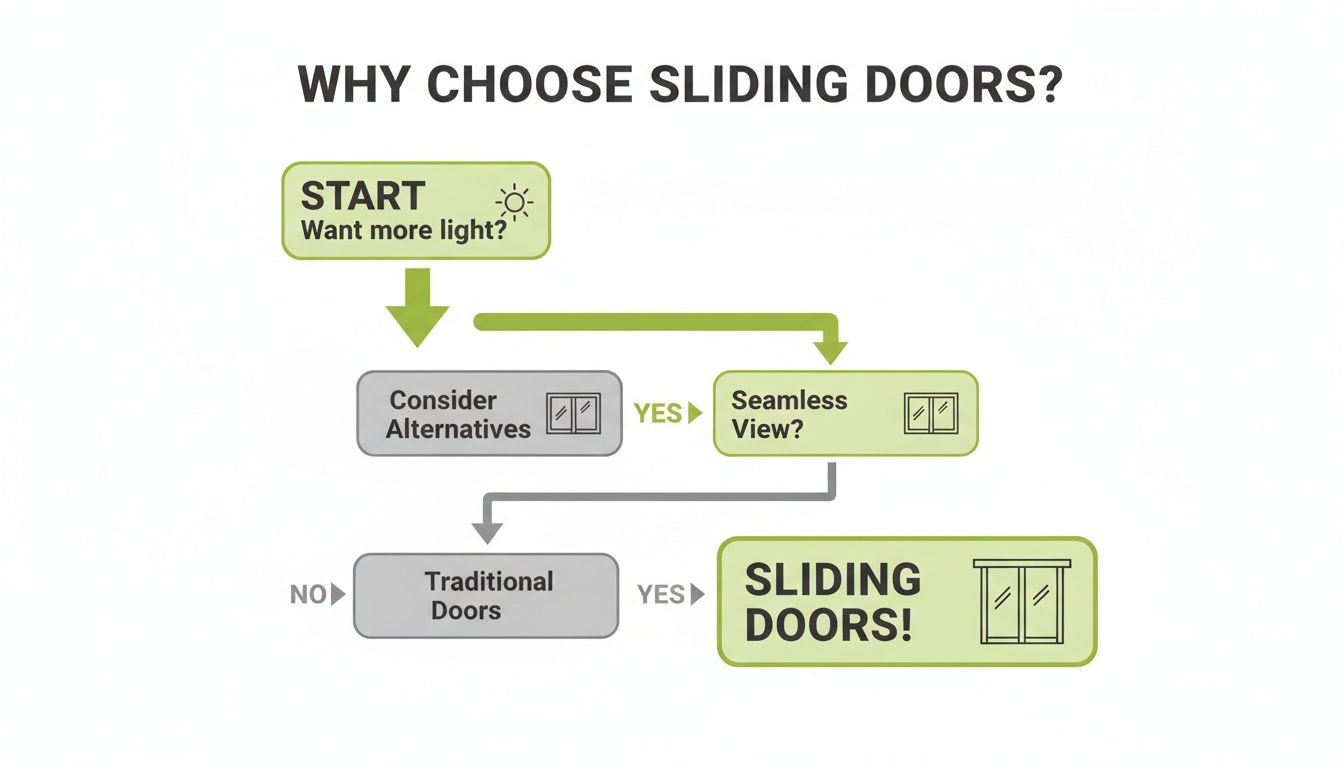
While sliding systems offer those incredible uninterrupted views, it's always good practice to know the alternatives. For some homes, especially those with smaller openings, you might find that exploring the benefits of bifolding doors provides a valuable point of comparison.
The frame is the skeleton of your sliding door, providing the crucial structure and defining its style, durability, and upkeep. In the UK, you’ll generally be choosing between three core materials.
Your choice of frame material is as much about aesthetics as it is about performance. It’s the visual anchor for your panoramic view, so it needs to complement your home's character while standing up to the British weather.
We find that most of our projects, from terraces in Manchester to modern homes in Newcastle, use one of these three options. Here’s a straightforward comparison to help you decide.
| Feature | Aluminium | uPVC | Timber |
|---|---|---|---|
| Sightlines | Ultra-slim for maximum glass | Thicker frames required for strength | Can be slim, but often thicker than aluminium |
| Durability | Exceptional. Doesn't rust, warp, or rot | Good, but can become brittle over time | Requires maintenance to prevent rot/warping |
| Maintenance | Very low. Just needs occasional cleaning | Low. Wipes clean easily | High. Needs regular painting or staining |
| Colour Options | Vast. Can be powder-coated any RAL colour | Typically limited to standard colours | Can be painted or stained any colour |
| Cost | Mid-to-high end, a premium investment | Most budget-friendly option | Mid-to-high end, variable with wood type |
| Lifespan | 45+ years | 20-30 years | 30-60+ years, if meticulously maintained |
Ultimately, Aluminium has become the go-to for premium sliding doors for a reason. Its strength allows for incredibly slim sightlines, which means more glass and less visible frame. It won't rust or warp, and its powder-coated finish lasts for decades with minimal fuss.
uPVC is the undisputed budget-friendly choice and modern systems are better than they used to be. However, the frames have to be thicker and bulkier to get the strength needed for large glass panels, which can compromise the view.
Timber offers a beautiful, traditional warmth that’s hard to beat, especially on period properties. It’s also a natural insulator. The big drawback is the maintenance. You have to commit to regular sanding and refinishing to protect it from the weather, which is a key factor for many busy homeowners.
The idea of installing huge glass panels might make you worry about a draughty home and sky-high heating bills. It’s a completely valid concern, but with modern glass external sliding doors, the reality is the exact opposite. Far from being a weak point in your home's thermal envelope, today’s advanced systems are designed to boost comfort, reduce your energy bills, and create a quieter home.
When you start looking at performance specifications, you'll quickly come across the term U-value. Put simply, a U-value measures how effective a door or window is at preventing heat from escaping. The rule is simple: the lower the U-value, the better the insulation.
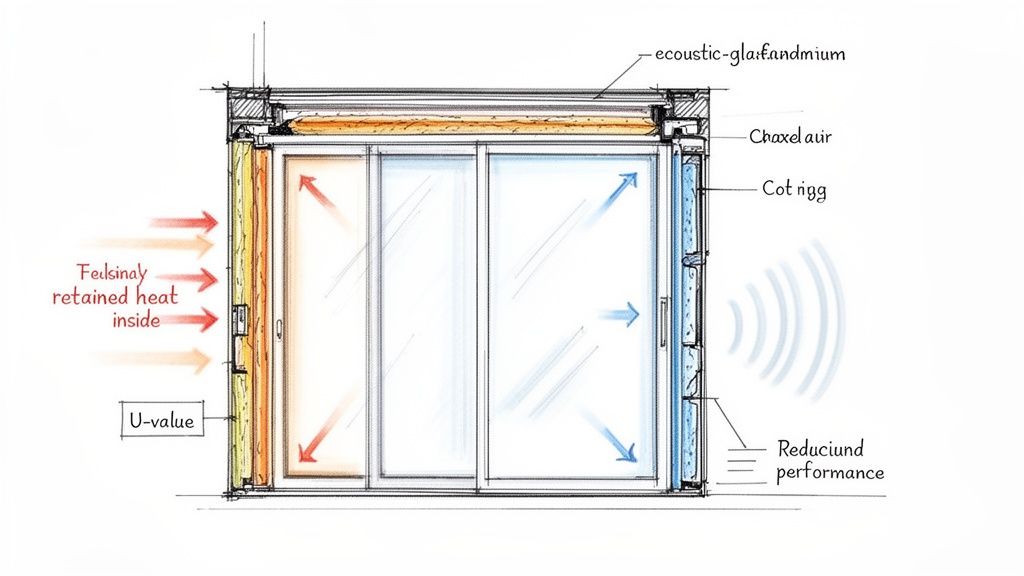
This impressive performance isn’t down to just one feature. It’s the result of clever engineering in both the frame and the glass, working together to keep your home comfortable whatever the weather.
Think of a thermally broken aluminium frame as being like a high-quality travel flask for your home. Aluminium is a fantastic material—strong, lightweight, and perfect for creating those slim, elegant sightlines we all want. The only downside is that it’s a natural conductor of heat. Without a thermal break, the winter cold would travel right through the frame and into your room.
A thermal break is an insulating barrier, usually a strip of robust polyamide, built right into the core of the frame. It physically separates the outer part of the frame from the inner part. This clever but simple feature stops heat transfer, keeping the warmth inside during winter and the heat out during summer.
This means you get all the sleek, durable benefits of an aluminium frame with none of the old thermal drawbacks. Your home stays warmer, your heating works less, and your energy bills start to come down.
The glass itself does much of the heavy lifting. Standard single glazing just isn't fit for purpose on an external door anymore. Today’s systems rely on sophisticated double or even triple-glazed units to deliver real performance.
These units work by trapping a layer of inert gas, like argon, between the panes. Argon is far denser than air and a very poor conductor of heat, which dramatically improves the U-value. This same principle also works wonders for acoustics.
Across the UK, there's a huge shift towards energy-efficient products, and high-performance glazing is at the heart of it. Modern external sliding glass doors, with typical U-values between 1.2-1.6 W/m²K, are leading this trend. Homeowners in cities from Newcastle to Nottingham are finding these doors not only cut costs but are also up to 10 times more impact-resistant than older models. You can read more about current glazing industry statistics to see the full picture.
If blocking out noise is a top priority for your home, it’s often worth looking at your existing windows, too. You can learn more about how secondary glazing works as a highly effective, complementary solution.
It’s a question we hear all the time from homeowners across Yorkshire: "Are large glass sliding doors really secure?" There's a lingering myth that a big pane of glass is an open invitation for trouble, but the reality of modern systems couldn't be more different.
The simple answer is a confident yes. Today's glass external sliding doors are engineered with layers of robust security features. It's not about a single lock; it's a complete system where the frame, glass, and locking mechanisms work in concert to create a formidable barrier, keeping your home and family safe.
Think about a traditional back door lock—it typically secures the door at just one point, usually around the handle. This can create a weak spot, where force applied at the top or bottom could potentially prise the door open. Modern sliding doors have completely engineered this vulnerability out of the design with sophisticated multi-point locking systems.
When you lock one of our sliding doors, you're not just throwing a single bolt. Instead, a series of strong, hooked bolts engage simultaneously along the entire height of the frame—top, middle, and bottom. This anchors the door securely, distributing any potential force across the whole structure and making it incredibly difficult to lift or force from its tracks.
It's the difference between trying to break one strong chain versus trying to break several at once. The entire door panel becomes one solid, immoveable unit.
True security goes beyond just the locks. The glass itself and how it's held within the frame are just as critical. That’s why all our high-quality external sliding glass doors are designed with internal glazing beads. This is a small but vital detail that means the strips holding the glass in place are on the inside of your home.
This clever design feature makes it physically impossible for anyone to pop the glass pane out from the outside without shattering it completely. And that brings us to the glass:
These advanced features are driving huge growth in the industry. The UK's windows and doors market is projected to reach USD 10,743.6 million by 2033, with enhanced security at the forefront. More telling for homeowners, properties with reinforced glass doors see 12% fewer insurance claims. It’s proof that investing in modern doors is a direct investment in your home's safety—a principle we apply to every project we undertake, from York to Newcastle. You can find more details on the growth of the UK windows and doors market on Grand View Research.
For complete peace of mind, you should always look for products that meet recognised industry standards. In the UK, the most important accreditation to look for is PAS 24:2016. This isn't just a sticker; it's a certification that proves the door system has withstood a battery of rigorous, simulated attack methods. A PAS 24 rating is your guarantee that the door has been independently tested and proven to provide an enhanced level of security.
While advanced locks and glass are the foundation of a secure door, layering your home's protection is always a smart move. Many of our clients complement their new doors by learning about the best security camera systems for home to create a truly comprehensive defence.
One of the biggest hurdles for any homeowner starting a renovation can be the thought of getting tangled up in red tape. When you’re looking to install beautiful new glass external sliding doors, you’ll need a basic grasp of the rules that govern home improvements here in the UK. The good news? For most projects, it's far more straightforward than you might think, especially when you have an expert partner to guide you.
You'll hear two key terms crop up time and again: Planning Permission and Building Regulations. People often use them interchangeably, but they are completely different things. Understanding what each one covers is the first step towards a smooth, compliant, and stress-free installation.
Planning Permission is all about how your project looks and how it affects the wider neighbourhood. It considers the visual impact of your new doors, whether they fit the character of the area, and if they might cause issues like overlooking or overshadowing your neighbours' homes.
When it comes to sliding doors, the rules are thankfully quite clear. In most situations, you will not need to apply for planning permission if you are:
There are, of course, exceptions. You will almost certainly need to seek planning permission if your property is a listed building or sits within a Conservation Area, like those found in historic parts of York or Harrogate. In these sensitive locations, any external change is scrutinised to protect the area's character.
This is where things get serious, and it’s non-negotiable. Building Regulations are a set of national standards for the design and construction of buildings, ensuring they are safe, healthy, and energy-efficient. Unlike planning permission, all new glazing installations must comply with Building Regulations, whether you needed planning permission or not.
Think of it this way: Planning Permission asks if you can do the work. Building Regulations dictate how you must do it to meet essential standards.
A professional installer's job is to make sure every part of your new doors meets these critical benchmarks. The key parts that apply to external sliding glass doors include:
A reputable installation company, like Glass Tech, handles all of this for you. We often self-certify our work through a government-approved Competent Person Scheme like FENSA. This provides you with a certificate proving full compliance—something that's vital when you eventually sell your home. While we manage the specifics for your doors, it's also wise to be aware of general construction permit requirements that could affect a larger renovation project.
Choosing your new glass external sliding doors is an exciting moment, but knowing what the installation involves is just as crucial. A professional, well-managed installation is the secret to ensuring your doors not only look fantastic but perform flawlessly for years to come. We believe in being completely open about our process, so let’s walk you through what happens from our first chat to the final, satisfying handover.
The work begins long before our fitting team arrives at your home. It all starts with a detailed survey, moves into precise, custom fabrication, and finishes with a clean, efficient installation on site. For our clients across Yorkshire, from Leeds to Harrogate, this methodical approach takes the stress out of the project and guarantees a perfect result.
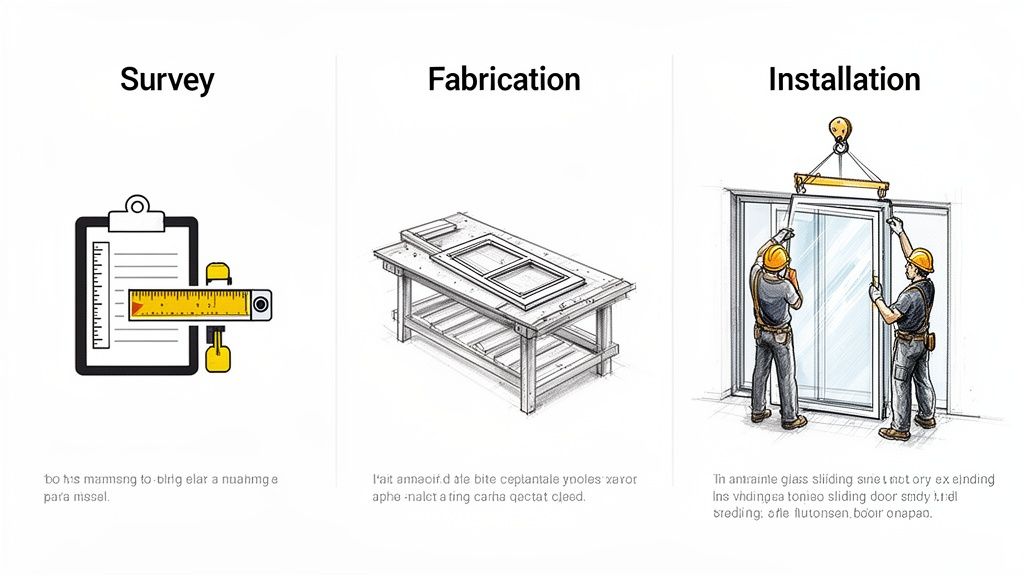
Before a single tool is unpacked, a huge amount of planning takes place behind the scenes. This meticulous preparation is what separates a standard job from a truly first-class one, and it’s a process we’ve refined to make sure every single detail is right.
Initial Design Consultation: It all starts with a conversation. One of our specialists will visit you to talk through your ideas, understand how you’ll use the space, and recommend the best system for your home and budget—whether that’s an inline, lift-and-slide, or pocket door.
The Technical Survey: Once you've settled on a design, we carry out a full technical survey. Our surveyors take pin-point accurate measurements of the opening, assess any structural points, and confirm site access. This is a critical step that ensures your bespoke doors are a perfect fit.
Bespoke Fabrication: With the survey data locked in, your doors are made to order. Our skilled craftspeople use the exact dimensions and your chosen specifications to build the frames and procure the high-performance glass units.
A professional installation is a service, not just a product. It's about respecting your home, communicating clearly at every stage, and managing the entire project so you don't have to worry about a thing.
This careful planning phase means that when installation day comes around, everything is set. It’s all about minimising disruption to your life by coordinating every detail, from scheduling to delivery, making the entire process as smooth as it can be.
On the agreed day, our experienced fitting team will arrive, ready to transform your home. Our priority is to work with maximum efficiency and minimum fuss, treating your property with the care and respect it deserves.
Protecting Your Home: First things first, we prepare the work area. We lay down dust sheets and protective coverings over floors and any nearby furniture to keep your home clean and tidy.
Removing the Old Unit: If we are replacing existing doors, we'll carefully remove the old frame and glass. We take great care to ensure the surrounding brickwork or plaster is disturbed as little as possible.
Fitting the New Frame: The new outer frame is then positioned in the opening. Our fitters use laser levels to get it perfectly plumb and square before securing it into the building’s structure. This is absolutely vital for a smooth-gliding door.
Installing the Glass Panels: Next, the heavy, high-performance glass panels are carefully lifted and glazed into the frame. We then install the glazing beads and check every seal is correctly compressed and in place.
Final Adjustments and Sealing: We make micro-adjustments to the rollers and locking mechanisms to guarantee an effortless glide and a tight, secure closure. The frame's perimeter is then sealed, inside and out, to create a completely weatherproof finish.
Clean-Up and Handover: Finally, we do a thorough clean-up, removing all debris and leaving your space as we found it. We’ll then walk you through how to operate your new doors and answer any questions before we consider the job done.
For most homeowners, the improvement is immediate and dramatic. It’s a key part of the service we provide on projects everywhere, from bustling cities like Newcastle to quiet villages around York. To see how these principles apply to our other installations, you can explore our work with bespoke glass doors and walls.
Making a significant investment in your home naturally comes with questions. We find that once clients start exploring the possibilities, a few key queries always come up. Here are our honest, experience-led answers to help you move forward with your project.
This is usually the first question, and the honest answer is: it varies hugely. The final cost depends on the size, the material you choose, and the complexity of the system.
As a rough guide, a standard 3-metre wide aluminium inline sliding door typically falls in the range of £3,500 to £6,000, fully installed by a professional team. More sophisticated systems like lift-and-slide or pocket doors will sit at the upper end of that scale, or higher. Factors like your location—a complex installation in a conservation area in Harrogate or York, for example—can also influence the price.
While uPVC is often seen as the budget option, we find high-performance aluminium offers the best long-term value for money. The only way to get a true figure for your home is to get a detailed, itemised quote.
Quite the opposite. One of the best things about modern sliding doors is how little looking after they need. Aluminium frames, in particular, are exceptionally easy to care for. They don't rust, warp, or rot, so a simple wipe-down with a cloth and some mild, soapy water is all that’s required.
The single most important job is keeping the tracks clear of grit and debris. A quick pass with a vacuum cleaner nozzle now and then is all it takes to keep the doors gliding smoothly for years.
Many of our glass options can also be specified with a self-cleaning coating. This clever technology uses sunlight and rain to break down and wash away dirt—a fantastic, low-effort feature that’s perfectly suited to the unpredictable British weather.
Absolutely. While it’s easy to picture them on a modern new-build, glass external sliding doors can bring a stunning new dimension to period homes. It all comes down to choosing the right frame and finish to complement the property’s original character.
For instance, we often use slimline aluminium frames finished in a timeless black or dark grey. This beautifully echoes the look of traditional steel-framed 'Crittall' windows, creating a perfect marriage of classic style and modern thermal performance.
If your home is in a conservation area, perhaps in a historic city like York or Newcastle, it's always wise to chat with the local planning authority first. That said, a skilled designer can almost always find a solution that feels both fresh and completely at home with the building's heritage.
Ready to transform your home with stunning panoramic views and an abundance of natural light? The team at Glass Tech has over 20 years of experience designing and installing bespoke glass features across Yorkshire and beyond. Get in touch for a free, no-obligation quote today.

A professional team of experts providing glass and glazing solutions covering the whole of Yorkshire & more...
Whether it's Leeds, York, North Yorkshire, Birmingham, Hull, Liverpool, Machester, Newcastle or Nottingham, get in touch to find out how we can help you with your bespoke glass project.