
A lot of homeowners across Yorkshire reach the same point with their garden. The space has potential, the view is good, the layout works, but the deck never looks finished for long. One wet winter roughens the boards. A bit of summer sun dries them out. Then the yearly cycle starts again with cleaning, sanding, staining and replacing the worst pieces.
That is usually when composite decking enters the conversation.
It is not a miracle product, and it is not right for every budget or every brief. But for many homes in Leeds, Harrogate, York, Hull, Newcastle and other northern areas, it solves problems that timber keeps bringing back. If you are weighing up composite decking pros and cons, a key question is not whether it looks good in a brochure. It is how it behaves in a damp, cold, changeable UK climate, and whether it still feels like a smart choice years after installation.
A good garden deck starts with a simple ambition. You want to step outside and use the space properly. Morning coffee. Late summer evenings. A level area for dining, planting, or linking the house to the garden.
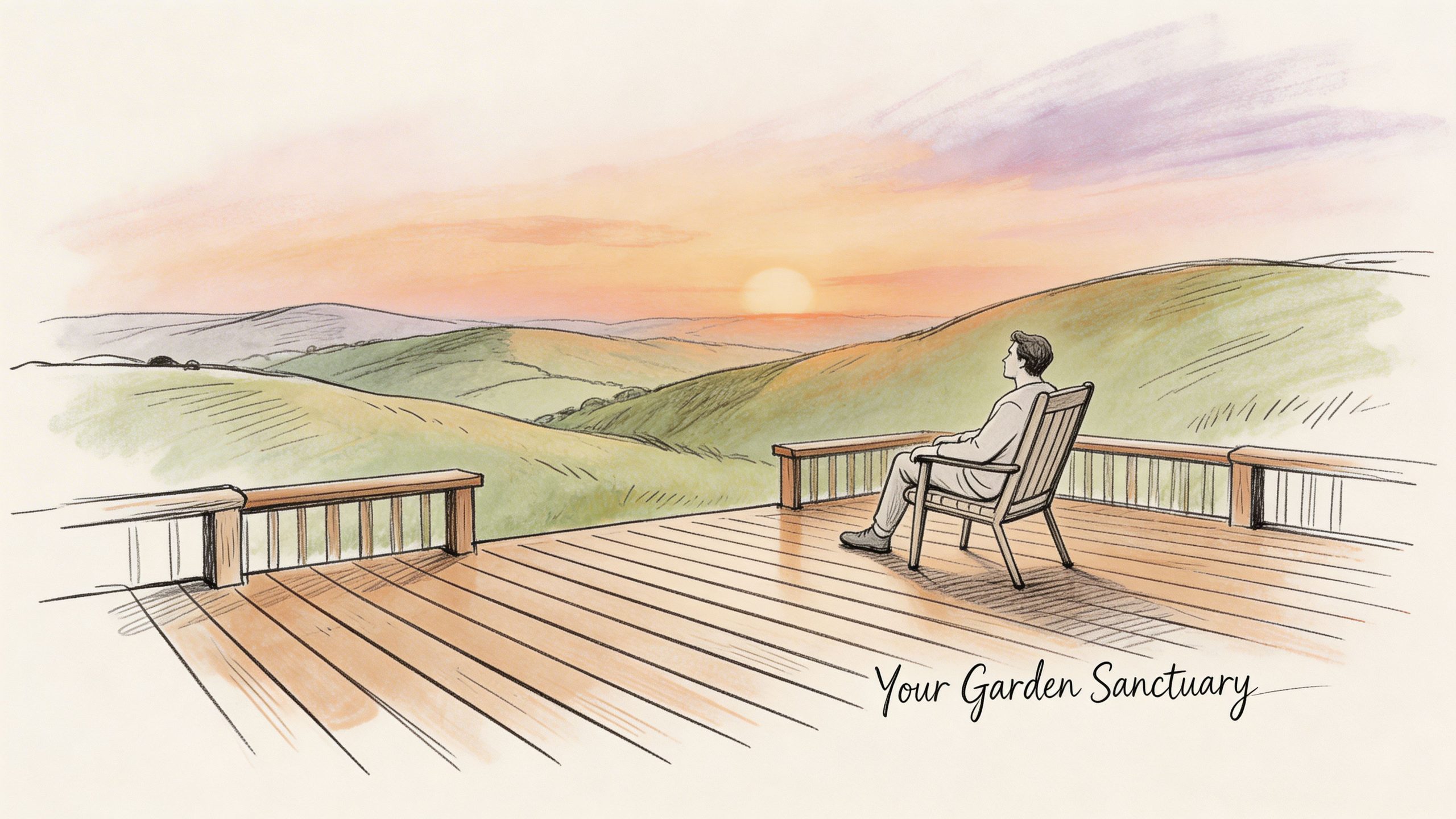
In Yorkshire, that ambition meets reality quickly. Rain sits on surfaces. Leaves stay damp. Timber edges lift, stain coatings fail, and boards that looked neat in spring can feel tired by autumn. The same applies in exposed parts of Newcastle, where wind-driven rain and colder winters put outdoor materials under pressure.
That is why composite decking has become such a common shortlist option for homeowners who want a smarter-looking, lower-upkeep garden. It offers a cleaner, more contemporary finish, and it pairs well with modern upgrades such as aluminium frames, porcelain paving and glass balustrade installers when a deck is raised or stepped.
Some decks are mainly visual. Others need to work hard every week.
Tip: The best deck layouts are planned from the house outward. Think about doors, furniture routes, sunlight and privacy before you choose board colour or finish.
The right answer is rarely “what is the cheapest board?” It is usually “what will still suit the house and the climate after several years of normal use?”
Composite decking is a manufactured board designed to give you the look of timber with less of timber’s upkeep. The simplest way to think of it is as an engineered outdoor surface rather than a natural plank.
Most homeowners first notice the finish. The more important difference is in how the board is built.
Traditional timber is one material all the way through. Composite is a blend, combining wood fibres and plastic-based content into a board designed for outside use. That mix helps reduce some of the familiar timber issues, especially rot, splintering and ongoing treatment requirements.
For day-to-day use, this means you are not dealing with a deck that needs regular staining or painting just to stay presentable.
Distinguishing between capped and uncapped boards is important for many buying decisions.
Uncapped composite is the more basic form. It may still offer lower maintenance than timber, but it is generally more exposed at the surface.
Capped composite has a protective outer polymer shell. That outer layer is the part worth paying attention to in northern parts of the UK, because it is what improves resistance to moisture, surface marking and general weathering.
If your garden is shaded, north-facing, or prone to staying damp after rain, capped products are usually the more sensible choice.
Yorkshire and the North East are not gentle environments for outdoor materials. Decking in Harrogate, Leeds or Newcastle often deals with prolonged wet periods, colder mornings and slower drying times than generic decking advice assumes.
That why not all “composite” performs the same in practice. Two boards may look similar in a sample box, but their surface technology can make a big difference once they are installed in a garden.
A practical rule is this. If you want composite because you are tired of maintenance and moisture-related problems, choose the version designed to deal with moisture properly, not the cheapest board that happens to be labelled composite.
The strongest case for composite decking is not just appearance. It is long-term practicality. When the right board is chosen and installed properly, it can remove a lot of the recurring problems that come with timber decks in the North of England.
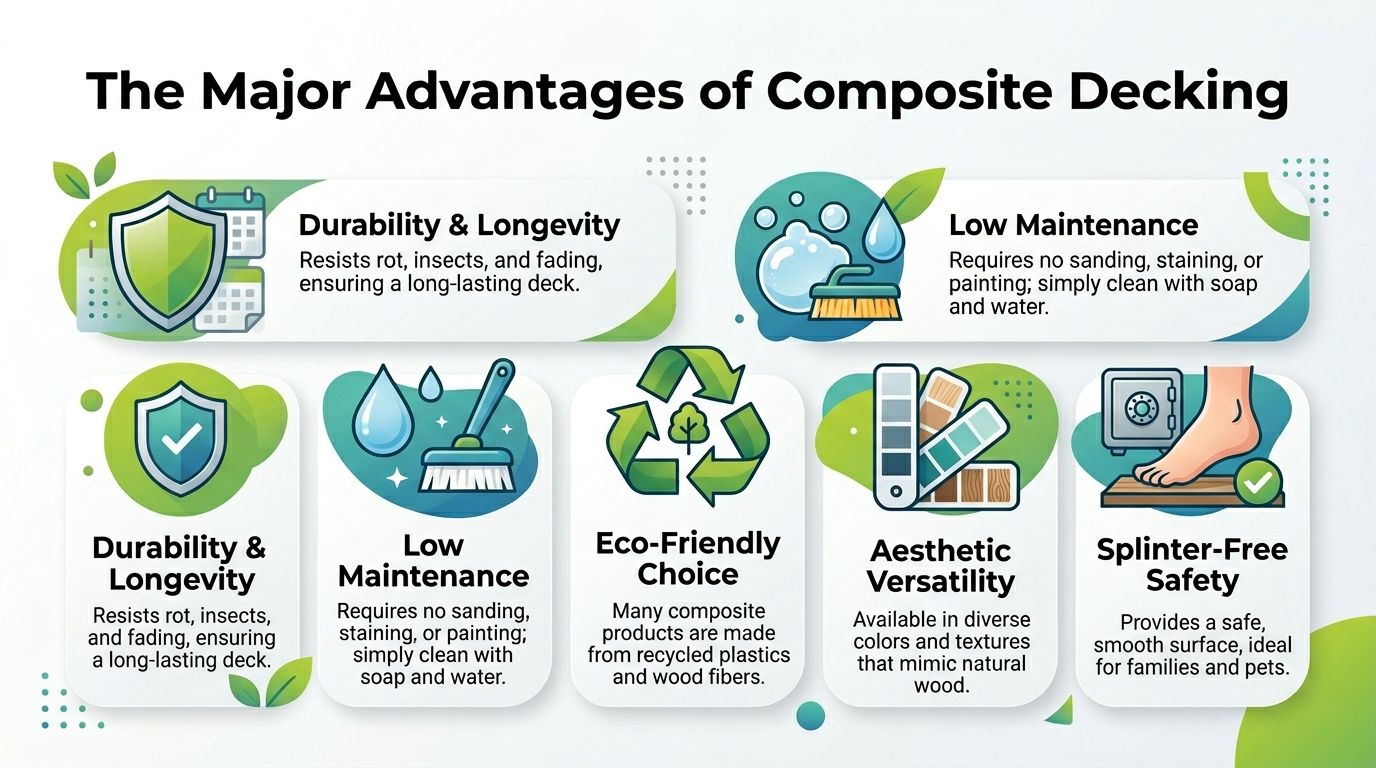
This is one of the biggest reasons homeowners switch.
In the UK, polymer-capped composite decking shows zero water absorption, compared with traditional wood-plastic composite boards that absorb around 2% water, according to Cladco’s guide to composite decking pros and cons. That matters in places such as Leeds and Harrogate, where average annual rainfall exceeds 1,100 mm. The same source notes that this moisture resistance is a key reason premium capped composites come with 25-30 year warranties.
That performance difference is not academic. Water ingress is what drives many outdoor material failures. If moisture cannot get into the board surface, you reduce the conditions that encourage mould, mildew and gradual breakdown.
Homeowners replace timber not because they dislike the look of wood, but because they are tired of maintaining it.
Composite suits homeowners who want to clean the deck and use it, rather than spend part of every year restoring it. Good boards do not need annual sealing or varnishing. Day-to-day upkeep is limited to routine washing with soap and water.
For busy households, that is a clear advantage. It also makes the deck easier to keep consistent in appearance from season to season.
Composite works especially well on newer extensions, renovated patios and gardens with modern detailing.
You can get:
Another practical strength is surface condition. Composite boards do not splinter in the way timber can. For households with children, pets, or anyone who likes to walk outside barefoot in summer, that makes a noticeable difference.
The boards also stay visually tidier with less intervention. You are not constantly dealing with rough patches, lifted grain or patchy stain coverage.
Cheap decking often creates expensive maintenance. Premium composite changes that equation by reducing repeat work and replacement pressure over time.
Key takeaway: If your main goal is to stop battling damp, surface wear and yearly treatment, capped composite is where value is most evident.
That does not mean every composite board is excellent. It means the right composite board can solve problems that timber keeps reintroducing.
Composite decking has genuine strengths, but it also gets oversimplified. Some sales conversations make it sound maintenance-free, slip-proof and immune to every problem. That is not how outdoor materials work in Yorkshire or Newcastle.
The first drawback is straightforward. Composite costs more to buy and fit than standard timber. For some projects, that higher entry price is completely justified. For others, it pushes the scheme beyond budget.
The sensible way to view it is as a long-term material decision, not a bargain option. If you want the lowest initial spend, timber wins. If you want fewer recurring jobs and a more stable finish, composite often justifies the extra outlay.
This catches homeowners out. They hear “composite” and assume every product behaves like a premium capped board. It does not.
A 2025 Which? survey referenced by Dino Decking found 22% of UK homeowners in northern regions reported staining or mould on composite decks after two years due to high humidity. The same source says only 40% of composites achieved a Pendulum Test Value over 36 when wet, which is considered low slip risk.
That tells you two things. First, low maintenance is not the same as no maintenance. Second, product selection matters a great deal in wet northern conditions.
Homeowners think of decking problems as winter problems. Summer can create its own. Darker composite boards can become uncomfortable underfoot in a south-facing garden during hot weather.
This does not affect every property in the same way. A partially shaded deck behaves differently from a fully exposed terrace. But if your garden gets strong afternoon sun, ask to see colour samples outdoors and think about where people will stand, sit and walk.
Composite is durable, not indestructible.
Dragging metal furniture, dropping heavy planters or leaving stubborn spills too long can still mark the surface. Some boards cope much better than others, especially capped products, but no deck material stays perfect if it is treated badly.
Timber can be sanded and re-finished if you want a different look later. Composite is less flexible in that sense. Once the boards are down, you are generally committed to that tone and style.
That makes sample selection more important than many people realise.
Tip: Always view decking samples outside in natural light. A board that looks ideal indoors can feel much darker, cooler or flatter once installed across a large area.
The honest version of composite decking pros and cons is simple. It solves a lot, but only if you choose the right board, accept the higher entry cost and plan for your site conditions properly.
Homeowners compare three routes. Standard timber, mainstream composite, and premium mineral-based options such as Millboard. Each has a place. The right choice depends on your priorities, not just your budget.
If you want to see what a conventional timber route looks like in product terms, this range of traditional timber decking is a useful benchmark for understanding the style and entry-point many homeowners start from.
| Feature | Composite Decking | Timber Decking | Millboard Decking |
|---|---|---|---|
| Initial cost | Higher than standard timber | Lowest entry cost | Premium end of the market |
| Maintenance | Low routine upkeep | Regular cleaning, treatment and periodic restoration | Low routine upkeep |
| Appearance | Consistent and contemporary | Natural grain and variation | Highly realistic timber look |
| Surface feel | Smooth and uniform | Natural texture, can roughen over time | More textured underfoot |
| Moisture resilience | Strong, especially with capped boards | More vulnerable to wet conditions | Strong choice for demanding sites |
| Colour change over time | Generally stable, product dependent | Weathers and changes naturally | Designed for long-term visual performance |
| Best fit | Busy households wanting low upkeep | Buyers prioritising natural wood and lower upfront spend | Premium projects where appearance leads |
Timber suits homeowners who like the ageing character of wood and do not mind regular upkeep. It also helps where the brief is cost-led.
The trade-off is ongoing work. In northern gardens, timber asks more from the owner. More cleaning, more treatment, more attention to surface wear.
Composite often lands in the practical middle. It offers a more polished finish than basic timber and less maintenance over time, without always pushing into the very top end of the market.
For many homes, that balance is exactly the point.
Millboard appeals to homeowners who want the most convincing timber look without taking on the maintenance cycle of real wood. It often suits high-spec garden renovations, raised terraces and projects where the deck needs to sit comfortably alongside premium glazing, masonry and architectural detailing.
If the brief is “good, better, best”, timber is good, composite is better for low upkeep, and Millboard is best when realism and premium finish matter most.
Most decking failures do not begin with the visible surface. They begin underneath. A good-looking board on a poor subframe is still a poor deck.
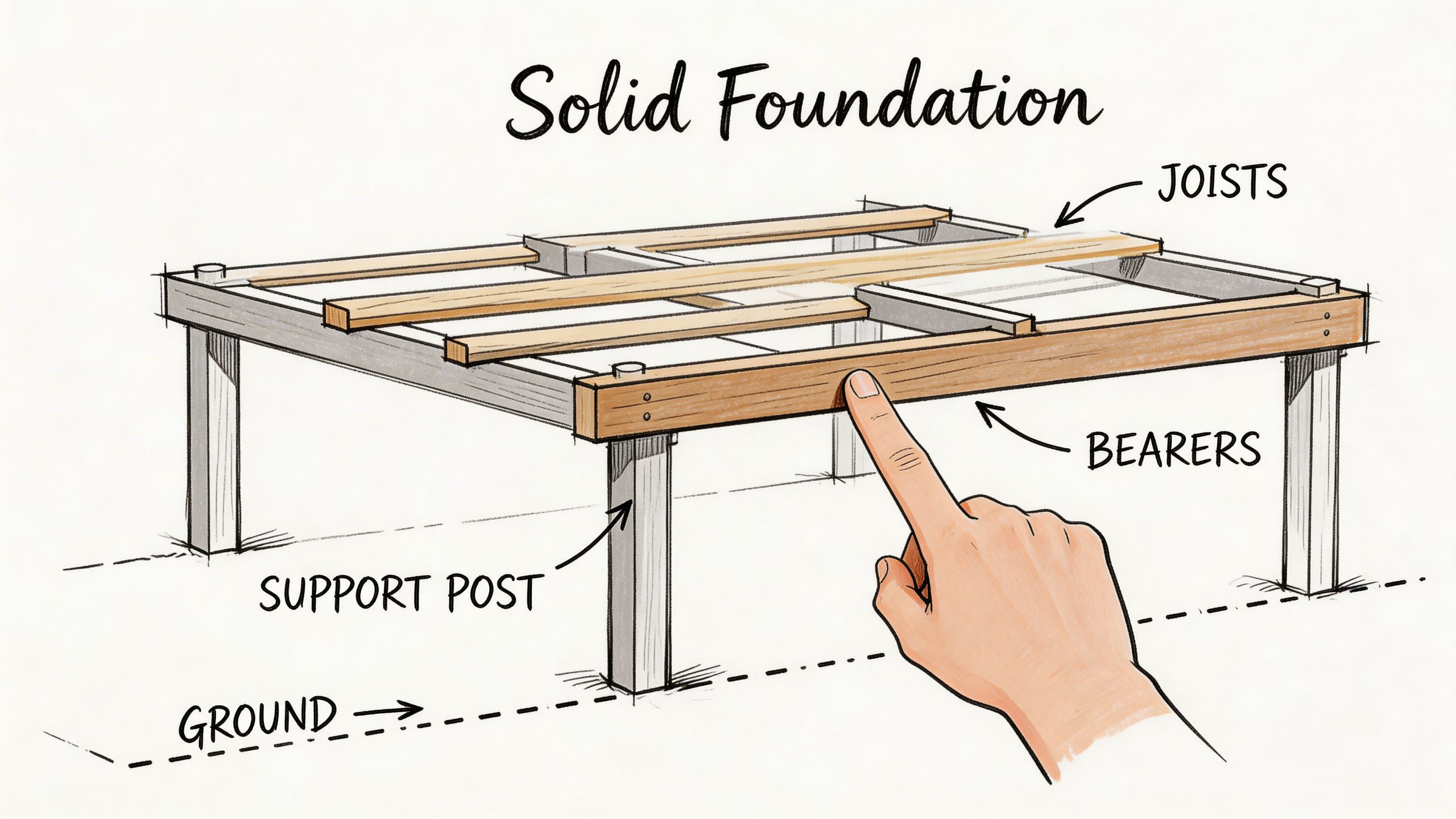
In Yorkshire, this matters even more because ground conditions, rainfall and winter temperature swings expose bad installation work quickly. Homeowners focus on board colour and finish, but the subframe is what decides whether the deck stays flat, stable and safe.
In the UK’s damp climate, especially in Yorkshire, improper joist spacing is a leading cause of composite deck failure. Joist centres should be no more than 300-400mm (12-16 inches) to reduce sagging and warping from high moisture, and northern England can experience 20-30% higher moisture absorption, according to this decking installation discussion from Mataverde.
That is why generic fitting advice can be risky. A board installed too wide on centres may look acceptable at handover, then start to feel springy or uneven after repeated wet periods.
The deck needs to shed water and breathe. If moisture sits around the frame, you create avoidable stress on both the structure and the finish.
A sound installation should allow for:
Key takeaway: Composite decking is not a shortcut around good construction. It performs best when the support structure is built specifically for the board and the site.
Many premium projects succeed or fail based on this planning. If the deck will carry balustrades, privacy screens or level changes, those loads and fixing positions need to be accounted for before the boards go down.
That is especially important on raised installations and terraces where homeowners are considering Glass Balustrades Yorkshire or Glass Balustrades Newcastle as part of the finished look. Glass systems need accurate setting out, proper edge support and a structure capable of taking the fixing method cleanly.
A deck and balustrade should be designed together, not treated as separate purchases.
This short visual gives a useful overview of how the supporting framework comes together before the finished surface is installed.
Some of the best installation decisions are not visible once the job is done.
Well-installed decking feels solid underfoot, drains properly and looks intentional from every angle. That is what separates a surface that merely looks smart on day one from one that still performs after several northern winters.
For many homeowners, yes. But only when the material matches the way the space will be used.
Composite tends to be a good investment when you value low upkeep, want a clean and consistent look, and do not want the yearly workload that often comes with timber. It also suits homes where the garden is part of a wider upgrade, especially when the outdoor area is being redesigned as a proper extension of the house rather than just a patch of hard landscaping.
That broader thinking is one reason outdoor projects keep getting more strategic. If you are interested in the bigger picture, this article on broader trends in outdoor living investments gives useful context on why homeowners are treating these spaces more seriously.
Ask yourself the following before choosing your deck surface:
If your priority is the cheapest route into a deck, composite may not be the right answer. If your priority is long-term ease and a sharper finished look, it often is.
Yes, but carefully. Use a gentle setting and keep the nozzle moving. Do not blast the surface at close range, especially around board edges, grooves or trims. For routine cleaning, a soft brush and warm soapy water are often the better choice.
Start with the manufacturer’s care guidance for the exact board you have. Light surface marks may be reduced with approved cleaning methods, but aggressive sanding is not the answer on composite. For stains, act quickly. The longer a spill sits, the more likely it is to leave a mark.
Some products are, especially in persistently wet or icy conditions. That is why slip performance should be checked before you buy, particularly for exposed decks in Yorkshire, Hull, Manchester or Newcastle. Surface texture, board profile and ongoing cleaning all affect how safe the deck feels underfoot.
This is one area where you should not rely on generic sales claims. Ask for the current fire classification for the exact product being quoted and check that it suits your property type and installation context. This matters more on balconies, roof terraces and raised external areas where regulations are tighter.
Yes, but only if the structure is planned properly. The fixing method for the balustrade must be considered before decking installation begins. On raised decks, that coordination is essential for both appearance and safety.
If you are planning a new deck, raised terrace or a full outdoor upgrade with glazing, Glass Tech can help with practical advice, quality installation and a joined-up approach to decking, balconies and glass balustrades across Yorkshire, Newcastle and surrounding areas.

A professional team of experts providing glass and glazing solutions covering the whole of Yorkshire & more...
Whether it's Leeds, York, North Yorkshire, Birmingham, Hull, Liverpool, Machester, Newcastle or Nottingham, get in touch to find out how we can help you with your bespoke glass project.