
That persistent draught chilling your living room, or the frustrating condensation blurring your garden view? They’re more than just minor annoyances. They are clear signals that your sliding doors need attention—and that it might be time to consider replacement glass sliding doors to get back your home's comfort, security, and energy efficiency.
Deciding between a simple repair and a full replacement can be a tough call. From my experience, though, certain persistent issues are tell-tale signs that your sliding patio doors are past their best. When you see these, a new installation is often the smarter long-term investment.
Understanding these indicators helps you make an informed decision, ensuring your home stays secure, warm, and looking its best.
It seems a growing number of UK homeowners are making this very choice. The home renovation market is booming, and that's driven huge growth in the UK’s door industry, which was valued at £2.41 billion in 2023. Projections show it soaring to £3.06 billion by 2029. Sliding patio doors are now a firm favourite for homeowners, especially for those in Yorkshire and across the North.
One of the most obvious signs is a constant draught. If you can feel a chill near your doors even when they're fully shut, the seals have almost certainly failed.
This is a really common problem with older, single-pane glass doors which offer very little insulation to begin with. The result? Your heating has to work that much harder to keep the room comfortable, which you'll definitely notice in your energy bills. Upgrading to modern, double-glazed units is the most direct solution to this costly problem.
Any visible damage to the glass itself is a major red flag. I’m not talking about small scratches here, but significant cracks, chips, or a shattered pane.
A crack doesn't just compromise your home’s security by creating a potential entry point for intruders; it also completely wipes out any thermal insulation the door once had. Leaving damaged glass unresolved is a risk to both your safety and your wallet.
For homeowners in places like Newcastle or Leeds, where the weather can really test a building, a compromised pane of glass is a serious weak point in your home’s defence against the elements.
Have you spotted a persistent mist or fog trapped between the two layers of glass in your double-glazed sliding doors? This is the classic sign that the airtight seal has failed.
When this happens, moisture-filled air gets inside the unit and condenses on the inner surfaces. This "misted glass" not only ruins your view but, more importantly, it means the insulating gas (like argon) has escaped, making the double glazing useless. At this point, no amount of cleaning will help; the sealed glass unit needs a full replacement. To help you spot this and other common issues, you can review these Thirteen Signs It's Time To Replace Your Windows And Doors.
Right, you’ve decided a replacement is needed. Now comes the most critical choice: the glass itself. It’s easy to focus on the frame, but the glazing you choose for your new sliding doors is the real workhorse. It dictates everything from your energy bills to your home's security and daily comfort.
Making the right call here isn't just about the upfront cost; it's about investing in long-term performance. Getting the glass right means a warmer home in winter, a cooler one in summer, and peace of mind knowing your family is safe. Let’s break down the options.
If your current doors have single-pane glass, upgrading to a modern sealed unit will be a night-and-day difference. Modern replacement glass sliding doors are built around these high-performance units.
Double Glazing: This is the industry standard for a good reason. It consists of two panes of glass separated by a sealed space. We fill this gap with an inert gas, usually argon, which acts as a powerful thermal blanket, drastically cutting down on heat loss.
Triple Glazing: For those chasing ultimate thermal efficiency, triple glazing is the answer. By adding a third pane of glass, you create two separate gas-filled cavities. The result is exceptional insulation, perfect for homes in colder spots or for anyone wanting to get their energy bills as low as humanly possible.
That gap between the panes, filled with argon gas, is the secret sauce. Argon is much denser than air, making it a terrible conductor of heat. It works year-round to keep warmth in during winter and keep the sun’s heat out during summer, giving you a more comfortable home and kinder energy bills.
To really take performance to the next level, we can add a low-emissivity (or Low-E) coating to the glass. This is an incredibly fine, totally transparent layer of metal oxide applied to one of the internal glass surfaces inside the sealed unit.
Think of it as a heat mirror. In winter, it reflects heat from your radiators and fireplace back into the room, stopping it from leaking outside. In summer, it does the opposite, reflecting the sun's infrared heat away from your home to prevent overheating. When you combine a Low-E coating with an argon-filled double or triple-glazed unit, you get a phenomenally efficient barrier. For a deeper dive into all the possibilities, you can explore our dedicated glass replacement services.
A common worry we hear is that Low-E coatings will make a room feel dark. Thankfully, that's a myth. Modern coatings are so advanced they are virtually invisible, letting in all the natural light while filtering out the unwanted heat. You get all the benefits without sacrificing that bright, airy feel.
Standard glass can be incredibly dangerous when it breaks, shattering into long, sharp shards. For the large expanses of glass found in sliding doors, UK building regulations rightly demand the use of safety glass. You have two main options.
Toughened Glass: This glass goes through a special heat-treatment process that makes it up to five times stronger than normal glass. If it ever breaks, it shatters into thousands of small, blunt, pebble-like pieces, which massively reduces the risk of a serious injury.
Laminated Glass: This is the top tier for both safety and security. It’s made by bonding two panes of glass together with a tough plastic interlayer (PVB). If the glass gets hit hard enough to crack, the fragments stick to this interlayer. The pane holds together instead of shattering, not only preventing injury but also making it extremely difficult for an intruder to get through.
The infographic below highlights some common warning signs that your current door glass might be failing and is due for a replacement.
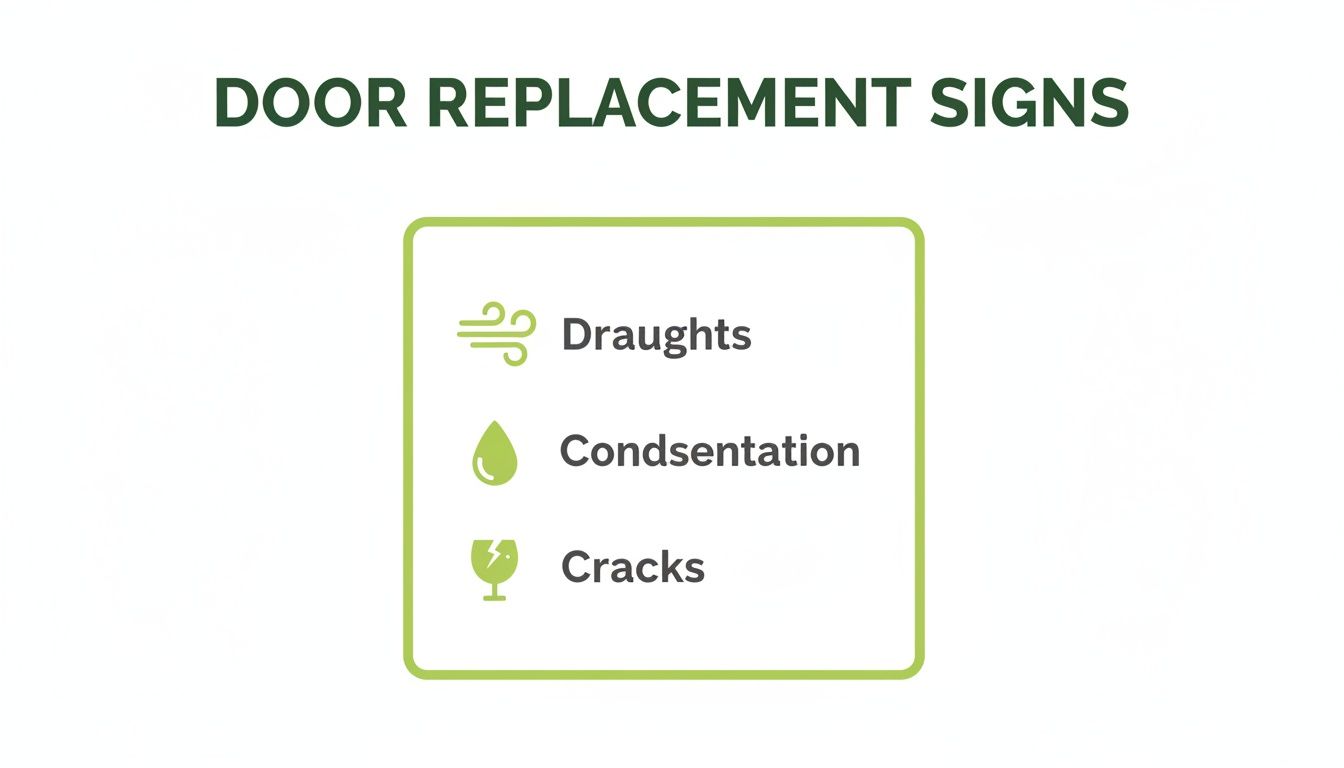
Catching these problems early is the key to keeping your home comfortable and secure. They are clear signals that it’s time to upgrade to modern, high-performance glass.
To help you weigh your options, here’s a quick comparison of the most popular glass types for sliding doors.
| Glass Type | Key Feature | Best For | Typical U-Value (W/m²K) |
|---|---|---|---|
| Low-E Double Glazed | Excellent all-round thermal performance | The new standard for most homes, balancing cost and efficiency. | 1.2 - 1.4 |
| Low-E Triple Glazed | Maximum insulation and energy savings | Colder climates, north-facing doors, or homeowners prioritising minimal energy use. | 0.6 - 0.8 |
| Toughened Safety Glass | Shatters into small, blunt pieces when broken | Essential for all doors as a minimum safety standard. | Varies with glazing |
| Laminated Security Glass | Holds together when shattered, resisting entry | Ground-floor doors, high-security needs, or ultimate peace of mind. | Varies with glazing |
Each option offers distinct advantages, and the best choice often involves combining them—for example, a Low-E double-glazed unit made with laminated glass for the perfect blend of efficiency and security.
It's clear that homeowners are waking up to the benefits of high-quality glazing. The UK market for replacement glass sliding doors is booming, especially in renovation hotspots across Yorkshire. In fact, the UK holds a significant 21.5% share of Europe's entire sliding patio glass door market. Projections show this market growing from USD 578.8 million in 2025 to a staggering USD 1,088.3 million by 2035. People want more natural light and lower energy bills, and modern glazing is how they get it.
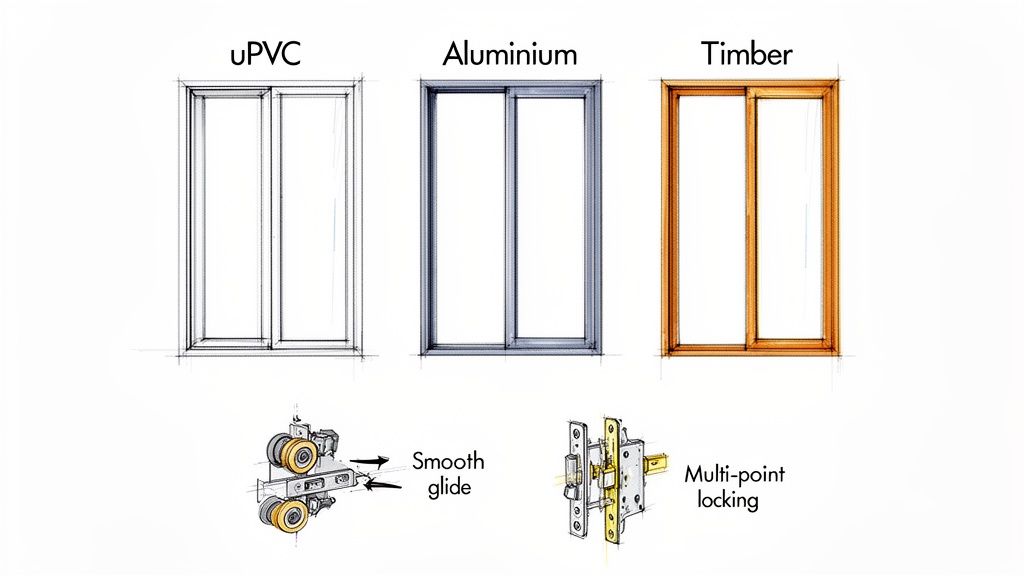
While the glass itself is a huge part of the equation, the frame and hardware holding it all together are just as vital. These components dictate the door's final appearance, its long-term performance, and how it feels to operate every single day. Getting this combination right is what separates a good installation from a great one.
The frame material you choose will influence everything from maintenance and thermal efficiency to the overall aesthetic. Let's break down the three main contenders for your replacement glass sliding doors.
The character of your home, your budget, and how much upkeep you’re willing to commit to will all point you toward the right frame material. Each has its own distinct personality and practical advantages.
uPVC (Unplasticised Polyvinyl Chloride)
For many homeowners, uPVC is the go-to option, and for good reason. It’s affordable, incredibly low-maintenance, and delivers excellent thermal performance, helping keep your home warm and your energy bills down. Modern uPVC won't rot, rust, or ever need a lick of paint—a quick wipe-down is all it takes to keep it looking fresh.
Aluminium
This is where contemporary design really comes into its own. Aluminium frames are prized for their immense strength, which allows for incredibly slim sightlines. What does that mean for you? Less frame and more glass, maximising your view and flooding your home with natural light—a feature we see requested time and again in modern homes across Yorkshire.
Despite their slender profile, aluminium frames are remarkably durable, secure, and weather-resistant. They come in a vast array of powder-coated finishes, allowing you to perfectly match your home's unique style. If you’re after that sleek, modern look, it’s hard to beat aluminium. To create a cohesive feel throughout your property, you can explore matching options in our range of high-quality windows and composite doors.
A key advantage of aluminium is its structural integrity over wide spans. If you’re dreaming of a large opening for that seamless indoor-outdoor feel, aluminium provides the strength needed without the bulky frames that other materials would require.
Timber
For sheer character and natural beauty, nothing quite compares to a timber frame. As a natural insulator, wood offers fantastic thermal performance. It brings a warmth and traditional charm that uPVC and aluminium struggle to replicate, making it the perfect choice for period properties or homes aiming for a more rustic aesthetic.
However, timber does ask for a little more TLC to protect it from the elements, including periodic staining or painting. It's worth noting that high-quality engineered timber and advanced treatments have drastically improved its lifespan and reduced this upkeep, but it remains a more hands-on choice.
The hardware is the functional heart of your sliding door. It’s a detail that’s all too easy to overlook, but getting it wrong can lead to daily frustration. A door that looks stunning but is a chore to open and close is not a good investment.
High-Quality Rollers and Tracks
The single most important feature for day-to-day satisfaction is that effortless glide. High-quality rollers, often made from durable stainless steel, run smoothly along a precisely engineered track. This ensures your door opens and closes with minimal effort, providing that satisfying, silent operation for years. Cheaper systems use inferior components that can wear out, stick, or become noisy over time.
Secure Locking Mechanisms
A sliding door is a key entry point to your home, and its security is non-negotiable. Modern replacement glass sliding doors should come fitted with a multi-point locking system as standard. This secures the door to the frame at several points—not just in the middle—making it far more resistant to forced entry. For complete peace of mind, always look for systems that have been tested and accredited to recognised security standards.
The market is clearly shifting towards these high-performance systems, with glass doors set to lead the UK market through 2029. Innovations are constantly meeting new regulations and homeowner demands. For example, while cost-effective uPVC still holds a 62% market share, premium aluminium options are carving out 35% of the patio door niche. In areas we serve like Newcastle and Manchester, these high-spec replacements are truly transforming properties.
When it comes to fitting new replacement glass sliding doors, getting the measurements right is the most critical part of the job. It’s no exaggeration to say that an error of just a few millimetres can cause major headaches, delays, and unexpected costs. A door that’s fractionally too big simply won’t fit, and one that’s too small leaves you with unsightly gaps that are difficult to fill and can compromise the whole installation.
While our team always performs a full, professional site survey before finalising any order, taking your own accurate initial measurements is incredibly helpful. It means we can give you a much more precise quote from the get-go and helps you understand exactly what’s involved. This guide will walk you through the proper way to measure an opening, just like a professional would.
You don’t need any fancy gadgets for this. A few basic tools are all it takes to get the job done properly. Before you start, grab these items:
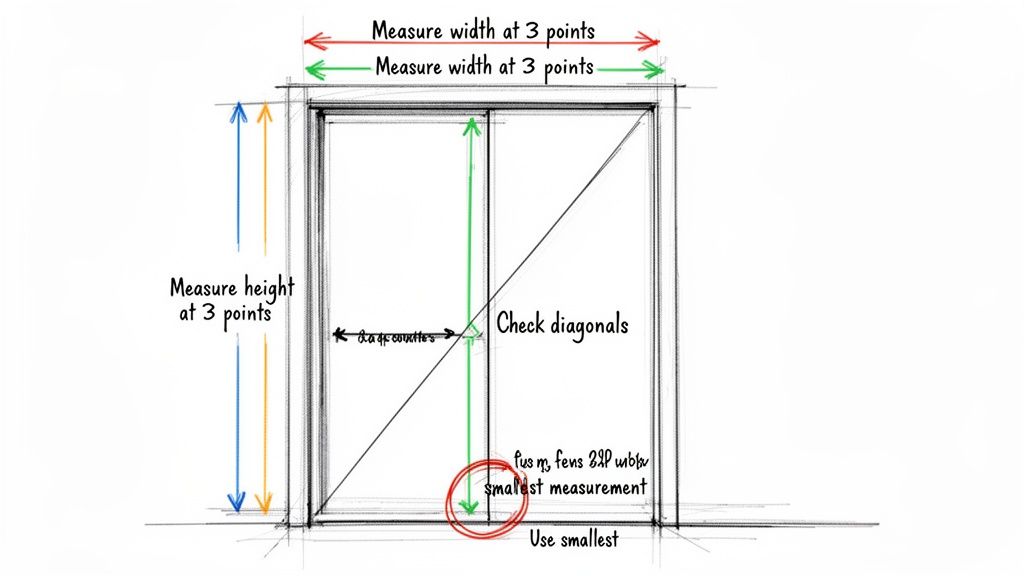
Here’s the golden rule for measuring any opening for a new door or window: measure everything three times. House walls, especially in older properties, are very rarely perfectly square. By measuring at the top, middle, and bottom, you account for any variations in the plaster or brickwork.
For the Width:
Jot down all three of these width measurements.
For the Height:
Make sure you write these three height figures down, too. This technique is vital whether you're in a modern Leeds new-build or a character property in York; you can't assume any opening is perfect.
Crucial Tip: Always Use the Smallest Measurement
When you give us the measurements for a quote, you must always use the smallest of your three width readings and the smallest of your three height readings. This is the professional standard. It guarantees the new door frame will fit into the narrowest part of the opening. Any small gaps can then be expertly packed and sealed by our installers, but a frame that's too big is a non-starter.
You’ve got your heights and widths. Now for the final check that separates a DIY measurement from a professional one: the diagonals. This simple step tells you whether your opening is truly 'square'.
An out-of-square opening isn't a disaster—it’s actually quite common—but it's vital information for our installation team.
To check, simply measure from the top-left corner of the opening down to the bottom-right corner. Then, measure from the top-right corner down to the bottom-left. In a perfectly square world, these two numbers would be identical. If they’re different, your opening is skewed. Make a note of both diagonal measurements so your installer can plan for it.
This is particularly important for projects across the North, from Newcastle to Manchester, where the massive variety in property age and building styles means we never take a square opening for granted. Knowing this upfront helps us prepare for a flawless installation, ensuring your new replacement glass sliding doors glide perfectly from day one.
You’ve picked the perfect door, and now you’re at the final, crucial hurdle: the installation. It’s here that many homeowners pause, weighing up the options. Do I tackle this myself, or do I call in the professionals? It’s a classic dilemma, pitting the temptation of saving a bit of cash against the peace of mind that comes with an expert job.
Taking on the installation of replacement glass sliding doors can seem like a great idea, especially if you’re handy around the house. The reality, though, is that this is a job demanding real precision and specialist skills. Being out by just a few millimetres can cause a cascade of problems down the line.
Fitting a sliding door isn't like hanging a standard internal door; it's a completely different ball game. The sheer weight of modern double or triple-glazed units, the absolute necessity for a perfectly level and plumb frame, and the technicalities of getting a weatherproof seal—it's a task that can quickly spiral out of control for even the most capable DIY enthusiast.
From our experience, the most common mistakes we see from DIY attempts almost always boil down to improper sealing. This leads to nagging draughts, water seeping in and damaging your flooring, and terrible thermal performance. Suddenly, all the benefits of your new energy-efficient glass are completely lost.
To even attempt this properly, your standard toolkit won't cut it. You need specialist gear:
While hiring a professional team might seem like just another cost, it's far more accurate to view it as an investment. You're investing in a guaranteed, long-lasting result that’s done right the first time. The benefits go well beyond just getting the door into the opening.
When you hire an experienced team, you're not just paying for their time and labour. You're buying their expertise, their efficiency, and your own peace of mind. A professional installer sees the whole picture, managing everything from the initial detailed survey right through to the final clean-up.
A professional installation comes with a workmanship guarantee. If any issues pop up because of the fitting—like a draught develops or a roller starts to stick—you have the assurance that it will be put right at no extra cost. That kind of security is invaluable.
For our clients in places like Yorkshire and Newcastle, a professional fit means the door will stand up to the uniquely challenging British weather, year after year. It's the same meticulous attention to detail our expert glass balustrade installers apply to their work, ensuring every single installation is secure, flawless, and perfectly sealed against the elements.
We recently worked on a project in a classic Leeds terrace, which perfectly highlights why professional experience is so important. The original brick opening was massively out of square—a very common issue we find in older properties. A DIY job would have almost certainly ended with a poorly fitted door that jammed constantly and let in rain.
Our team used precise packing techniques to set the new frame perfectly plumb and square within the skewed opening. We then used a multi-layered sealing process to create a completely weatherproof barrier, guaranteeing the door would glide flawlessly and be free of draughts. The homeowner was left with a perfectly operating door and the confidence it would perform for decades, saving them a world of stress and potential long-term costs.
Finally, a professional fitter also takes care of the proper disposal of your old doors and automatically ensures the work complies fully with UK Building Regulations. This means you'll receive essential paperwork like a FENSA certificate, a document that's vital when you eventually sell your home as proof that the installation meets the required safety and thermal efficiency standards.
Deciding on a big home improvement project like installing replacement glass sliding doors always comes with a few final questions. It's a significant upgrade, after all, and you need clear, straightforward answers before you commit. We've pulled together some of the most common queries we get from homeowners to help you move forward with confidence.
This is usually the first question on everyone's mind, and the answer depends heavily on your choice of material, glass, and the size of the opening.
As a solid ballpark figure for a standard 2.4-metre wide door in 2026, you should budget from around £2,300 for a professionally fitted uPVC door. If you're leaning towards premium aluminium frames—which are hugely popular for their elegant, slim sightlines—prices will typically start closer to £3,200.
Of course, extras like triple glazing, sleek integrated blinds, or specialist colour finishes will add to the final figure. Timber frames can be in a similar price bracket to aluminium, but if you're looking at bespoke designs or premium hardwoods, the cost will be higher. It’s an investment, but one that adds instant value and pays you back over time with lower energy bills.
For a straight swap—where the new door is designed to fit the existing opening—our professional installation team can usually have the entire job done and dusted within a single day. You can expect it to take anywhere from four to eight hours.
That timeframe covers everything: carefully taking out the old door, preparing the opening, fitting the new frame, installing the glass, and then meticulously sealing the whole unit to make it completely weatherproof. If the project involves structural changes, like making the opening wider, it will naturally take longer. We always give a clear, realistic schedule for our projects across Yorkshire, from Leeds to Newcastle, to keep disruption to an absolute minimum.
It's a common myth that replacing a door means days of mess and disruption. With an experienced team and no structural work, you can often head out for the day and come home to a beautiful, fully functioning new sliding door.
UK Building Regulations are rightly very strict, especially when it comes to thermal efficiency and safety. Any professional installer must follow them to the letter.
Part L (Conservation of Fuel and Power) is a big one. It states that any replacement door must have a U-value of 1.4 W/m²K or better for the whole unit. This measures how well the door stops heat from escaping.
Then there's Part F (Ventilation), which often means trickle vents need to be included to ensure healthy airflow and prevent condensation. Most importantly, safety glazing (either toughened or laminated glass) is mandatory for large panes like those in sliding doors. This is crucial for preventing serious injury if the glass ever breaks. Using a FENSA-registered installer like us guarantees that all work is fully compliant. You'll get a certificate to prove it, which is an essential document if you ever decide to sell your home.
Absolutely. If your existing frames are still in good shape—not warped, rotten, or damaged—then just replacing the sealed glass unit is a great, cost-effective option. It's the perfect solution for fixing problems like misted-up double glazing or a single cracked pane.
However, if your frames are old, letting in draughts, or the rollers are so worn that opening the door feels like a workout, replacing only the glass is a false economy. A full replacement will solve all those security and performance issues in one go. You’ll get much better insulation, modern locking systems, and that smooth, effortless glide you're looking for.
For those thinking about privacy with their new glass, there are plenty of smart solutions, from integrated blinds to decorative films. For some great ideas, check out this guide on Privacy for Sliding Patio Doors. We can help you weigh up the pros and cons and decide if a glass-only fix or a complete new door system is the right move for your home.
Ready to transform your home with stunning, high-performance replacement glass sliding doors? The expert team at Glass Tech is here to guide you through every step, from initial design to flawless installation. Serving homeowners across Yorkshire and the North, including Leeds, York, and Newcastle, we pride ourselves on quality craftsmanship and outstanding service. Contact us today for a no-obligation quote and discover how we can enhance your home's light, value, and security.

A professional team of experts providing glass and glazing solutions covering the whole of Yorkshire & more...
Whether it's Leeds, York, North Yorkshire, Birmingham, Hull, Liverpool, Machester, Newcastle or Nottingham, get in touch to find out how we can help you with your bespoke glass project.