
When you've invested in a beautiful dining table, coffee table, or desk, the last thing you want is for it to be damaged by daily life. A custom-cut tempered glass for table tops is more than just a protective layer; it's a practical and elegant solution that shields your furniture from scratches, spills, and heat, giving you complete peace of mind, especially in a busy family home.
Think of standard, or annealed, glass like an ordinary digestive biscuit—it serves a purpose but crumbles quite easily under a bit of pressure. Tempered glass, on the other hand, is like a twice-baked biscotti. It's been through an intense process of extreme heating and rapid cooling, which fundamentally changes its structure, making it incredibly tough and resilient.
It's this engineered strength that makes tempered glass the go-to solution for protecting valuable furniture across the UK. It acts as a durable, transparent shield against the hazards of everyday life. A dropped set of keys, a knock from a toy, or a spilt cup of coffee no longer needs to be a disaster for your tabletop.
The single biggest benefit of a tempered glass table protector is its remarkable durability. It's designed to be four to five times stronger than ordinary annealed glass of the same thickness, meaning it can easily handle the demands of a busy household or office environment.
Beyond its resistance to knocks and impacts, it also boasts excellent heat resistance. You can place a hot cup of tea or a warm serving dish directly onto the glass surface without worrying about causing thermal shock cracks or marking the wood underneath. This makes it an incredibly practical choice for dining tables where hot food is served regularly.
Perhaps the most compelling reason to choose tempered glass is its safety profile. While its strength makes it difficult to break, accidents can still happen. This is where tempered glass truly proves its worth, especially in homes with children and pets.
If it does break, it doesn't shatter into the long, dangerous shards you see with standard glass. Instead, it crumbles into small, dull-edged, pebble-like pieces. This unique fracture pattern drastically reduces the risk of serious injury, which is why it's officially classified as a "safety glass" and is a legal requirement for applications such as glass balustrades and shower screens.
By choosing tempered glass, you aren’t just protecting your furniture; you're adding a vital layer of safety to your home. It’s a smart, practical choice that blends elegant design with robust, real-world protection.
For homeowners looking for bespoke glass, from a simple table protector to a more complex project, finding a reliable local specialist is key. As a family-run business based in Harrogate, we specialise in supplying and installing high-quality glass products across the region. We regularly create tempered glass table tops for clients across Yorkshire, including Leeds, and further afield in areas like Newcastle and Manchester, offering expert advice and a seamless service from the initial measurement right through to installation. This local focus ensures you receive a perfectly tailored product and personalised attention.
On the surface, a tempered glass table top looks just like any other. The secret to its remarkable strength and safety, however, lies in a dramatic manufacturing process involving extreme heat and rapid cooling. It’s this controlled thermal treatment that transforms standard glass into a high-performance safety material.
The journey starts when a piece of standard annealed glass, already cut and finished to your exact specification, enters a specialist furnace. It’s heated uniformly to a precise temperature of over 600°C, reaching a point where the glass softens but doesn't melt.
Once at the perfect temperature, it's moved out and subjected to a process known as "quenching." High-pressure jets of cold air are blasted across both surfaces at the same time. This forces the outer layers to cool and solidify almost instantly, while the inner core of the glass remains scorching hot.
Here’s where the magic happens. As that molten inner core finally starts to cool and shrink, it tries to pull away from the already rigid outer surfaces. This creates a state of permanent, powerful internal stress.
Think of it like a constant tug-of-war. The outer surfaces are locked into a state of high compressive stress (pushing inwards), while the core is trapped in a state of tensile stress (pulling outwards). This locked-in compression acts like a suit of armour, making the glass incredibly resistant to knocks, impacts, and scratches. It’s this powerful internal balance that makes toughened glass four to five times stronger than ordinary annealed glass.
This infographic breaks down the core benefits born from this clever process.
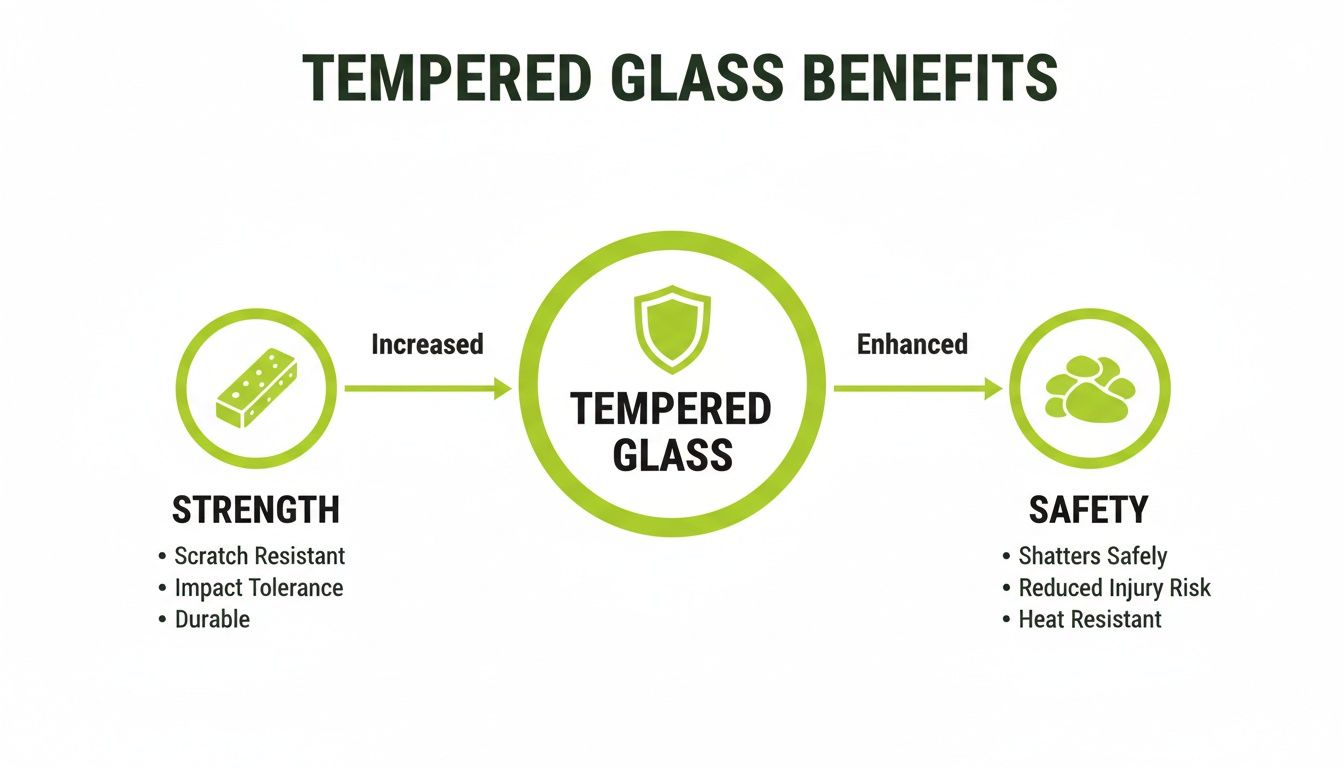
As you can see, this engineered strength goes hand-in-hand with an equally important safety feature.
That same internal stress is also responsible for tempered glass’s most critical safety feature. If the glass ever receives a blow hard enough to break through its compressive outer layer, all that stored energy is released in an instant.
Instead of breaking into dangerous, razor-sharp shards, the entire pane shatters into small, blunt, pebble-like pieces. This predictable fracture pattern is what earns it the official "safety glass" designation, and it’s a non-negotiable feature for furniture in a busy home.
The balanced stress within tempered glass is the secret to both its exceptional strength and its safe-break characteristics. It’s an engineered feature that provides security and durability in one transparent package.
This unique structure also gives tempered glass fantastic resistance to thermal shock. You can take a hot dish straight from the oven and place it on your glass dining table without worrying about the sudden temperature change causing a crack. It’s a practical, real-world benefit that makes it the perfect choice for kitchens and dining rooms everywhere, from Newcastle to Yorkshire.
Picking the right thickness for your tempered glass table top is one of the most important decisions you'll make. It’s a choice that directly impacts safety, style, and how the table functions in your home. Get it right, and your table will be both beautiful and perfectly suited for its job.
The first thing we need to figure out is the role your glass will play.
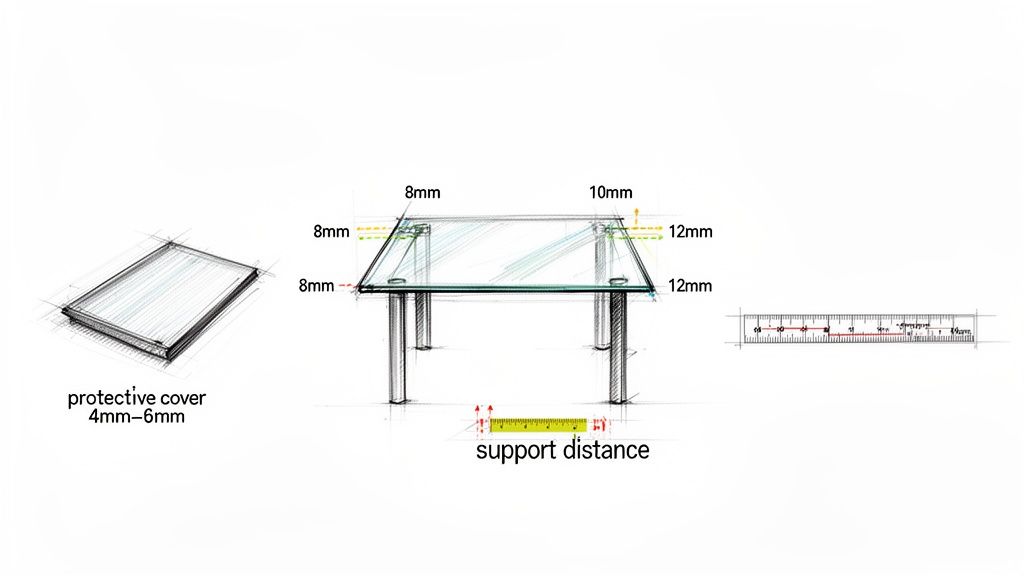
It all comes down to one simple question: is the glass acting as a protective cover for a solid table, or is it going to be the standalone tabletop itself? Your answer will point you straight to the correct thickness, ensuring you don't overspend on glass that's too thick, or worse, choose one that’s dangerously thin.
When your main goal is simply to protect a solid surface—like a beautiful wooden dining table, an antique desk, or a painted sideboard—the glass isn’t bearing any structural load. Its job is to be a shield, guarding the furniture against scratches, spills, and heat marks.
For this purpose, a slimmer piece of glass is ideal. It offers robust protection without being visually intrusive.
Now, if the glass is the table—supported only by a frame, legs, or a pedestal—its thickness becomes a critical matter of safety and structural integrity. The glass has to be strong enough to support its own weight and anything you put on it, all without flexing.
For these unsupported or partially supported tops, thicker glass is non-negotiable. The size of the glass and the distance between supports are key factors here; a larger span with less support demands thicker, more rigid glass to guarantee stability.
As a rule of thumb, 8mm is the absolute minimum thickness we'd recommend for any table where the glass is the primary surface. Anything thinner presents a serious safety risk.
To make it easier, we've put together a quick-glance table to help you match the glass thickness to its use.
| Application | Recommended Thickness | Best For |
|---|---|---|
| Protective Cover | 4mm | Small, fully supported surfaces like lamp tables, side tables, and small insets. |
| Protective Cover | 6mm | The standard for most applications, including dining table tops and desks. |
| Standalone Top | 8mm | Small-to-medium coffee and dining tables that have good, solid support. |
| Standalone Top | 10mm | Larger dining tables or desks where you want extra strength and a premium, heavy feel. |
| Standalone Top | 12mm+ | Very large or heavy-duty tables, especially those with minimal support from the base. |
This table serves as a great starting point for most standard furniture.
Ultimately, the perfect thickness is the one that keeps your family safe while achieving the look you want. As your local glass specialists, we create and deliver bespoke tempered glass for table tops across the North of England, from Leeds to Newcastle. We can offer specific, practical advice based on your table's unique design and measurements, ensuring you make a choice you can be confident in for years to come.
Once you’ve settled on the right thickness, the really creative part begins. This is where you get to shape the finer details that will turn a simple piece of glass into a centrepiece for your home. The finish of the edges, the shape of the corners, and the very type of glass itself all contribute to the final look and feel.
This is your chance to create something that perfectly complements your existing decor, whether you're aiming for sleek and modern or classically elegant.
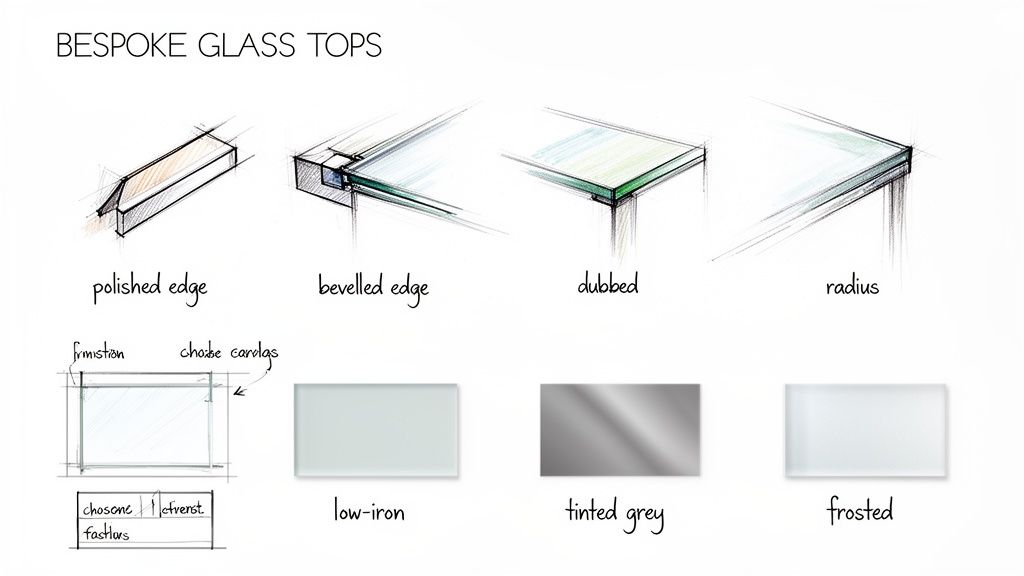
Personalising your glass is all about striking the right balance between style and function, ensuring the final product not only looks incredible but also fits seamlessly into your lifestyle.
The edge finish is one of the most defining choices you'll make. It’s far more than just a safety feature; it sets the entire character of the glass. Two main options stand out for their popularity and distinct styles.
Just as important are the corners, especially for square or rectangular tops. Sharp, pointed corners can be a hazard, particularly in busy family homes. We offer a couple of simple ways to soften them.
A "dubbed corner" is a simple and practical solution where we lightly sand down the sharp point. For a more deliberate and refined look, a "radius corner" gives you a smooth, gentle curve.
Beyond the edges, the glass itself holds some exciting design potential. While standard clear glass is a brilliant all-rounder, we can use specialised types to give your room a completely unique personality.
These options allow you to go far beyond a simple protective cover and create a genuine design feature. Whether you’re looking for crystal clarity or a bold statement, the right combination of finishes will bring your vision to life.
For a closer look at what’s possible, you can explore some of our bespoke glass projects. Our work across Yorkshire and Newcastle often involves these exact customisations, transforming ordinary furniture into something truly special.
So, you’re ready to order a bespoke tempered glass top for your table? Great choice. Getting the measurements right is the most critical step to ensuring a perfect fit, and it's simpler than you might think. As local specialists, we've helped countless homeowners across Yorkshire and the North get it spot on, and we'll guide you through the process from start to finish.
First, let's look at how to measure your tabletop correctly.
Before you do anything else, grab a good quality tape measure. Our golden rule is simple: measure twice, cut once. It saves a lot of headaches later on.
For Squares and Rectangles: These are the most straightforward. Just measure the length and the width of your table from one edge to the other. If you'd like a slight overhang, simply add the extra amount you want to both measurements. If you prefer the glass to sit just inside the frame (inset), then subtract a few millimetres from your length and width.
For Circles: Find the widest point of your circular table and measure straight across the centre. This measurement is the diameter, and that's all we need to create a perfect circle for you.
For Ovals and Custom Shapes: Anything that isn't a standard shape needs a physical template. The best way is to get a large sheet of paper or sturdy cardboard, lay it over the tabletop, and carefully trace the exact outline. Cut it out, place it back on the table to double-check the fit, and then you can get that template to us.
A quick tip from experience: always check for imperfections, especially with older furniture which might not be perfectly square. Measuring the width and length in a couple of different places will quickly show up any variations you need to account for.
Once you've got your dimensions, the rest of the process is reassuringly simple. We're a family-run business based in Harrogate, and we take real pride in serving homeowners across Yorkshire and the North. Our whole approach is built on providing expert, friendly advice, from your first phone call right through to delivery.
We believe ordering bespoke glass should be easy. Whether you're in Leeds, Manchester, or Newcastle, we’re here to help you get exactly what you need with confidence and clarity.
Being local means we genuinely understand what homeowners in our community are looking for. We handle every kind of project, whether it’s a small piece of protective glass for a cherished coffee table or a huge, statement dining top that will be the centrepiece of your room. You can choose from a range of finishes, like a crisp glass tabletop with a clear flat edge for that clean, modern aesthetic.
Our commitment to quality is unwavering, from the glass we source to the service we provide. If you have an existing table with damaged glass and need a precise replacement, our team has the expertise to help. You can learn more about our fast and reliable glass replacement service and how we can bring your furniture back to life.
One of the best things about a tempered glass table top is just how easy it is to live with. Your new glass surface is wonderfully low-maintenance, and with just a few good habits, you can keep it looking flawless for years to come.
A crucial first step actually happens during the installation. Whether our team is fitting it or you're placing it yourself, it’s vital to put small, clear plastic or rubber pads between the glass and the table itself. These inexpensive little buffers are essential; they stop the glass from slipping and create a protective cushion that prevents scratches on both the glass and your furniture.
When it comes to cleaning your tempered glass for table tops, forget about harsh, abrasive chemical cleaners. They’re not only unnecessary but can also damage specialist coatings or leave behind a stubborn, filmy residue. The best method is also the simplest and most cost-effective.
For a perfect, streak-free shine, all you really need are a couple of microfibre cloths.
This two-cloth technique is the secret professionals use to get rid of every single streak, leaving the glass absolutely crystal clear. It's a method that works just as well on other glass surfaces in your home. For more advice, you might find our guide to maintaining beautiful glass splashbacks helpful, as it follows very similar principles.
While tempered glass is incredibly tough and shrugs off most of the knocks and scrapes of daily life, it's important that we're realistic—it is highly scratch-resistant, not scratch-proof. Its toughened surface will easily stand up to things like cutlery, keys, and mugs being placed on it.
However, the surface can be scratched by very hard or abrasive materials. The most common culprits we see are unglazed ceramic bases on pots and mugs, coarse scouring pads, or jewellery containing diamonds and other hard gemstones.
To keep your table top in pristine condition, we always advise using placemats, coasters, and trivets. This is especially important during meals or when you're displaying decorative items that might have a rough base. This simple precaution is the single best way to protect your investment and ensure you enjoy its flawless beauty day after day, whether your home is in Yorkshire, Newcastle, or anywhere in between.
When you're considering a bespoke glass table top, it's natural to have a few questions. We've put together answers to some of the most common queries we hear from our clients to help you make your choice with complete confidence.
This is a really important one: no, it absolutely cannot. All the shaping, cutting, drilling for parasol holes, and edge finishing has to be done before the glass goes through the thermal toughening process.
Once tempered, the glass has a carefully balanced internal stress. Any attempt to cut or drill it will cause it to shatter into those small, safe cubes. This is exactly why getting the measurements right for your bespoke order from the start is so crucial.
The load a glass table can bear isn't a single number; it depends on a combination of three key factors: the thickness of the glass, its overall size, and, just as importantly, the quality of the base supporting it.
As a practical example, a properly supported 10mm thick glass top is more than strong enough to handle the daily demands of a busy family dining table. We always provide specific guidance based on how you plan to use your table to ensure it’s both safe and perfectly stable.
While tempered glass is incredibly tough and highly scratch-resistant, it's not entirely scratch-proof. It stands up brilliantly to everyday use, like contact with cutlery, plates, and keys.
However, it can be scratched by extremely hard or rough materials. Think things like diamond rings or the unglazed, abrasive bases found on some ceramic plant pots or mugs. Using placemats and coasters is always a good habit to keep your glass top looking pristine for years to come.
For broader tips on maintaining the longevity and appearance of all your furniture, including tables, you might find these general furniture care tips useful.
Ready to protect your furniture with a perfectly-fitted glass top? For expert advice and a bespoke quote, contact the team at Glass Tech. We deliver custom-made glass across Yorkshire, Newcastle, and the North. Visit https://www.hgwsolutions.co.uk to learn more.

A professional team of experts providing glass and glazing solutions covering the whole of Yorkshire & more...
Whether it's Leeds, York, North Yorkshire, Birmingham, Hull, Liverpool, Machester, Newcastle or Nottingham, get in touch to find out how we can help you with your bespoke glass project.