
A glass table top is one of the most versatile and elegant upgrades you can make to your home. It’s a deceptively simple idea that delivers on multiple fronts: protecting a cherished family heirloom from daily life, creating a feeling of light and space in a smaller room, or simply giving a tired piece of furniture a fresh, modern feel. It’s a smart, practical investment for any homeowner.
A piece of glass on a table does more than just sit there looking good; it works hard to improve your living space. By reflecting light, it can make a room feel noticeably larger and brighter—a brilliant trick for opening up a cosy dining area in Leeds or a compact living room in Sheffield. Its crystal-clear nature also means you can add a tough, protective layer to a beautiful wooden table without hiding its grain and character.
This simple addition brings a clean, timeless look that complements any decor, from the most traditional to the ultra-modern. And unlike wood, which can suffer from stains, scratches, and heat marks, a quality glass surface is incredibly resilient and easy to live with. A quick wipe is all it takes to deal with spills and fingerprints, keeping it looking pristine for years.
The real beauty, though, lies in its versatility. You can use a bespoke glass table top to:
As a family-run business based in Yorkshire with over 20 years of experience, we at Glass Tech have seen firsthand how a well-chosen glass table top can completely transform a space. It’s not just about aesthetics; it’s about adding durable, practical value to the furniture you use every day.
Whether you're in York, Hull, or anywhere across the North, a bespoke glass solution offers a lasting improvement. In this guide, we'll walk you through everything you need to know—from choosing the right type and thickness to measuring for that perfect fit—so you can make a confident and informed decision for your home.
Picking the right glass for your table top goes far beyond just what it looks like. It’s a decision that directly affects the safety, durability, and even the feel of a room. Not all glass is made the same, and what’s perfect for a quiet flat in Harrogate might not be the best fit for a busy family home in Sheffield. Getting this choice right means your new table will not only look fantastic but will stand up to daily life for years to come.
Think of it like choosing tyres for a car; you need the right type for the job it has to do. To feel confident in your decision, it helps to understand the real-world differences between the options you’ll come across for your glass table top.
The most basic glass you’ll find is annealed glass. This is just standard, untreated float glass. Picture a simple window pane – it does the job, but if it breaks, it shatters into large, dangerously sharp shards. Because of this, we’d only ever recommend annealed glass as a simple protective cover for a solid piece of furniture where there’s almost no risk of it getting knocked.
On the other hand, you have toughened glass, which is also known as tempered glass. This is the gold standard for safety in most homes. It goes through a special process of extreme heating and rapid cooling, which makes it up to five times stronger than standard annealed glass. But the real magic happens if it does break. Just like a car's side window, it's designed to crumble into lots of small, granular, pebble-like chunks that are far less likely to cause a nasty injury.
This simple guide can help you think through the best path for your own furniture.
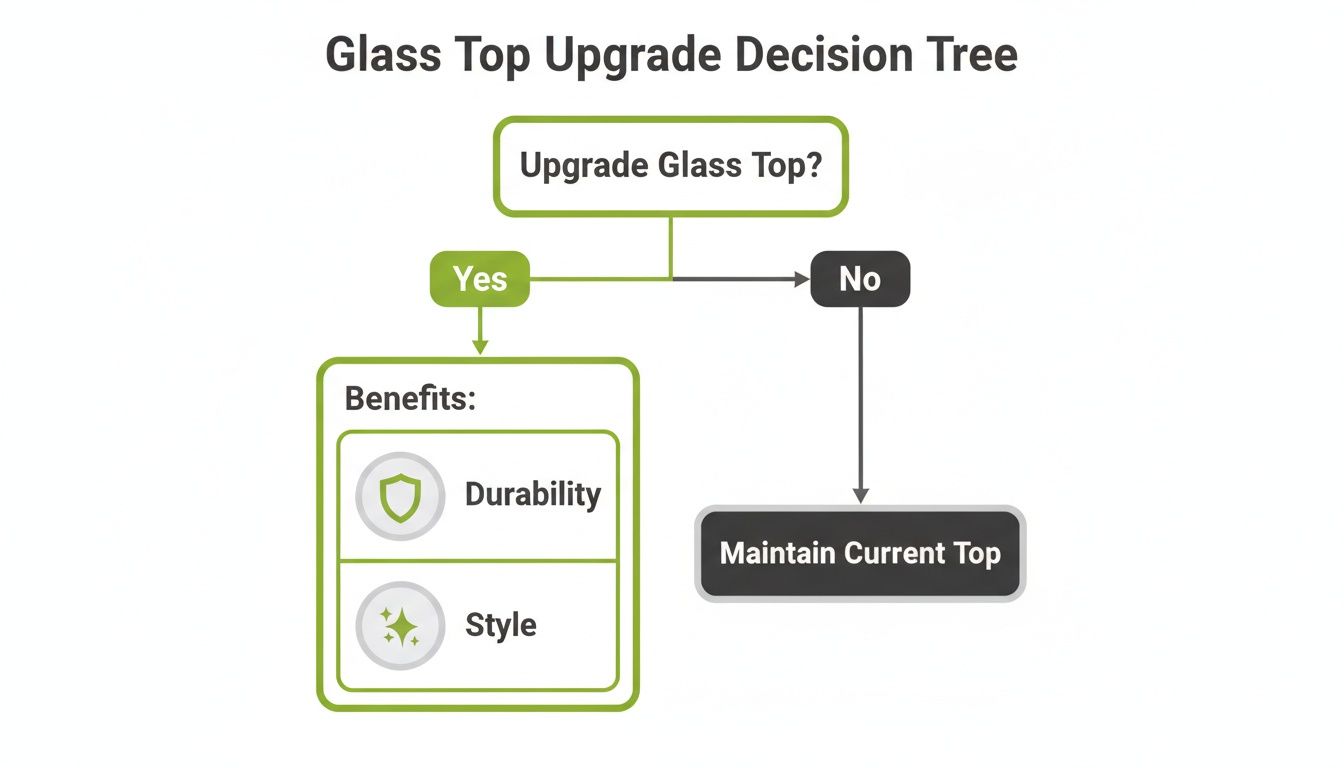
As the infographic shows, upgrading to a quality glass top brings both strength and style to the table—a huge plus for any homeowner. It’s no surprise that demand for these safer, stronger options is on the rise. We've seen a huge shift in UK homes, with market data showing a 12% year-on-year increase in demand for tempered glass. It now accounts for over 60% of the market, purely down to its superior safety performance.
For situations that demand ultimate peace of mind or a very specific aesthetic, there are a couple of other fantastic options to consider.
For many of our bespoke glass projects, homeowners find that the final decision often comes down to balancing the top-tier safety of toughened glass with the pristine clarity of low-iron. Both are a world away from standard glass.
While alternatives like an acrylic round table top can offer a modern, transparent look, for that genuine premium feel and unmatched clarity, nothing quite compares to real glass.
Okay, so you’ve picked the type of glass you want. Now we get to the details that really define the look and feel of your table: the thickness of the glass and the style of its edge. These aren’t just aesthetic choices; they are fundamental to the safety, durability, and overall presence of your glass table top. Getting them right is what separates a good table from a great one.
Think of glass thickness as the backbone of your table. It has to be up to the job. A slim 6mm sheet of glass, for example, is ideal as a protective cover for a solid wooden coffee table where the base is doing all the heavy lifting. But if the glass itself is the table, like a large dining surface, it needs much more substance.
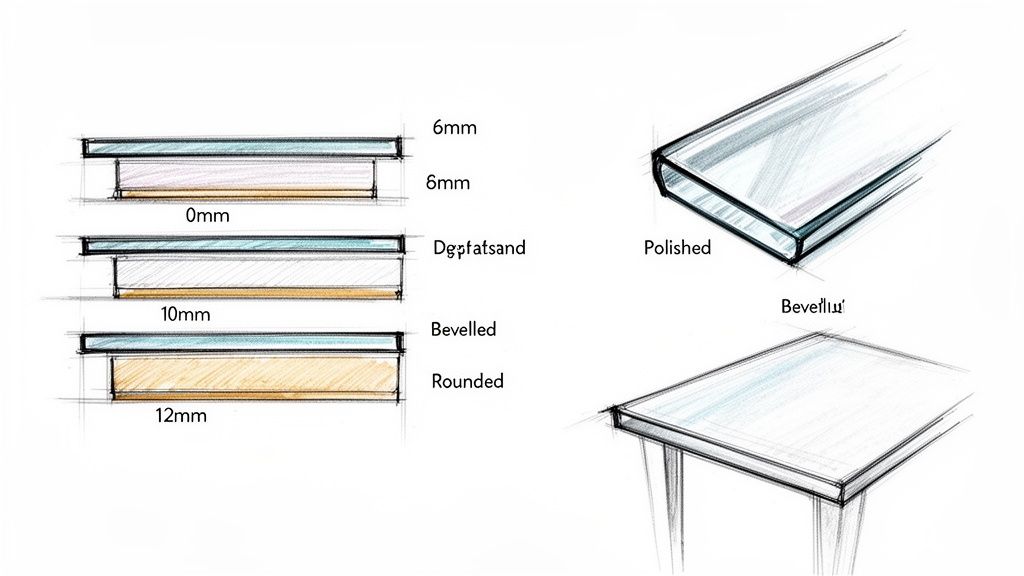
For most standalone glass tables—think of a dining table on a central pedestal or a large desk on four legs—we almost always recommend a thickness of 10mm or 12mm. This gives the glass the rigidity it needs to handle everyday life, from stacks of books and heavy serving dishes to someone leaning on it, all without flexing or feeling fragile.
For smaller side tables, or where the glass sits snugly within a supportive metal frame, 8mm is often a perfectly good option. The key is always to balance the thickness with the amount of support the glass has and the load it will carry. Thicker glass not only feels more premium but is a crucial safety factor, especially for bigger, unsupported tops. It’s a detail we scrutinise on every project, from family dining rooms in Leeds to modern flats in Manchester.
To make this simpler, here’s a quick guide to help you match the thickness to the job.
| Table Type / Use | Typical Size | Recommended Thickness |
|---|---|---|
| Protective Cover (on an existing table) | Any | 6mm |
| Small Coffee/Side Table (fully supported) | Up to 1000mm x 600mm | 8mm |
| Dining Table / Desk (supported on a frame) | Up to 1800mm x 900mm | 10mm |
| Large Dining Table (on legs/pedestal) | Over 1800mm x 900mm | 12mm |
| Very Large / Bespoke Table | Custom | 15mm or 19mm (consultation needed) |
This table serves as a solid starting point, but we always advise discussing your specific needs with us to ensure a perfect, safe fit for your home.
The edge finish is the final, defining touch. It’s a subtle detail, but one that has a huge impact on your table’s character and how it ties into the rest of your room.
There are two main styles you’ll come across:
A great way to think about it is that a polished edge is like a modern, invisible picture frame. A bevelled edge, on the other hand, is a more traditional, ornate frame that is designed to be a feature in its own right. Both are completely safe and smooth, so the decision really comes down to your personal taste.
Once you’ve settled on the perfect glass type and finish, we get to what is arguably the most critical step: getting the measurements right. An accurate measurement is the absolute foundation of a flawless fit for your glass table top, and while it might sound a bit daunting, you can measure most standard shapes with confidence using a few professional tips.
For simple squares and rectangles, the job is pretty straightforward. Always use a good quality metal tape measure for the best accuracy. It’s absolutely vital to measure the length and width at several different points—for instance, measure across both ends and then again right through the centre. You’d be surprised how often tables, especially older wooden ones, aren't perfectly symmetrical. Taking multiple measurements reveals any small variations, ensuring your new glass doesn't overhang awkwardly on one side.
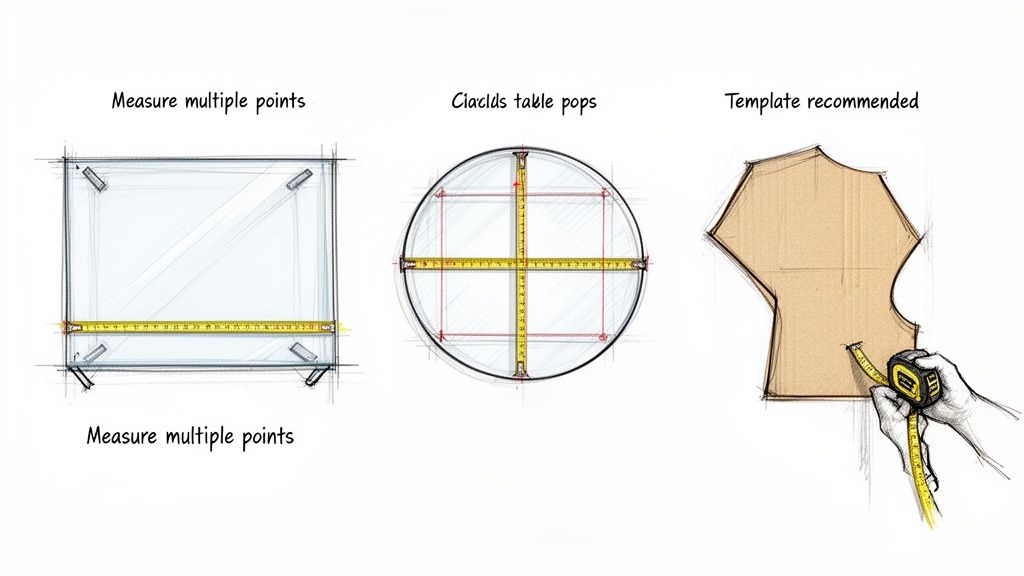
Measuring isn't a one-size-fits-all task; the approach changes with the shape of your table. Here’s a quick guide on how to tackle the most common types:
It can also be helpful to think about the bigger picture. Understanding the basics of how to measure a room for furniture can give you a better feel for how the final piece will sit and interact with the space around it.
For anything with unusual curves, corners that aren't a perfect 90 degrees, or a completely unique, free-form shape, making a physical template is the safest bet. It’s easier than it sounds. You can create one from a large piece of cardboard or some sturdy brown paper. Just lay it over your table base, carefully trace the exact outline, and cut it out. This gives us a perfect pattern to follow.
For high-value or particularly intricate projects, a professional survey is the best way to guarantee absolute precision. If you are ordering a complex bespoke glass table top for a home in Newcastle or York, our expert team can provide an on-site measuring service for complete peace of mind.
This service is something we especially recommend for projects that involve our glass replacement service, as it ensures the new glass fits any existing framework perfectly. It simply removes all the guesswork and guarantees a flawless result, every time.
So, you’ve picked out the perfect glass for your table. Now for the exciting part: bringing it all together and making sure your new glass table top is secure, stable, and looks just right in your home.
Fitting your glass is usually a straightforward job, but the method you choose will depend on the final look you're after.
For most projects where the glass is simply protecting a surface—like a wooden desk, dining table, or sideboard—the best and simplest solution is using small, clear anti-slip pads. These are just discreet little plastic discs that sit between the glass and the furniture.
They provide just enough grip to stop the heavy glass from sliding around. They also create a tiny, almost invisible air gap, which is crucial for preventing any moisture from getting trapped underneath and potentially damaging the wood. It’s our go-to method for most protective tops.
If you’re aiming for a more sleek, integrated design, you might want to consider bonding the glass directly to its base. This is a more specialist technique that uses a UV-cured adhesive to create a permanent, incredibly strong, and totally invisible bond between the glass and metal supports.
It’s a fantastic option for creating those modern, minimalist tables where the glass seems to float effortlessly on its pedestal.
When it comes to budgeting for your project, we believe in being completely upfront. The final price of your bespoke glass table top comes down to a few key factors, all of which you can adjust to fit your budget.
Here’s what shapes the final cost:
This breakdown helps you see exactly where your money is going. Investing in a quality, custom-made glass table top is a decision that pays dividends in both durability and style. It's a trend we're seeing across the country; the UK tabletop glassware market was valued at a robust USD 606 million in 2020, and it's projected to hit USD 1018.07 million by 2026.
You can discover more insights about the UK tabletop glassware market to see the full picture. It shows just how many homeowners are choosing to enhance their properties with high-quality glass.
One of the best things about a glass table top is just how simple it is to live with. Unlike wood, which needs regular sealing and polishing, glass is wonderfully low-maintenance, a perfect fit for a busy home. With just a little bit of care, you can keep that surface looking crystal clear for many years to come.
The real secret to a pristine, streak-free shine isn’t a pricey commercial product. In fact, you’re better off avoiding most of them. Many household glass cleaners contain ammonia, which over time can potentially damage the edge seals on your glass or even the finish on surrounding furniture. A much simpler, safer, and more effective solution is one you can mix up right in your own kitchen.
For a fantastic homemade cleaner, just mix equal parts distilled water and white vinegar in a spray bottle. Using distilled water is the key here, as it’s free from the minerals in tap water that are notorious for leaving streaky deposits behind. Simply give the glass a light spray and wipe it clean with a microfibre cloth for a flawless finish.
For the very best results, always use two cloths: one for the initial clean and a second, dry one to buff the surface. This simple trick prevents streaks and removes every last trace of moisture, leaving nothing but a brilliant shine.
Of course, the best way to deal with scratches is to avoid them in the first place. Getting into a few good habits is the easiest way to protect your investment and keep your table looking immaculate.
If you do pick up a minor scuff, a high-quality cerium oxide polish can often do the trick, but it’s a job that requires a gentle touch and a bit of patience. This straightforward approach to maintenance helps our customers across Yorkshire and Newcastle enjoy their glass for years. Much like our easy-to-clean glass splashbacks, the true beauty of a glass surface is its lasting, effortless appeal.
We find that once homeowners start exploring the options, a few common questions always come up. It's perfectly normal. Choosing the right glass is an important decision, so we've gathered the most frequent queries we hear from clients across Yorkshire to give you clear, practical answers.
For any table where the glass provides structure or isn't fully supported by a solid base underneath, our answer is an unequivocal yes. The difference in safety is night and day. Standard float glass, when it breaks, shatters into large, razor-sharp shards that are incredibly dangerous.
Toughened glass, on the other hand, is up to five times stronger. It can handle the knocks and bumps of a busy family home. Crucially, if a serious accident were to cause it to break, it crumbles into small, pebble-like pieces, dramatically reducing the risk of injury. For a standalone dining table, coffee table, or desk, it’s not just a feature—it's a fundamental safety requirement.
It absolutely can, and it's one of the most popular reasons people come to us. Think of a glass protector as a crystal-clear shield for your treasured furniture. It takes all the daily abuse—spills, heat rings from hot mugs, scratches from keys, and dings from cutlery—so the wood underneath remains pristine.
It means you can actually use your beautiful table every day without worrying about damaging it. You get all the beauty of the wood grain, but with a surface that's a breeze to just wipe clean.
This isn't just a niche idea; it's a smart, widespread home upgrade. The UK glass tableware market shows a clear shift towards these practical solutions, with residential use now accounting for 65% of the market. Families are choosing low-maintenance tops that resist stains up to 50% better than untreated wood. In competitive property markets like Newcastle, this simple feature has even been shown to boost resale prices by 8-12%. You can read the full analysis of the European glass tableware market to see the data for yourself.
The unique quality of glass is its ability to adapt. Because it's transparent and plays with light, it doesn't impose a style of its own. Instead, it complements what's already there.
Whether your home is a traditional Harrogate townhouse or a sleek, modern flat in Leeds, a glass top adds a touch of class without clashing with your furniture or colour scheme. It has a knack for making rooms feel brighter and more spacious, making it one of the most versatile design choices you can make.
Ready to find the perfect, durable glass top for your furniture? The team at Glass Tech is here to help. With over two decades of experience serving homes across Yorkshire, we can guide you to a bespoke solution that's just right.

A professional team of experts providing glass and glazing solutions covering the whole of Yorkshire & more...
Whether it's Leeds, York, North Yorkshire, Birmingham, Hull, Liverpool, Machester, Newcastle or Nottingham, get in touch to find out how we can help you with your bespoke glass project.