
Think of annealed glass as the starting block for almost every type of glass you see in your home. It’s the foundational, raw material—the ‘standard’ glass that comes out of the float glass process before it’s strengthened, laminated, or specialised for a particular job.
The name comes from its manufacturing method: a precise, controlled cooling process called annealing. This technique is what removes all the internal stresses from the glass, making it stable and incredibly easy to work with.
Annealed glass is the fundamental flat glass that forms the basis for countless home improvements, from simple window panes to decorative panels. It’s the very foundation of the UK's flat glass market, a sector valued at USD 4.77 billion in 2024 and poised for significant growth. You can dive deeper into these market trends over at Market Research Future.
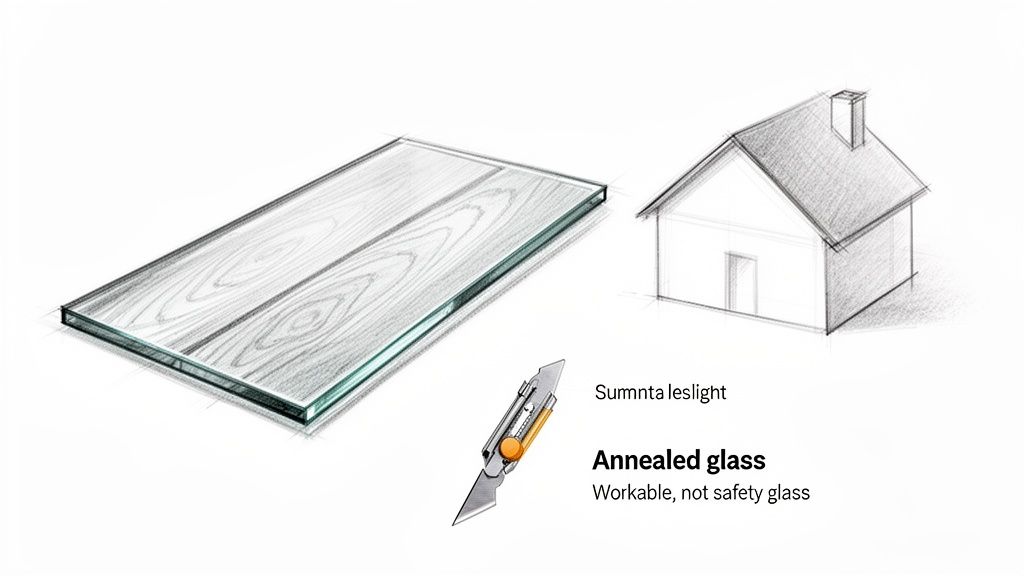
Its most defining characteristic comes directly from how it’s made. Molten glass is first heated to around 600°C before being cooled down very slowly in a special chamber known as an annealing lehr.
This slow, controlled cooling is the key. It allows the glass to settle evenly without locking in internal stresses. The result is a perfectly stable product that can be cut, drilled, edged, and polished with absolute precision.
This remarkable workability is why it's the go-to choice for things like custom-cut picture frames or bespoke decorative door panels. But here's the crucial point for any homeowner: in this raw state, annealed glass is not a safety glass.
To quickly summarise, here are the core characteristics of standard annealed glass.
| Characteristic | Description |
|---|---|
| Workability | Excellent. Can be easily cut, drilled, and polished to bespoke sizes and shapes. |
| Optical Clarity | Very high. Provides a clear, distortion-free view. |
| Strength | Low. Relatively fragile and susceptible to thermal shock (sudden temperature changes). |
| Breakage Pattern | Dangerous. Shatters into large, sharp, dagger-like shards upon impact. |
These properties paint a clear picture: annealed glass is a versatile starting point, but its use is limited by its brittleness.
When weighing up your options, it’s all about understanding these key properties:
That dangerous breakage pattern is precisely why Building Regulations restrict its use in what are known as ‘critical locations’. Areas like doors, low-level glazing, or glass balustrades must use a safety glass like toughened or laminated glass. We’ll dig into that crucial difference next.
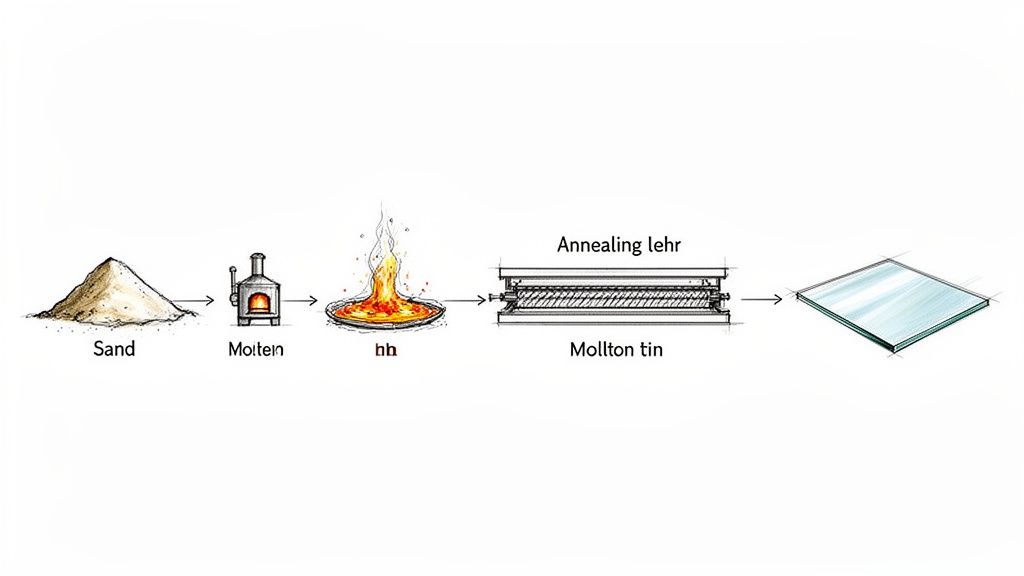
The journey from a handful of raw materials to a perfect sheet of glass is a masterpiece of industrial engineering. It’s a process that underpins the entire modern glass industry, known as the float glass process. This method is responsible for almost all the flat glass you see today, from windows to balustrades.
It all starts with a very precise, time-honoured recipe. The ingredients are surprisingly common materials, used in glassmaking for centuries, but combined with absolute precision.
This mix is fed into a colossal furnace, where it’s melted down at blistering temperatures of around 1,500°C. What emerges is a perfectly uniform, glowing molten liquid, ready for the most ingenious part of its journey.
This is where the real magic happens. The molten glass is poured from the furnace in a continuous ribbon, floating onto a huge, shallow bath of molten tin.
You might ask, why tin? It’s because glass and tin are like oil and water—they don't mix. The glass, being less dense, simply floats on top. Pulled by gravity, the liquid glass spreads out across the perfectly flat surface of the tin, creating a sheet with uniform thickness and an impeccable finish.
The final thickness of the glass is controlled by the speed at which this ribbon is pulled off the tin bath. By tweaking the speed, manufacturers can produce glass of a specific, consistent thickness, completely free of the waves and distortions common in older production methods.
This single innovation is the reason modern glass has such incredible optical clarity. Whether it's for huge picture windows in a Newcastle home or a bespoke glass staircase in Yorkshire, that flawless flatness is born right here.
As the ribbon of glass glides along the tin bath, it begins to cool and solidify. But it’s not finished yet. The most vital step for creating stable, usable glass is still to come.
Once the sheet leaves the tin bath, it enters a long, tunnel-like oven called an annealing lehr. This is the final, and arguably most critical, stage in making true annealed glass.
Inside the lehr, the glass temperature is brought down with painstaking slowness as it travels over hundreds of metres. This controlled cooling ensures that the entire sheet—from its core right to the surface—cools down at the exact same rate. If it cooled too quickly, immense internal stresses would get locked inside, making the glass fragile and unpredictable.
This stress-relieving process is precisely what annealing is. It gives the glass its stability, ensuring it can be reliably cut, drilled, polished, and shaped. It’s this process that creates the fundamental base material for countless glass applications across the North of the UK and beyond.
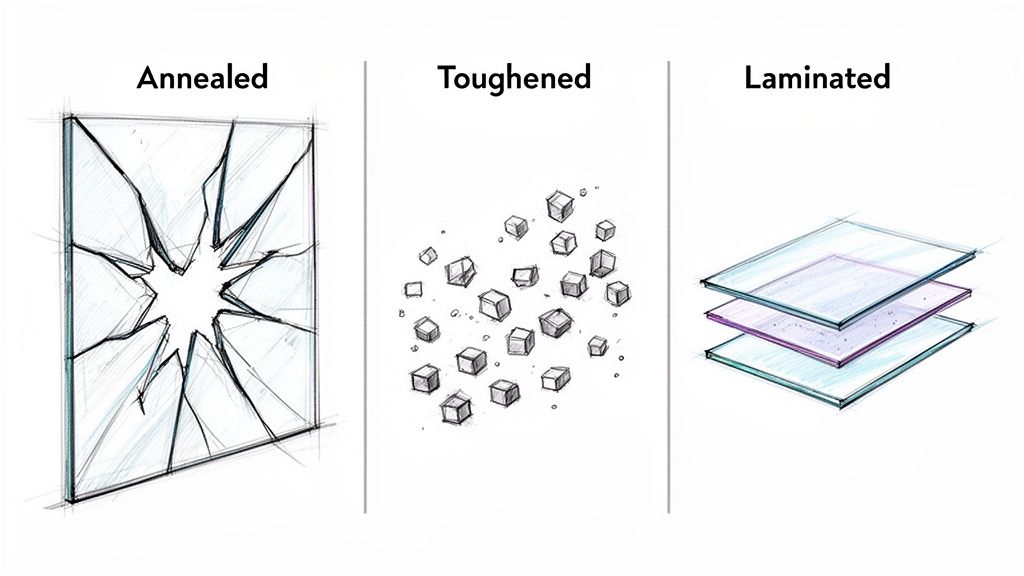
Getting to grips with the different types of glass is vital for any home project. It’s the key to making a choice that ensures both safety and longevity. While annealed glass is the base material for everything, you'll rarely find it used in its raw form for any application that needs to be structural or safe.
Instead, think of annealed glass as the starting block for two much more advanced safety options: toughened and laminated glass. These are the materials you’ll see used to meet UK safety standards in homes from Sheffield to Sunderland. In fact, annealed glass is the base for 60-70% of all architectural glass before it's processed into a stronger product. Toughened glass alone commands a 42.38% revenue share in 2024, showing just how crucial this processing is. You can see more details on the UK's flat glass market on Grand View Research.
Toughened glass, which you might also hear called tempered glass, starts its life as a normal sheet of annealed glass. The magic happens in a secondary process where it’s heated in a furnace to over 600°C and then blasted with high-pressure cold air.
This rapid cooling, known as "quenching," causes the outer surfaces to harden much faster than the centre. This creates a powerful state of compression on the outside and tension in the core, making the final pane four to five times stronger than the original annealed sheet.
But its real safety benefit is revealed when it breaks. Instead of fracturing into long, dangerous daggers, it shatters into thousands of small, blunt, pebble-like pieces, dramatically reducing the risk of serious injury. This is precisely why it’s a must-have for applications like Glass Balustrades Yorkshire and across the country.
Laminated glass achieves its safety rating through a completely different, but equally clever, method. It's essentially a glass sandwich, made by bonding two or more sheets of glass together with a tough, clear plastic interlayer, usually Polyvinyl Butyral (PVB).
If the glass cracks or breaks under impact, the sticky interlayer holds all the fragments in place. The pane remains a single, intact barrier. This is a critical safety feature for overhead glazing like skylights or for balustrades where preventing a fall is the absolute priority. Its robust nature makes it the go-to choice for high-security applications, such as Glass Balustrades Newcastle.
When a panel gets damaged, it's important to know what your options are. It might be worth reading our guide on choosing the right glass replacement service.
So, which one is right for you? The best choice depends entirely on where and how the glass will be used. This table breaks down the core differences to help you make an informed decision for your project.
| Feature | Annealed Glass | Toughened Glass | Laminated Glass |
|---|---|---|---|
| Strength | Basic | High (4-5x stronger) | High (similar strength to annealed) |
| Breakage Pattern | Large, sharp shards | Small, blunt cubes | Cracks but stays in place |
| Safety Level | Very low (not a safety glass) | High (prevents cutting injuries) | Very high (provides a barrier) |
| Typical Use | Picture frames, protected windows | Balustrades, shower screens, doors | Skylights, high-level balustrades, shopfronts |
As you can see, the choice is clear. Both toughened and laminated glass are engineered specifically for safety-critical areas, leaving annealed glass for protected, low-risk applications where impact is not a concern.
It's clear that annealed glass, on its own, isn't the right choice for areas where safety is the top priority. But that doesn’t mean it doesn't have a place in your home. In fact, its most common application is one you probably look through every single day without a second thought.
Take a look at your windows. Annealed glass is the go-to material for the individual panes inside sealed double or triple-glazed units. Tucked away securely within the frame, it’s shielded from direct knocks and the kind of sharp temperature changes that could cause it to fail. This is the perfect job for it, letting you enjoy its fantastic optical clarity without any safety compromises.
Away from windows, annealed glass really comes into its own in places where the risk of human impact is practically zero, and it isn't being asked to act as a safety barrier. Because it’s perfectly flat and easy to work with, it's brilliant for those bespoke items that bring a touch of class to your interior design.
Some common and perfectly safe uses include:
But here’s the crucial point: for any glass that acts as a barrier or is in a high-risk area—like a glass balustrade in a Yorkshire home or a shower screen in Newcastle—the raw annealed glass must be processed into toughened or laminated safety glass. Under UK building regulations, this is completely non-negotiable.
This distinction is at the very heart of how we approach safety on every single project. Annealed glass is a fantastic base material, but our team's expertise lies in knowing exactly where it's appropriate and, more importantly, when an upgrade to safety glass is essential.
For instance, you might have a beautiful decorative feature wall made of annealed glass panels, tucked away in an alcove where they can’t be knocked. That’s perfectly fine. But the very moment that glass is intended for a door, a full-height partition, or a balustrade, it absolutely has to be either toughened or laminated. You can see how we put these principles into practice in our detailed guide to designing beautiful and compliant glass balustrades.
When it comes to installing glass in your home, safety isn't just a good idea—it’s a legal requirement. In the UK, the rules are set out in Approved Document K of the Building Regulations, which covers protection from falling, collision, and impact. These aren't just bureaucratic guidelines; they exist to keep you and your family safe by dictating exactly what type of glass can be used, and where.
For any homeowner, getting to grips with these rules is essential. They are precisely why you can't just put standard annealed glass wherever you like, especially in high-risk areas of your home. Failing to comply can put people in danger and create major headaches when you come to sell your property.
Approved Document K identifies specific zones within a property as 'critical locations'. Think of these as areas where there's a greater chance of someone accidentally making impact with the glass, and where a breakage could cause serious injury. Using the right kind of safety glass in these locations isn't optional; it's mandatory.
The most common critical locations include:
These regulations are all about ensuring that if an accident does happen, the glass breaks in a predictable and safe way, dramatically reducing the risk of harm.
So, why is what is annealed glass completely unsuitable for these critical locations? It all comes down to the way it breaks. As we've covered, when annealed glass shatters, it fractures into large, dagger-like shards with razor-sharp edges. This presents an extreme and completely unacceptable risk of severe injury.
Imagine a child tripping and falling against a low-level patio door made from annealed glass. The outcome could be catastrophic. The regulations are in place to prevent exactly this kind of scenario, making sure glass in high-traffic, high-risk areas fails safely.
This is why toughened or laminated glass is always specified for these applications. Whether it’s for a stunning new glass balustrade in Harrogate or a modern glass staircase renovation in York, compliance is non-negotiable. It gives you the peace of mind that your installation isn’t just beautiful, but also meets or exceeds all legal safety standards, protecting your family for years to come.
Getting to the point where you feel confident about your glass choice is one of the most important parts of any home renovation. Now that you know the difference between annealed, toughened, and laminated glass, you're in a great position to make a smart decision that balances safety, style, and your budget.
To get it right, it really just comes down to asking a few simple questions about where and how the glass will be used. The answers will point you directly to the correct specification for your project.
Think about the specific panel of glass you're planning.
If you answered 'yes' to any of these questions, you’re looking at what UK Building Regulations define as a 'critical location'. It's a simple but crucial designation. It means that, by law, you must use a type of safety glass—either toughened or laminated.
This simple decision tree can help you visualise the process. As soon as you identify a risk, the choice becomes clear.
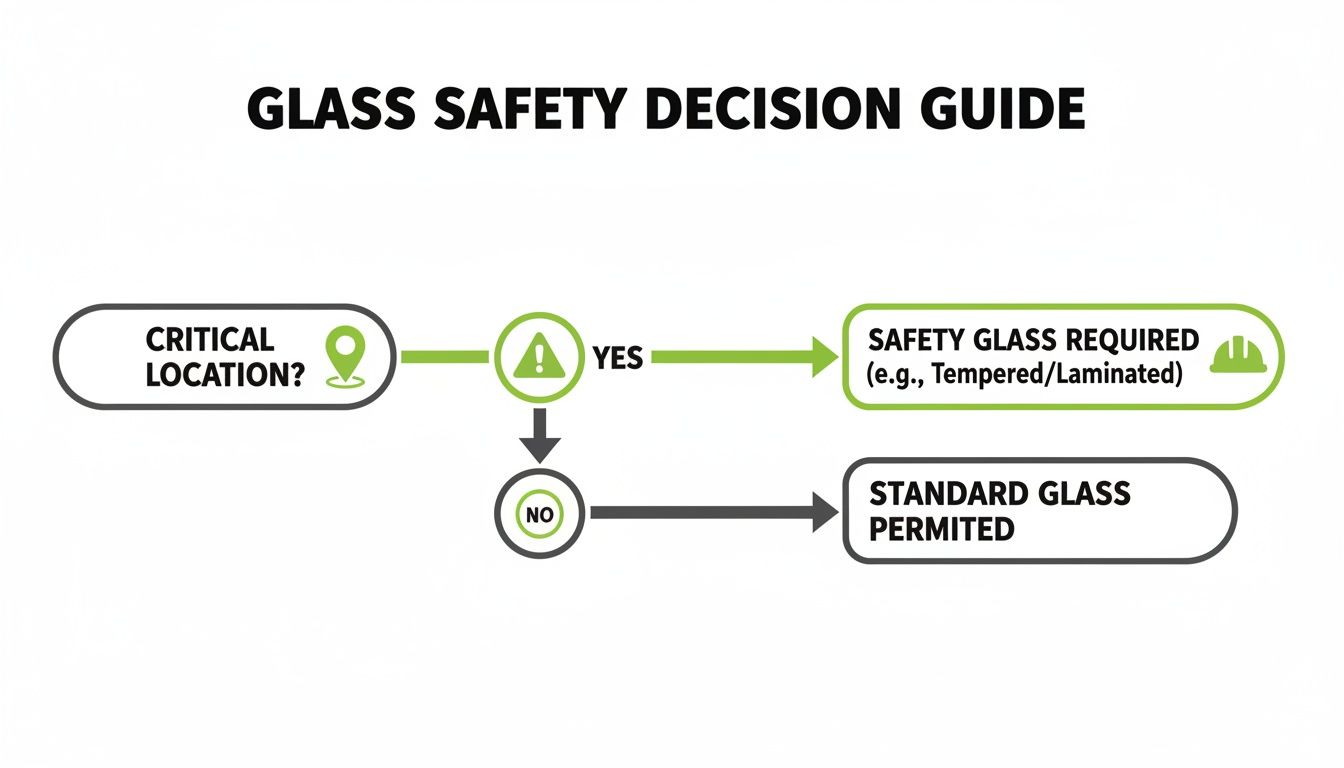
As you can see, identifying a critical location immediately takes standard annealed glass off the table for safety reasons. For those other spots—think protected, decorative uses far away from any risk of impact—annealed glass is still a perfectly good and cost-effective choice. And if you’re thinking about a custom shower, you can learn more about bespoke glass shower screens and enclosures.
Our team is here to help homeowners across the North of the UK, offering professional surveys and guidance. Whether you need a compliant glass solution for your Glass Balustrades Yorkshire or a stunning shower screen in Newcastle, we ensure you get the perfect fit for your project.
Of course, the type of glass isn't the only decision. Many homeowners also look into extra treatments for their glazing. For example, if you're concerned about being overlooked, exploring the best window film for privacy can be a fantastic way to finish off your project.
It’s natural to have a few questions when you’re deciding on the right materials for your home. To help you out, here are our answers to some of the most common queries we get from homeowners about annealed glass.
Absolutely, and this is one of its biggest advantages. The slow, controlled cooling process used to create annealed glass leaves it with very little internal stress. This stable state means it can be easily cut, drilled, and polished into custom shapes on demand, making it perfect for bespoke projects.
It’s crucial to remember that this workability is lost once glass is toughened. The toughening process locks in a huge amount of stress, so any cutting or drilling must be completed before the glass goes into the furnace. After that, it cannot be altered.
As a raw material, yes, annealed glass is less expensive. It doesn’t undergo the extra, energy-intensive heat treatment that toughened glass does, which is reflected in the base cost.
However, the more important question is the cost of the final, compliant product for your specific job. UK building regulations require safety glass (either toughened or laminated) for the vast majority of residential applications like balustrades, doors, and any low-level windows. So, while annealed glass is cheaper on paper, the glass you’ll actually need to install to meet safety standards is the one that determines the true cost. Projects like installing Glass Balustrades in Newcastle will always be priced based on the required safety glass, not the raw annealed sheet.
This all comes down to one critical factor: safety. Annealed glass should never be used for balustrades, barriers, or any overhead glazing, and for good reason. When it breaks, it shatters into large, razor-sharp shards that can cause severe, life-threatening injuries.
Just as importantly, a broken annealed glass balustrade would leave a gaping hole, offering zero protection from a fall. Regulations across the UK are incredibly strict on this point. Whether your home is in Manchester or York, the law mandates the use of toughened or laminated safety glass to ensure these barriers remain secure, even if a panel is damaged.
Ready to discuss the right glass for your project? The team at Glass Tech has over 20 years of experience helping homeowners across Yorkshire and the North UK. We offer expert advice and professional installation for everything from balustrades to bespoke commissions. Get in touch today for a free, no-obligation survey.

A professional team of experts providing glass and glazing solutions covering the whole of Yorkshire & more...
Whether it's Leeds, York, North Yorkshire, Birmingham, Hull, Liverpool, Machester, Newcastle or Nottingham, get in touch to find out how we can help you with your bespoke glass project.