
Deciding between sliding and bifold doors is one of the most exciting choices you'll make for your home. It’s a decision we see homeowners across Yorkshire grapple with, and it nearly always boils down to one fundamental question: do you prioritise a vast, unbroken view when the doors are closed, or a completely open, seamless transition to your garden when they’re open?
There’s no single right answer, but understanding this core trade-off is the key to finding the perfect fit for your lifestyle and your home.
This is the classic debate and the primary difference between the two systems.
Sliding Doors: For the Uninterrupted Panorama
A sliding door is all about the glass. With fewer, much wider panels, they create a stunning, cinematic "picture frame" effect. When closed on a chilly Yorkshire day, you get a magnificent, uninterrupted view of your garden. The trade-off? Even when fully open, at least one panel remains fixed, meaning your clear opening is typically only 50-66% of the total width.
Bifold Doors: For Bringing the Outside In
Bifolds are designed for a different purpose. They operate like a concertina, with the panels folding and stacking neatly to one or both sides. This creates a huge, clear opening of up to 90% of the aperture, completely blurring the line between your living room and patio. The compromise is that when closed, the multiple vertical frames are more noticeable and can slightly interrupt the view.
Our Experience: If your home overlooks a stunning view or you simply want to maximise light all year round, sliders are often the better choice. If you love to entertain and envision a free-flowing space for summer barbecues, the wide-open access of a bifold is hard to beat.
Beyond the view, you need to consider how each door type will physically work with your room and furniture layout.
Sliding doors have a real space-saving advantage. The panels glide parallel to the wall on a track, so they don’t encroach on your internal or external space at all. You can place sofas, tables, or plant pots right up against them without worrying about clearance.
Bifold doors, on the other hand, need what’s called "stacking space." The folded panels will sit in a bundle at one end of the track, either inside the room or out on the patio. You need to account for this stack and keep the area clear.
As homeowners across Northern England continue to embrace open-plan living, this choice has become a defining feature. It's no surprise that in recent home extension projects, bifold doors were a feature in 68% of designs, prized for that transformational open feel. However, modern slimline sliders are rapidly gaining ground, especially for homes where the view is paramount.
Whichever you choose, modern systems offer fantastic security. A door fitted with a multi-point locking system can significantly improve your home's protection, potentially reducing burglary risk by as much as 40%.
And don't forget the practicalities of a new opening to your garden. Many of our clients find that adding durable fly screen doors is a brilliant way to enjoy the fresh air without letting insects in. If you're thinking about other ways to use glass inside your home, our guide to glass doors and walls is full of inspiration.
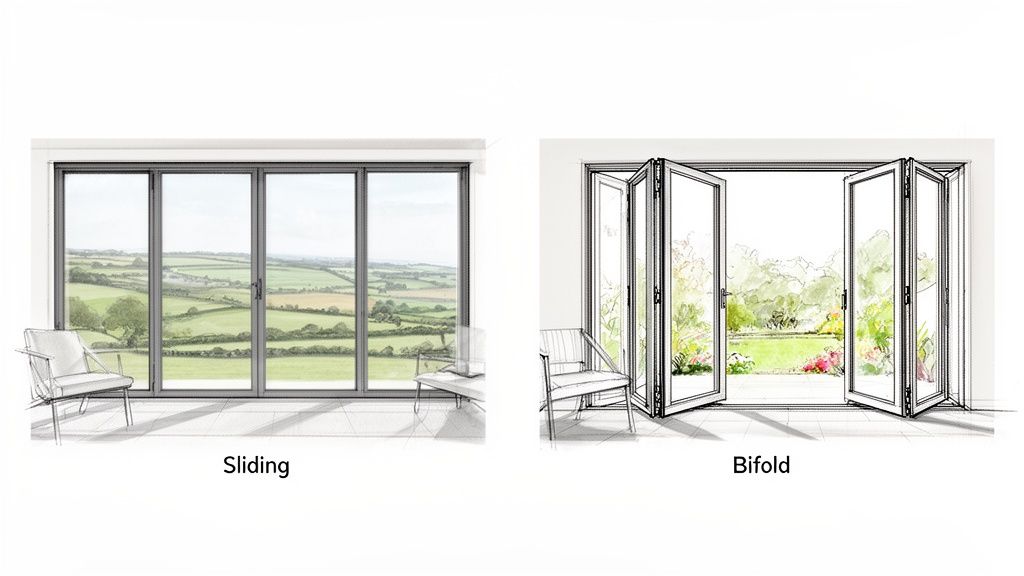
When we talk to homeowners about new patio doors, the conversation often starts with one key question: do you want to prioritise the view when the doors are closed, or create the widest possible opening when they’re open? This is the fundamental trade-off between sliding and bifold doors.
Both styles will completely transform your home, but they achieve it in very different ways. It’s a choice that comes down to how you live and what you want to see.
Sliding doors are all about minimalism and massive panes of glass. Because they have far fewer vertical frames, they essentially turn an entire wall into a huge picture frame, offering a stunning, uninterrupted vista.
Think about a home overlooking the Yorkshire Dales or with a beautifully landscaped garden. A sliding door captures that view perfectly, flooding the room with light and connecting you to the outside, even on the coldest winter days. It’s about making the scenery part of your home, all year round.
Bifold doors, on the other hand, are engineered for one purpose: to completely remove the barrier between your home and your garden. Their clever concertina mechanism allows the entire set of doors to fold back and stack neatly to one side.
This creates an incredibly wide opening—often up to 90% of the total width—that truly merges your indoor living area with your patio. If you love entertaining, hosting summer barbecues, or just want that feeling of a completely open-plan space, nothing beats a bifold. It physically and visually transforms how you use the room.
Of course, there’s a trade-off. When closed, a bifold door system has more frames and panels. While modern slimline profiles have come a long way, those vertical lines are an inherent part of the design and will be more visible than with a sliding door.
Sliding doors put the focus on the view when closed, while bifold doors are all about the wide-open connection to the outside. Understanding which of these matters more to your lifestyle is the key to making the right decision.
To help simplify the choice, here’s a quick comparison of the key characteristics you’ll want to consider for your home.
| Feature | Sliding Doors | Bifold Doors |
|---|---|---|
| Primary Appeal | Maximises the view with large, uninterrupted glass panels. | Creates a wide, seamless opening to the outdoors. |
| View When Closed | 'Picture frame' effect with minimal vertical frames. | More visible frames between each folding panel. |
| Clear Opening | Typically 50% to 66% of the total aperture. | Up to 90% of the total aperture. |
| Architectural Style | Complements modern, minimalist homes exceptionally well. | Suits both contemporary and traditional properties. |
| Best For | Framing a scenic view in areas like North Yorkshire. | Merging indoor and outdoor entertainment spaces. |
Ultimately, there is no single "best" door—only the best door for you and your property. If your dream is to sit in your living room in Harrogate and look out at an unobstructed, panoramic view of the garden, a sliding door is almost certainly the right fit. But if you imagine spending your summers in Leeds with an entire wall opened up for parties, then a bifold door will deliver that experience perfectly.
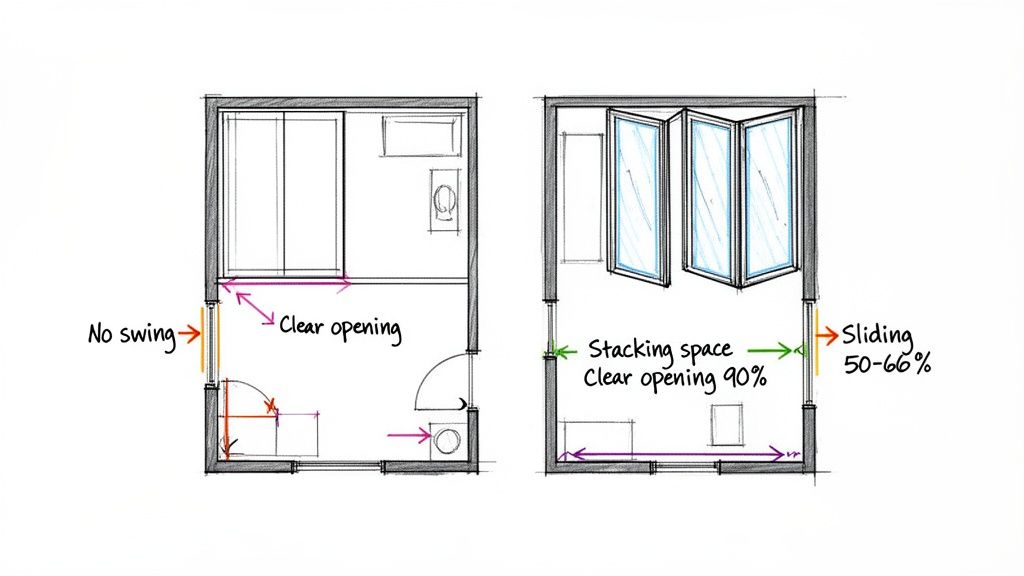
Beyond how they look, the practical impact a new set of doors has on your room’s layout is a massive consideration. It's something we talk through with every homeowner. The choice between sliding and bifold doors really boils down to how each one operates and the physical footprint it leaves behind.
This isn’t just a minor detail; it directly affects where you can place furniture, how people move through the space, and the overall feel of both your indoor and outdoor areas.
A sliding door's biggest practical plus is its clean, simple operation. The panels glide smoothly along a track, staying perfectly parallel to the wall, which means they require zero swing room. This makes them a brilliant choice for rooms where every inch counts, or for homes with smaller patios and balconies.
You can put a sofa, a dining table, or outdoor planters right up against the glass without ever having to think about blocking the door. For homeowners in cities like Hull or Nottingham with terraced houses or compact gardens, this space-saving design is often a game-changer.
Bifold doors work in a completely different way. The panels fold together in a concertina style and gather—or 'stack'—at one or both ends of the frame. This stack needs a dedicated clear zone, either inside your room or out on the patio, depending on how they're set up to open.
Before you set your heart on bifolds, you have to be realistic about this clearance. A five-panel system, for instance, could create a stack that’s 50-60cm deep. You need to make sure you have enough room for these folded panels to sit comfortably without blocking a key walkway or making your furniture layout feel awkward.
Now, here’s the most compelling reason people choose bifold doors: the incredible opening they create. When you push them all the way back, they can reveal almost 90% of the entire structural opening. It’s this unrivalled level of access that creates that jaw-dropping, seamless flow between your home and garden.
Sliding doors, by their very nature, can't compete with that. Since at least one panel has to stay in place for the others to slide behind, your clear opening is usually limited to between 50% and 66% of the total width.
The core trade-off is this: Bifold doors provide a much larger clear opening but require stacking space, while sliding doors have no spatial footprint but offer a more restricted opening.
Let’s put that into a real-world context for a home in Newcastle or Sheffield:
That functional difference is huge. If your dream is hosting summer parties where people can drift in and out effortlessly, the huge opening of a bifold is invaluable. You can see how this works by learning more about our bespoke bifolding door systems and how we can tailor them to your home.
On the other hand, if your main priority is daily access and maximising your usable floor space year-round, a sliding door is often the more practical, fuss-free solution.
Here in the North of England, whether you're on the windswept Yorkshire coast or in a bustling city like Newcastle, we all know one thing for certain: a new set of patio doors has to perform. Keeping your home warm and the elements out is a top priority, making thermal efficiency a deal-breaker when choosing between sliding and bifold doors.
A question we hear all the time is whether the multiple seals on a bifold door create weak points for draughts. It’s a fair question, but today's high-quality systems are engineered precisely for the challenging British climate. They're built with sophisticated thermal breaks inside the aluminium frames and advanced weather gaskets that create a surprisingly robust barrier against heat loss.
On the other hand, sliding doors have their own inherent thermal strengths. Their huge, uninterrupted panes of glass and minimal framing mean there are naturally fewer places for warmth to escape. This design minimises what we call 'thermal bridging' and contributes to fantastic insulation.
When you're talking about energy efficiency, the most important figure to know is the U-value. This number simply measures how well a door, window, or any material stops heat from passing through it. The rule is easy: the lower the U-value, the better the insulation.
All new doors and windows must legally meet a minimum standard, but choosing a system with an even lower U-value is a smart investment. It can lead to real, noticeable savings on your energy bills year after year. This is especially true for us in Yorkshire, where a long, cold winter can really push your heating system to its limits.
The difference can be huge. Research highlighted by the Energy Saving Trust (EST) shows that modern doors with low-U-value glass—typically around 1.0 W/m²K or less—can reduce heat loss by up to 35% compared to old-fashioned single-glazed units. For an average home, that could mean saving around £245 every year on heating. You can see more details in the full research on building performance.
It doesn’t matter how good your doors are on paper; if they aren’t installed perfectly, they won't perform. The advertised U-value is only achieved when the entire frame is sealed flawlessly against the walls of your home.
Even the smallest gaps or an imperfect seal can completely undermine the performance of your brand-new doors. This leads to cold spots, draughts, and the high energy bills you were trying to avoid. Professional installation isn't a luxury—it's an essential part of the investment.
An experienced fitter, like our teams at Glass Tech, ensures every seal is airtight and every component is perfectly aligned. This meticulous approach guarantees you get the full insulating benefits, keeping your home in Leeds, York, or Manchester comfortable all year. Taking extra steps to weatherproof your doors to save energy also helps maximise performance.
So, how do the two systems really stack up?
Ultimately, there's no single "winner" here. Both modern sliding and bifold doors offer fantastic thermal efficiency. Your decision shouldn't come down to a fear of one being draughty. Instead, focus on choosing a high-quality system with a great U-value and, crucially, making sure it’s fitted by a team of experts.
When you’re investing in beautiful new doors, you need to be confident they’re secure, built to last, and won’t turn into a maintenance headache. Both modern sliding and bifold systems are designed to be incredibly robust, but they get there in slightly different ways.
Thankfully, any old ideas about patio doors being an easy target for intruders are firmly in the past. Today’s high-quality systems are engineered with sophisticated security that gives homeowners real peace of mind, whether you’re in a quiet Harrogate cul-de-sac or a bustling part of Leeds.
Security is non-negotiable, and the good news is that top-tier sliding and bifold doors are both exceptionally secure. They are built with multiple layers of protection that are a world away from older door designs.
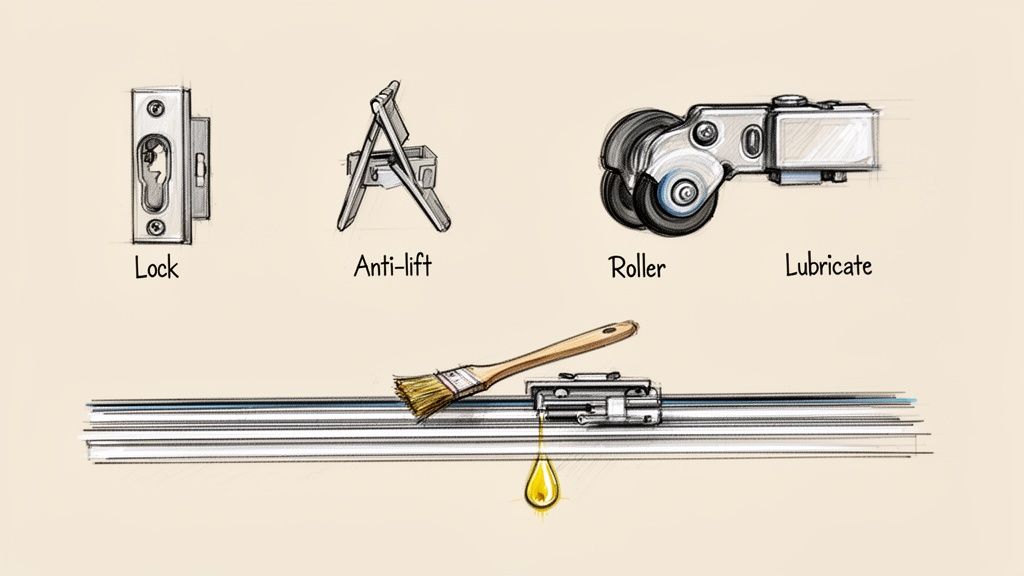
With sliding doors, the security focus is on preventing the panels from being forced apart or, crucially, lifted off their tracks. Key features you should look for are:
Bifold doors also rely on robust multi-point locking. Typically, a primary ‘traffic door’ has the main lock, while the other panels are secured with shoot-bolts that engage firmly into the top and bottom tracks. When fully locked, the entire concertina of panels becomes a single, solid, and incredibly secure wall.
A common myth we often hear is that the hinges on bifold doors are a weak point. In reality, the high-quality, precision-engineered hinges used on modern bifolds are designed to resist tampering, making them just as secure as their sliding counterparts.
The long-term performance of your doors comes down to the quality of their moving parts. Sliding doors, by their nature, have a simpler mechanism with fewer components. Their main point of wear is the set of rollers that carry the considerable weight of the glass panels. That's why we insist on high-quality stainless steel rollers, which are engineered to handle that load smoothly for decades with minimal fuss.
Bifold doors have a more complex array of parts, including hinges, pivots, and rollers that guide the folding action. While this creates that incredible opening, it does mean there are more moving parts that could, over many years, require adjustment. However, a properly engineered and professionally installed system from a specialist like us will perform flawlessly for a very long time.
For both systems, the key to durability is the frame material. Aluminium is the superior choice, as its inherent strength and resistance to warping or corrosion make it perfect for the unpredictable weather we see across Yorkshire.
A little bit of simple, regular care will keep your doors operating perfectly and looking their best. This isn't about time-consuming chores, just a few quick jobs to keep everything clean and moving freely.
For both sliding and bifold doors:
One extra tip for bifold doors:
Ultimately, whether you choose sliding or bifold doors, professional installation is the foundation of long-term security and durability. A system that is perfectly aligned, balanced, and commissioned will always perform better and last longer.
Let's talk about the numbers. Deciding between sliding and bifold doors is a big decision for your home, and having a frank conversation about the investment is the right place to start. Both options are a significant upgrade, so getting a clear picture of the costs from day one helps you plan your project budget, whether you’re in Leeds, Harrogate, or anywhere across Yorkshire.
As a general rule of thumb, bifold doors often have a higher price tag per metre than sliding doors. The reason for this comes down to their complex, finely-tuned mechanics. The intricate system of hinges, runners, and multi-point locking that allows the panels to fold away so seamlessly is a brilliant piece of engineering, and that precision is naturally reflected in the cost.
While every project we undertake is bespoke, we can give you a realistic idea of what to expect. The final figure will always depend on the size of your opening, the material you choose (our aluminium systems are incredibly popular), and your glazing specification.
So, what's the difference for a standard-sized opening?
It's so important to see this as an investment, not just a cost. A high-quality, professionally installed door system adds real value to your home, transforms how you live in it, and improves energy efficiency – providing a return you'll appreciate for years.
The quote for your new doors involves more than just the unit itself. Several on-site factors are crucial in working out the total project price, and it's something we assess carefully during our initial surveys.
Structural Work: Does a new opening need to be created, or an existing one widened? This nearly always requires a new steel lintel (RSJ) to support the wall above, which will add to the labour and material costs of the job.
Site Access: Getting the new frames and glass to the installation spot can also influence the price. A terraced house on a narrow York street or a top-floor apartment in Sheffield might require more logistical planning than a detached home with easy access to the garden.
Lead Times: It's worth remembering that bespoke systems, especially with custom RAL colours or non-standard sizes, will have a longer lead time. Planning ahead is vital, as fabrication and delivery can take several weeks. You can explore the full range of our options and specifications in our product brochure.
Ultimately, nothing impacts the long-term value of your investment more than the quality of the installation. Going with a cheaper, less experienced fitter might look like a saving at first, but it’s a false economy. An improper fit can lead to draughts, stiff operation, poor performance, and the need for expensive repairs down the line. A professional installation ensures your doors deliver on their security and thermal ratings, operate flawlessly, and stand the test of time.
Choosing between sliding and bifold doors is a significant decision, and by now, you'll have a good grasp of how each system offers a unique way to connect your indoor and outdoor spaces. The truth is, there's no single "best" door. The right choice is the one that perfectly suits your home, your lifestyle, and your vision for the space.
To help you decide, let's crystallise the key points. This final summary is designed to give you that last bit of clarity, helping you make a confident choice for your property.
Sliding doors are, without a doubt, the ideal solution when your primary goal is to maximise the view and conserve precious floor space. When closed, they act like a living piece of art, framing your garden or landscape with vast, uninterrupted panes of glass.
You should be leaning towards sliding doors if:
Bifold doors are the undisputed champion of creating a truly seamless transition. They are designed for homeowners who want to completely erase the barrier between inside and out, creating one large, flowing area for living and entertaining.
Bifold doors are likely the right choice for you if:
This decision guide helps visualise how factors like your budget and the complexity of your project influence the final cost.
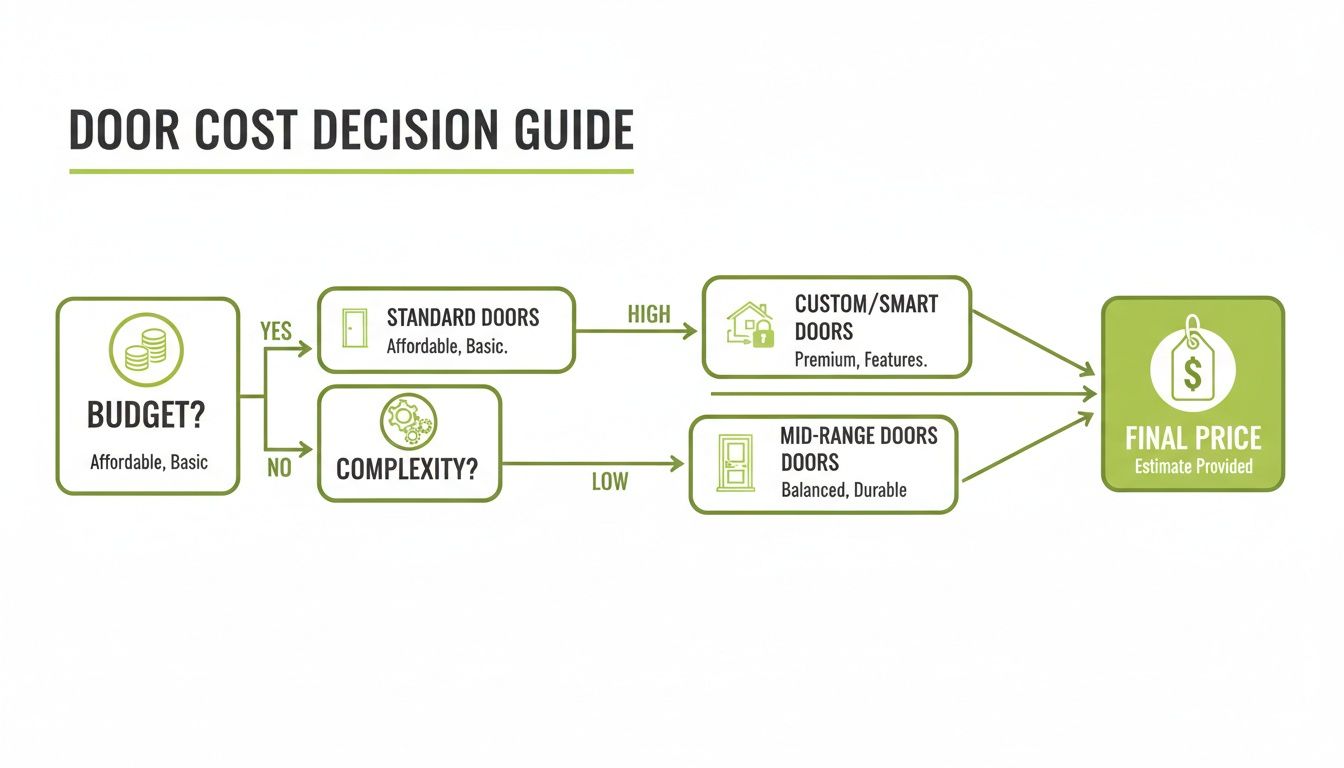
As the guide illustrates, while bifold doors often have a higher starting cost due to their complex hardware, it’s often the extent of structural work needed for any large opening that has the biggest impact on the final price.
Still unsure which is the right fit for you? The best way forward is always with expert advice tailored to your specific property. At Glass Tech, we have over 20 years of family-run experience in designing and installing beautiful, high-performance glazing across Leeds, Manchester, Newcastle, and the whole of Yorkshire.
Let us help you bring your vision to life. Contact our team today for a free, no-obligation survey. We can discuss your ideas, assess the space in person, and provide a personalised recommendation that fits your home, your lifestyle, and your budget.
Find out more and get in touch at https://www.hgwsolutions.co.uk.

A professional team of experts providing glass and glazing solutions covering the whole of Yorkshire & more...
Whether it's Leeds, York, North Yorkshire, Birmingham, Hull, Liverpool, Machester, Newcastle or Nottingham, get in touch to find out how we can help you with your bespoke glass project.