
You see it first thing in the morning. A band of condensation along the bottom edge of the bedroom window. The bathroom glass stays misted long after the shower. In the kitchen, the corners near the frames never seem fully dry in winter.
Most homeowners in Yorkshire put that down to the weather, old habits, or “just one of those things”. In practice, it points to a ventilation problem. Modern homes hold heat far better than older ones, but that tighter envelope also traps moisture from cooking, washing, drying clothes, and breathing.
That is why upvc windows with vents have gone from being an optional detail to a practical necessity. For many households in Leeds, York, Hull, Manchester and Newcastle, the conversation is no longer whether vents are worth having. It is whether the windows are fitted properly, compliant, and suitable for the property.
You fit new windows to make the house warmer and quieter, then the bedroom glass starts streaming each morning and the bathroom ceiling never seems fully dry. I see that across Yorkshire all the time, especially in retrofit jobs where older homes have been tightened up but the ventilation has not been updated to match.
The issue is rarely a dramatic leak. It is ordinary moisture from showers, cooking, drying clothes and sleeping, building up day after day in a house that now holds heat and air far more effectively than it used to. Left alone, that shows up as condensation on the glass, mould around reveals, stale air in closed rooms, and finishes that do not last as well as they should.
Background ventilation gives that moisture a managed escape route while the window stays shut. That matters in winter, overnight, and on exposed elevations in places such as Leeds, York, Hull, Manchester and Newcastle, where opening a sash wide is not always realistic.
Since the 2022 updates to Part F of the Building Regulations, this has become more than a comfort issue. On many replacement window projects, especially where existing vents are being removed or windows are being upgraded in a more airtight property, ventilation provision needs proper attention. Homeowners in the North often only hear about that requirement once quotes are on the table. It is better to deal with it at the specification stage than discover after fitting that the new windows are neat, warm, and still not compliant.
If you want a broader homeowner-friendly explanation of why this matters, this guide on Indoor Air Quality 101 is a useful companion read.
Good ventilation should be quiet, predictable, and practical to live with. A house should not depend on someone remembering to crack a window open every morning.
The first signs are usually small, but they are consistent:
In practice, these are the warning signs that the property needs steadier airflow, not just more heating or more wiping down. Upvc windows with vents help control that background moisture before it turns into a decorating problem, a mould issue, or a failed installation choice on a regulated retrofit.
A trickle vent is a small controllable ventilator fitted into or onto a window frame. It allows a limited amount of fresh air to move through the window assembly while the main window stays closed and secure.
That sounds minor, but it changes how a room behaves. Instead of relying on occasional bursts of ventilation, the room gets a low-level flow of air in the background.
Think of a modern insulated house as a well-made box. That is good for retaining heat, but boxes need a managed way to breathe. Without it, moisture lingers.
Cooking releases vapour. Showers release vapour. Drying clothes indoors releases plenty more. Even sleeping in a closed bedroom adds moisture to the air. In older draughtier homes, some of that escaped through gaps around frames and fabric. Newer uPVC installations are much tighter, which is better for efficiency but less forgiving if ventilation is poor.
Most trickle vents have a simple internal slider or flap. You open them to allow background airflow and close or reduce them if conditions call for it. Used properly, they support daily comfort without leaving the whole window open.
Three practical points matter to homeowners:
A vented window is not a faulty window. It is a sealed window with a controlled path for air, which is exactly what many modern homes need.
When people search for upvc windows with vents, they are often really asking a bigger question. How do I keep the house warm, compliant and free from recurring condensation? The vent is one key part of that answer.
Not all vents are fitted the same way, and the right choice depends on the window profile, the room, and whether you are replacing the whole unit or adapting an existing one.
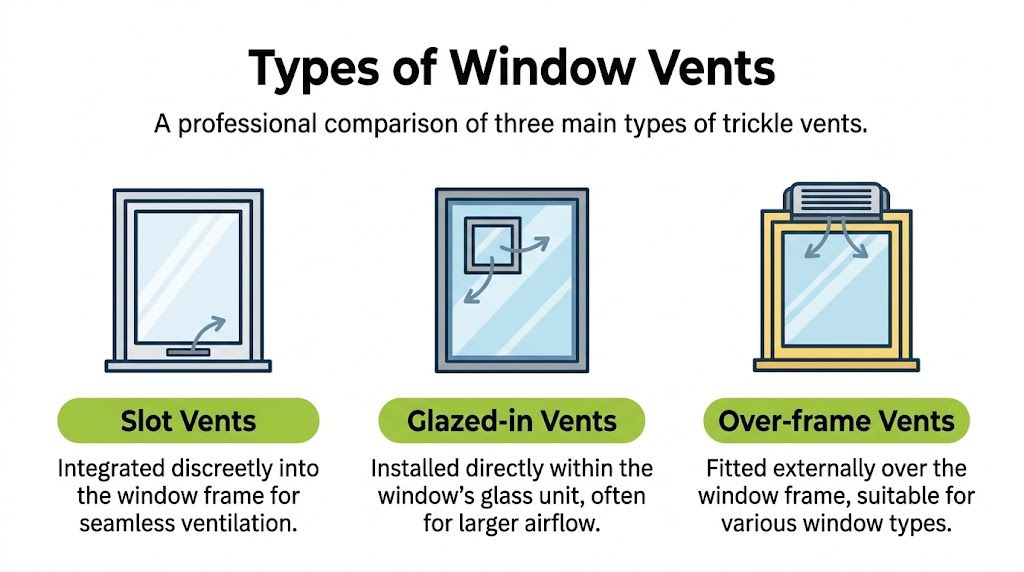
Slot vents are the type most homeowners see on new uPVC windows. They are machined into the head of the frame before assembly and offer a neat integrated look. According to this overview of vent types, slot vents typically provide 4000-12000 mm² equivalent area depending on length and configuration, and they are well suited to compliant pre-planned fabrication work: https://www.shengxinaluminium.com/understanding-upvc-windows-ventilation-key-concepts_n515
They tend to be the cleanest visual option. If the window is being manufactured from scratch, they are often the obvious choice.
Over-frame vents sit externally over the top of the frame rather than being machined through it in the same way. They are often useful on retrofit projects where altering the frame directly is not ideal. The same technical overview notes 5000-8000 mm² equivalent area as a typical airflow range for over-frame options: https://www.shengxinaluminium.com/understanding-upvc-windows-ventilation-key-concepts_n515
These can be a sensible answer on older properties where the installer wants to avoid unnecessary disruption to the frame construction.
Through-frame vents are more direct. They are drilled fully through the profile and can provide higher airflow. The same source lists capacities up to 20000 mm² equivalent area, but also notes the trade-off. If sealing is poor, infiltration risk increases: https://www.shengxinaluminium.com/understanding-upvc-windows-ventilation-key-concepts_n515
On some homes, especially where more ventilation is needed, they can work well. On a rushed or poorly judged job, they can create more problems than they solve.
| Vent Type | Best For | Aesthetics | Performance (Airflow) |
|---|---|---|---|
| Slot vents | New uPVC window manufacture, clean modern installations | Most discreet | 4000-12000 mm² EA |
| Over-frame vents | Retrofit work and frames where machining is less suitable | More visible | 5000-8000 mm² EA |
| Through-frame vents | Higher airflow requirements and certain specialist retrofits | Least discreet | Up to 20000 mm² EA |
For homeowners comparing specifications, a product brochure such as https://www.hgwsolutions.co.uk/assets/brochures/HGS-ProductBrochure2022.pdf can help you see how vented and non-vented glazing products sit within a broader window and door package.
In practical terms:
A good installer does not start with the vent type. They start with the room, the frame, and the compliance requirement.
The biggest win is straightforward. Better background airflow means less lingering moisture and a lower chance of condensation turning into mould.
That matters in the North where homes spend long periods shut up through colder weather. It also matters in bedrooms, kitchens and bathrooms where moisture builds up quickly.
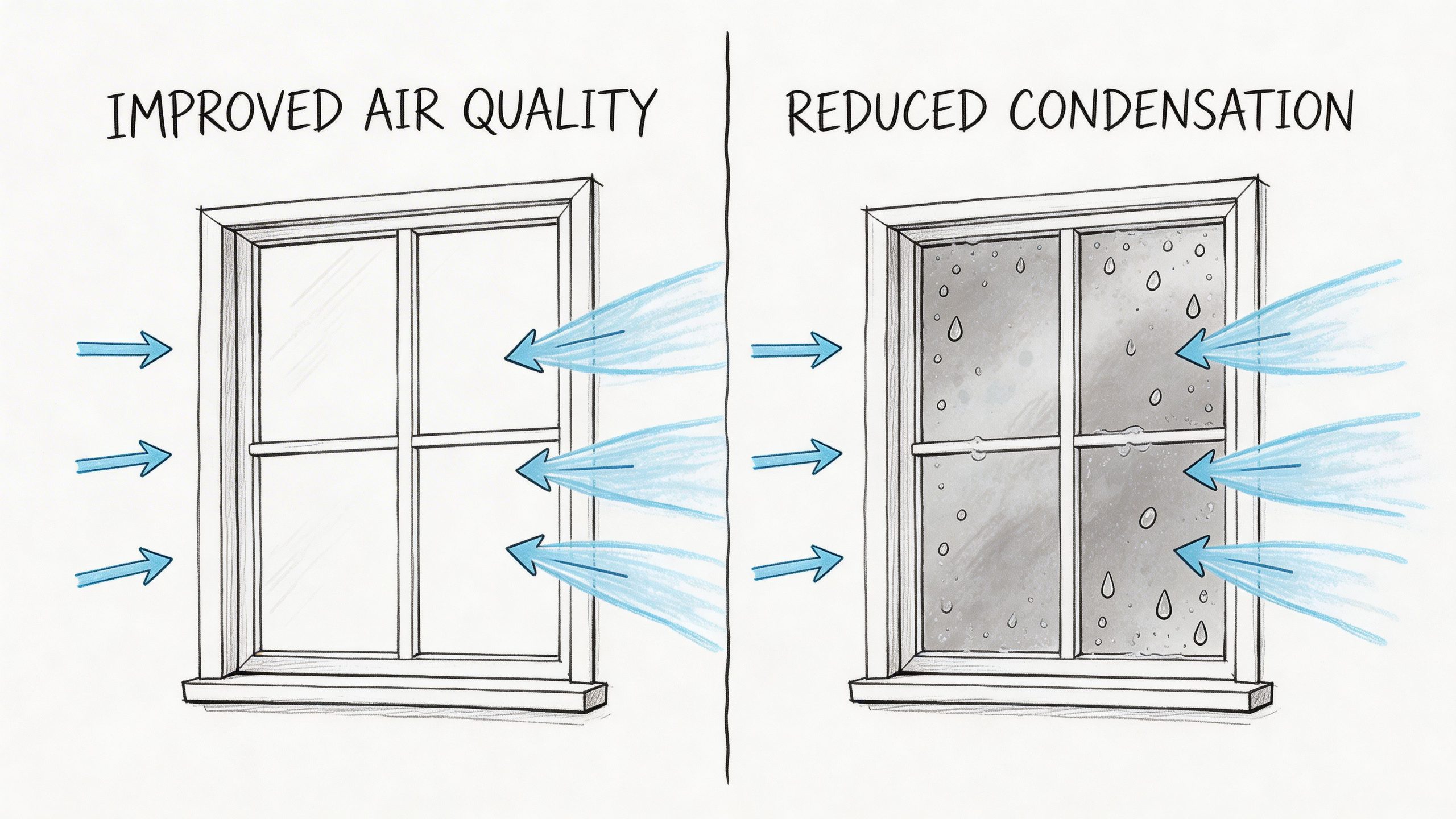
In the UK, vented uPVC windows support energy efficiency as well as moisture control. One market summary notes that before the 2022 rule change, airtight uPVC installations in Yorkshire contributed to mould issues in 20-25% of homes, and that balanced airflow through vents can help save 10-15% on bills by reducing reliance on more energy-intensive ventilation methods: https://www.mordorintelligence.com/industry-reports/global-upvc-doors-and-windows-market
That is the part homeowners often miss. Moisture is not only a comfort issue. It can undermine how well a room performs.
There are valid concerns. I hear the same ones repeatedly.
A properly specified vent should provide controlled airflow, not a harsh draught. Problems come from poor product choice, poor fitting, or vents being added with no thought for room use and exposure.
They can affect acoustics if the wrong vent is used in the wrong location. This is one reason exposed roads and urban settings need more care in specification.
No in any normal practical sense. A trickle vent is not a substitute opening into the home. It is a purpose-made ventilator within the window system.
The quality of the overall glazing package still matters. If noise control is already a concern, options such as secondary glazing can form part of the wider solution, particularly in older properties where full replacement is not always the best route.
The mistake is treating vents as a universal add-on. They perform best when they are chosen as part of the whole window strategy, not bolted on as an afterthought.
The honest view is simple. Vents improve liveability, but only when the installer takes room use, orientation, frame type and local exposure seriously.
The legal position changed in a way homeowners cannot ignore.
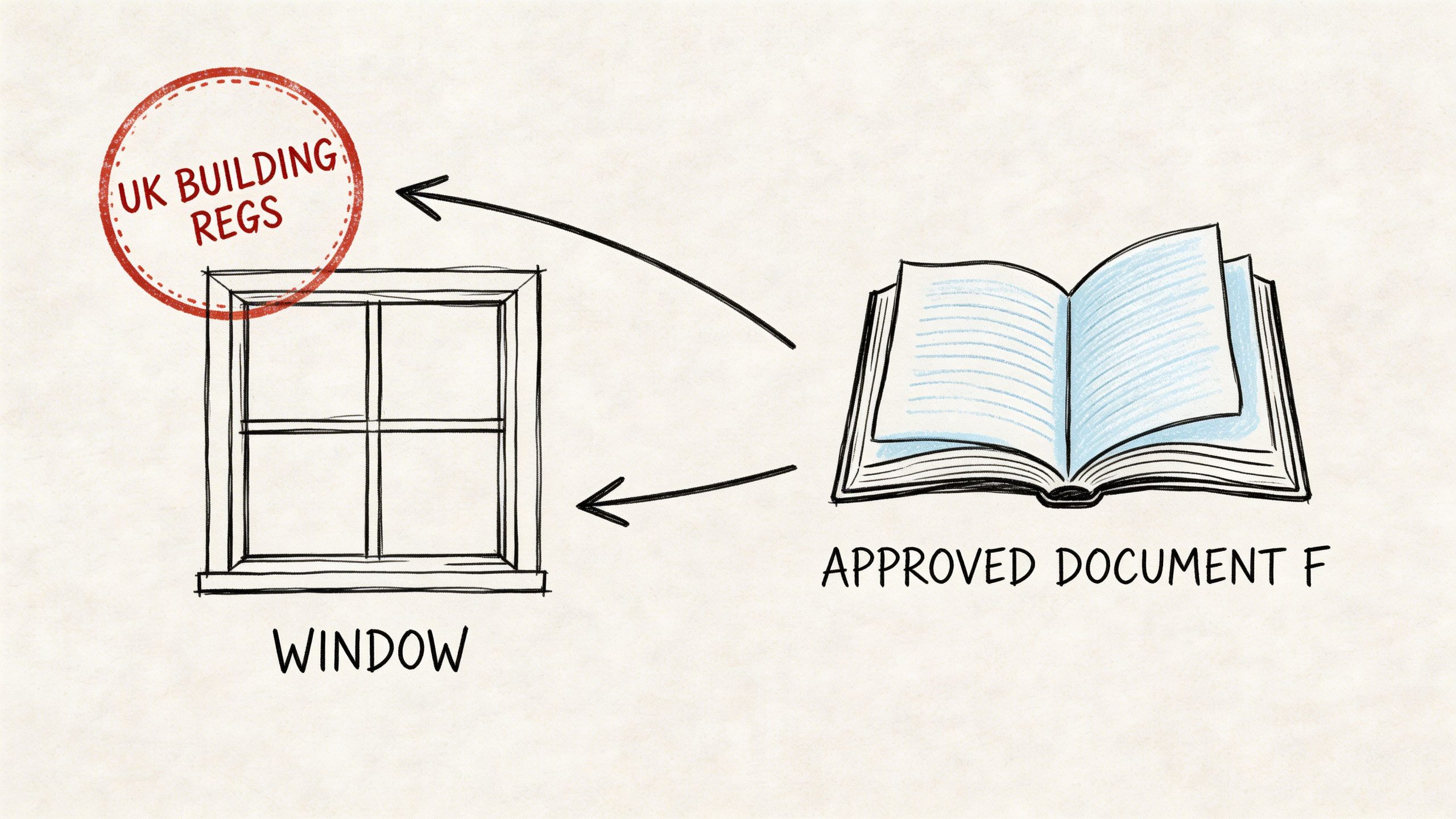
Since 15 June 2022, Approved Document F has required trickle vents on all new and replacement uPVC windows, including replacement work where the original windows did not have them. That applies across domestic and commercial property, including Yorkshire, and non-compliant installations can fail FENSA certification, with knock-on consequences for legal paperwork and insurance validity. The same guidance notes typical background ventilation of 4000-8000 mm² equivalent area per room: https://www.lockwoodwindows.co.uk/blogs/trickle-vents-all-you-need-to-know
If you replace windows now, the installer cannot copy what was there before if it no longer meets the current rule set. “The old ones didn’t have vents” is not a route around compliance.
That catches people out on renovations. They assume a like-for-like replacement means no design changes. Under current regulations, ventilation has to be addressed.
Another trade-focused guide gives the room-level figures used for replacement work under Part F. It states that habitable rooms require 8000 mm² equivalent area per room, while kitchens and utility rooms need 4000 mm² EA plus mechanical extract where applicable. It also warns that non-compliance can lead to remedial costs of up to £5,000 per dwelling: https://www.dekkowindows.com/news/a-trade-guide-to-compliance-integrating-double-glazed-window-vents
That is why a proper survey matters. Vent choice is not just about what fits neatly on the frame. It is about meeting the room’s requirement.
For a quick visual overview of the regulation background, this video is useful:
Homeowners tend to focus on the visible finish. Building control and certification focus on whether the installation is compliant. Those are not always the same thing.
A neat-looking window can still be a wrong one if the ventilation provision is missing or undersized.
If a quote for replacement windows barely mentions ventilation, ask more questions before signing anything.
For many homeowners, the actual decision is not “vents or no vents”. It is whether to retrofit vents into existing windows or move to full replacement windows with integrated ventilation.
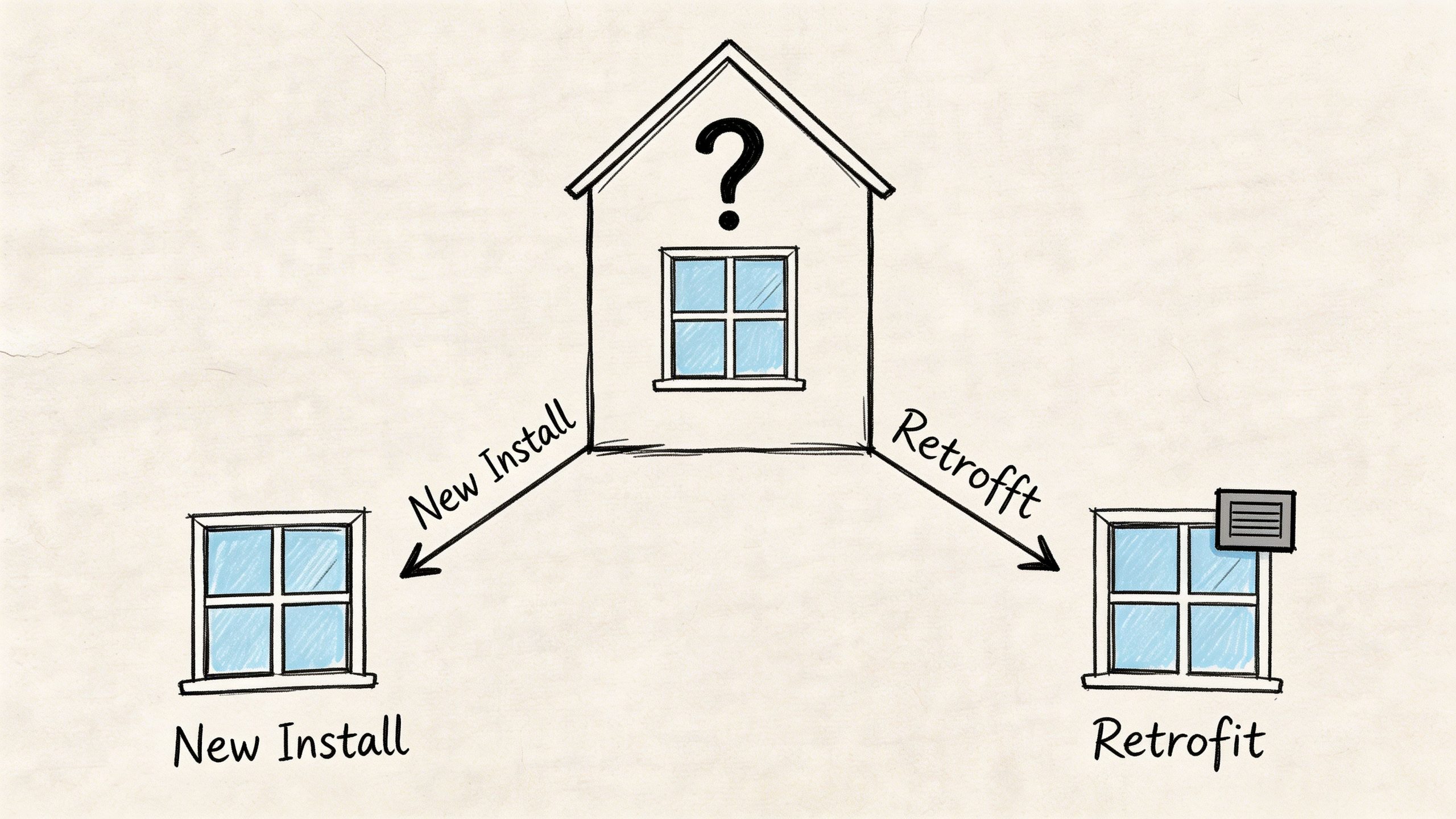
Retrofitting can be sensible if the current frames are otherwise sound, the glazing still performs adequately, and the main issue is lack of compliant background ventilation.
That route can be useful on older Yorkshire homes where the windows are serviceable but moisture control is poor. It can also help if you are phasing wider refurbishment works rather than replacing everything at once.
Replacement offers better long-term value when the existing windows are tired, poorly insulated, awkward to adapt, or already close to the point where other repairs are needed.
A full new system gives the installer more control over vent integration, finish and overall performance. It also avoids forcing modern compliance into a frame that was never designed for it.
A practical decision comes down to these points:
If you are reviewing broader exterior upgrades, it helps to compare the windows alongside other products in one place, such as https://www.hgwsolutions.co.uk/windows-composite-doors.html
The regulatory backdrop matters here. Guidance aimed at retrofit projects in Yorkshire notes that since the 2022 Part F change, all replacement windows require vents, and warns of fines up to £5,000 under the Building Safety Act 2022 for non-compliant work, alongside the risk of EPC rating drops: https://www.framemaster.co.uk/blog/how-to-install-trickle-vents-upvc-windows/
If the windows are good, retrofit may be enough. If the windows are average at best, replacement pays back in fewer compromises.
That judgement needs a site survey, not guesswork. Older terraces in Leeds, exposed homes near the coast, and mixed-era properties around Harrogate or York rarely suit a one-size-fits-all answer.
Vents are low maintenance, not no maintenance. If they clog up, airflow drops and the whole point of having them starts to fade.
The good news is that care is simple. Most homeowners can stay on top of it with a quick seasonal check.
A vent that feels stiff, whistles unusually, or seems to have little effect may be dirty. It may also point to a fitting issue, especially after other building work nearby.
This often comes up during wider renovation projects. If you are coordinating multiple trades, it is worth using a refurbishment checklist so details like ventilation do not get missed. A broader service page on Property Refurbishments gives a useful sense of how these jobs overlap in real homes.
Vents fail without obvious signs. They do not break in dramatic fashion. They just move less air, collect more dirt, and stop doing the job you expected.
Trickle vents help background airflow. They do not replace fan maintenance, sensible heating patterns, or basic moisture control habits such as using lids on pans and drying clothes with care.
If condensation returns, do not assume the vent itself is faulty. Check the room routine as well as the hardware.
Not when they are properly specified and used as intended. The point is controlled background airflow without opening the whole sash. That is very different from leaving a window wide open in winter.
If a room feels noticeably draughty, the issue is fit, product choice or a wider insulation problem rather than the concept of window ventilation itself.
This is a fair question, especially on exposed sites. In Yorkshire’s harsher conditions, poorly fitted vents can increase noise ingress by 5-10dB in windy areas, but modern concealed or acoustic-baffled designs are tested to standards such as 1100Pa for wind-driven rain to reduce leakage and weather-related issues: https://colinssashwindows.co.uk/blog/trickle-vents-in-windows-better-air-quality-less-condensation/
That is why exposed locations need careful product selection. A vent that is fine on a sheltered suburban street may be wrong for a coastal or high-wind setting.
Possibly, yes, if the vent is basic and the site is already noisy. That is the honest answer.
The better answer is that modern vent design has improved a lot. Acoustic-baffled and concealed options can reduce that compromise significantly. On busy roads or urban positions, ask specifically about acoustic performance rather than assuming every vent behaves the same way.
Often yes, but not always with the same method. Some frames suit retrofit neatly. Others are better replaced altogether.
The decision should be based on the existing frame construction, room use, exposure and whether the result will be compliant and tidy. Good installers inspect first and recommend second.
Yes. The same weather-focused guidance notes that regular cleaning is important because blockages can reduce airflow by 20%. Dust, airborne particles and moisture-related grime build up more quickly than many homeowners expect: https://colinssashwindows.co.uk/blog/trickle-vents-in-windows-better-air-quality-less-condensation/
A simple clean and function check a few times a year is enough.
No. Closing them for long periods tends to bring the condensation problem back.
You may adjust them to suit weather and comfort, but in most homes the better approach is to let them provide the background airflow they were designed for.
If you are weighing up retrofit vents, full replacement windows, or a broader glazing upgrade across Yorkshire, Newcastle, Manchester or Nottingham, Glass Tech can help with practical advice, a proper site survey, and compliant installation customized to the property rather than a one-size-fits-all quote.

A professional team of experts providing glass and glazing solutions covering the whole of Yorkshire & more...
Whether it's Leeds, York, North Yorkshire, Birmingham, Hull, Liverpool, Machester, Newcastle or Nottingham, get in touch to find out how we can help you with your bespoke glass project.