
You’re staring at a spot in the house that feels unresolved. The front door lets everyone see straight into the hall. The stairwell gets daylight, but no character. An internal door does the job, yet looks flat and ordinary. That’s where patterned stained glass earns its place.
Used well, it doesn’t feel old-fashioned or theatrical. It gives a home privacy, softness and a sense of craft that standard clear glazing cannot. In Northern homes especially, where light can be cooler and more directional, patterned glass can change how a room feels from morning through to dusk.
For homeowners looking at staircase renovations, feature glazing, or refined period details in places like Harrogate, York, Leeds and Newcastle, the appeal is straightforward. You keep the light. You gain texture, colour and individuality. And you stop relying on bland off-the-shelf solutions that could belong in any house on any street.
Many people still picture stained glass as something reserved for chapels, Victorian villas, or grand civic buildings. That’s understandable. Some of the best-known examples sit in those settings. But in domestic design, patterned stained glass has moved well beyond that narrow image.
In a modern Leeds townhouse, a single glazed panel beside the entrance door can soften an otherwise crisp, minimal hallway. In a Harrogate terrace, a coloured fanlight can bring back lost character without making the whole property feel stuck in the past. In a new-build near Newcastle, a geometric landing window can introduce warmth into a space full of plaster, oak and steel.
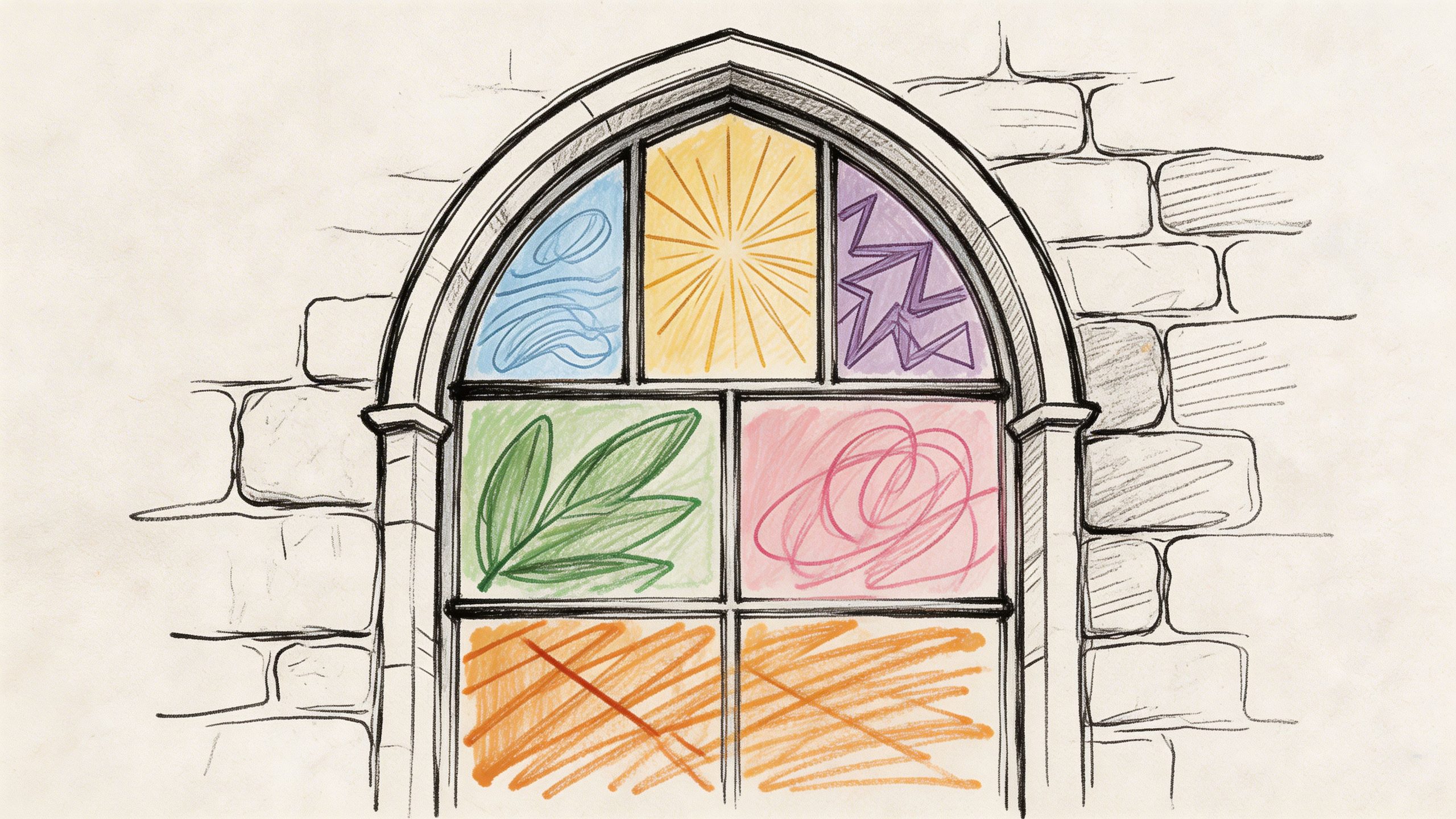
The change isn’t only visual. It’s atmospheric.
Clear glass gives you openness. Patterned stained glass gives you openness with restraint. It filters. It obscures. It catches the daylight and spreads it differently across plaster, timber and stone. That matters in homes where people want privacy at the front elevation or want a staircase to feel like a designed feature rather than just a route between floors.
Patterned stained glass works best when it solves a real problem first, then adds beauty on top.
That problem might be overlooking from the street, a dark stair turn, or a plain internal partition that needs more personality. When the panel is sized properly and the pattern suits the architecture, the result feels settled. It looks as though it belongs there.
At this point, many homeowners hesitate. They worry stained glass will fight against a modern scheme.
Usually, the opposite is true. Traditional floral motifs suit period entrances and Edwardian hallways. Stronger geometry works well in contemporary glazing. Restrained colour blocking can sit comfortably beside oak treads, black hardware and slimline glazing systems often used in Glass Balustrades Yorkshire projects and staircase refurbishments across the North.
The point isn’t to recreate a church window in a suburban landing. The point is to borrow the craft, the light-play and the permanence of the material, then shape it for the way people live now.
Good patterned stained glass looks effortless. It never is. Every strong panel depends on disciplined design, accurate cutting and a full understanding of how glass, lead, solder and support all work together.
At its best, it’s a jigsaw of light. Each piece must fit. Each line has to earn its place. If the drawing is weak, the panel looks fussy. If the construction method is wrong, the design won’t perform as it should in the space.
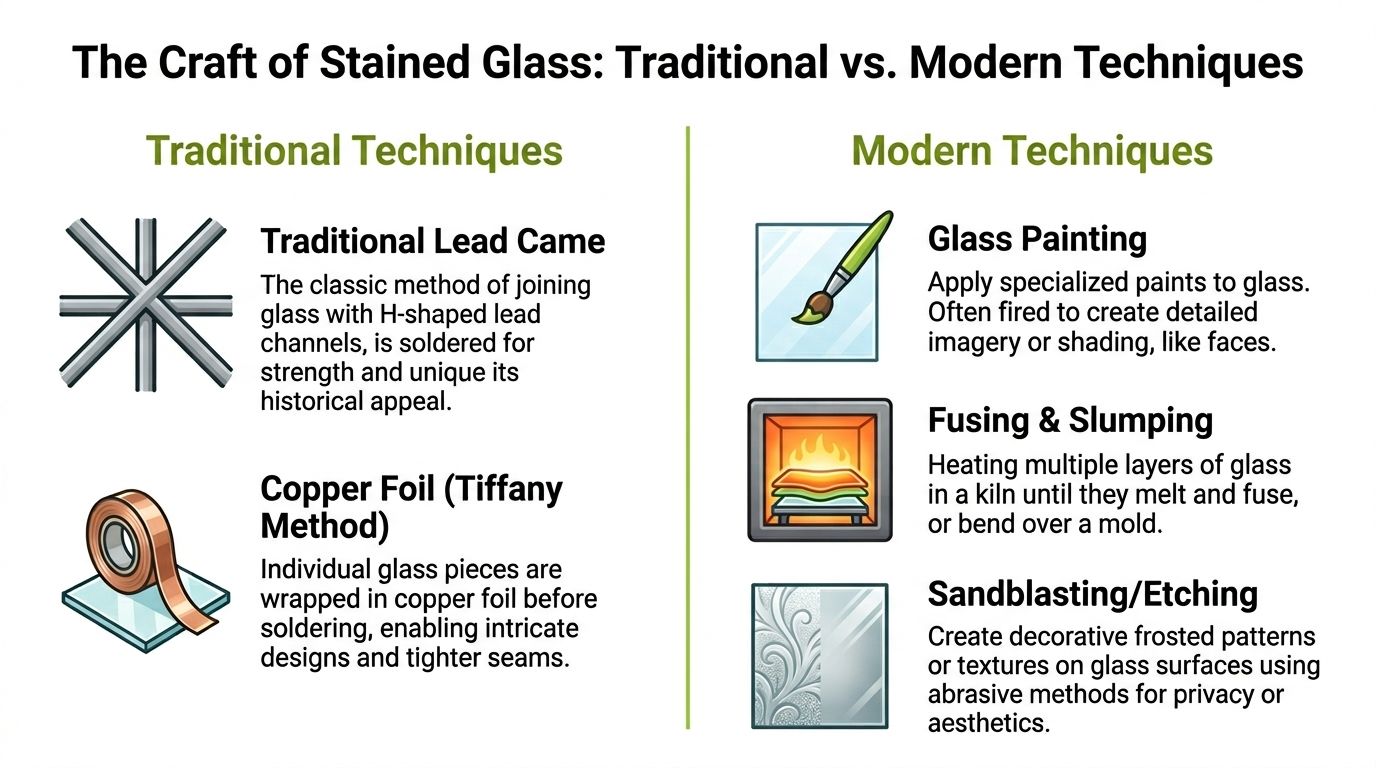
The two methods most homeowners hear about are lead came and copper foil.
Lead came is the traditional method. Glass pieces sit within H-shaped lead channels, then joints are soldered. This gives the panel its familiar linework and a strong architectural rhythm. For door panels, fanlights and larger window sections, lead came often feels right because the lines are confident and the finished piece has visual weight.
Copper foil, sometimes called the Tiffany method, wraps each piece of glass in copper tape before soldering. This allows finer detail and tighter curves. It’s useful for intricate motifs and smaller decorative pieces, though in domestic architectural glazing it needs careful judgement. Too much detail can become visually busy once daylight hits from behind.
A simple comparison helps:
| Method | Best suited to | Visual character | Watch out for |
|---|---|---|---|
| Lead came | Doors, fanlights, stair windows, larger panels | Bold lines, traditional structure, strong pattern definition | Heavy linework can overwhelm very small designs |
| Copper foil | Intricate details, smaller decorative panels, tighter curves | Delicate, refined, more illustrative | Can look fussy in large architectural settings |
One of the great strengths of traditional stained glass is that the colour is part of the glass itself, not a surface trick. According to this stained glass material data sheet, traditional glass batches are made with approximately 70% silica, 15% alkali and 15% stabilisers, with metallic oxides added for colour. The same source notes that cobalt at 0.1% to 1% creates deep blues, while colloidal gold at 0.01% to 0.1% produces ruby red.
That matters in practice. The colour sits within the material, so it doesn’t behave like a decorative coating that sits on top. The same source points to medieval panels surviving for 700+ years with minimal fading, which is why well-made stained glass still carries a sense of permanence.
Style should follow architecture, not trend.
For period homes, Victorian and Arts and Crafts influences often work well. Think climbing stems, tulip heads, repeating leaves and softly textured obscured glass around the coloured sections. Art Deco panels suit houses with stronger symmetry and cleaner proportions. They rely on stepped forms, sunbursts and disciplined geometry.
For newer homes, simpler usually wins. Broad shapes. Repeated lines. Limited colours. Enough pattern to create identity, not so much that it competes with everything else in the room.
If you’re refining colours for a decorative scheme, this guide to an Art Nouveau color palette is useful because it shows how muted greens, amber tones, dusky reds and blue-greys can sit together without becoming harsh.
Patterned stained glass today isn’t limited to one classic approach. It often sits alongside:
Workshop reality: the best design on paper can still fail if the lead lines ignore structure.
That’s why practical glass design starts with location. A front door panel takes different stresses from an internal screen. A staircase window behaves differently from a bathroom casement. The right technique depends on where the panel is going, how large it is, and what it must do every day.
The biggest mistake people make is thinking patterned stained glass belongs only in a window opening. It can work there beautifully, but that’s only one application. In a house, the best placements are usually the ones that solve privacy, light flow or visual balance.
A decorative panel can turn a forgotten area into a feature without adding clutter. That’s why it suits homes across Yorkshire, Hull, Leeds and the North East effectively. Many properties already have spots where daylight is available but character is missing.
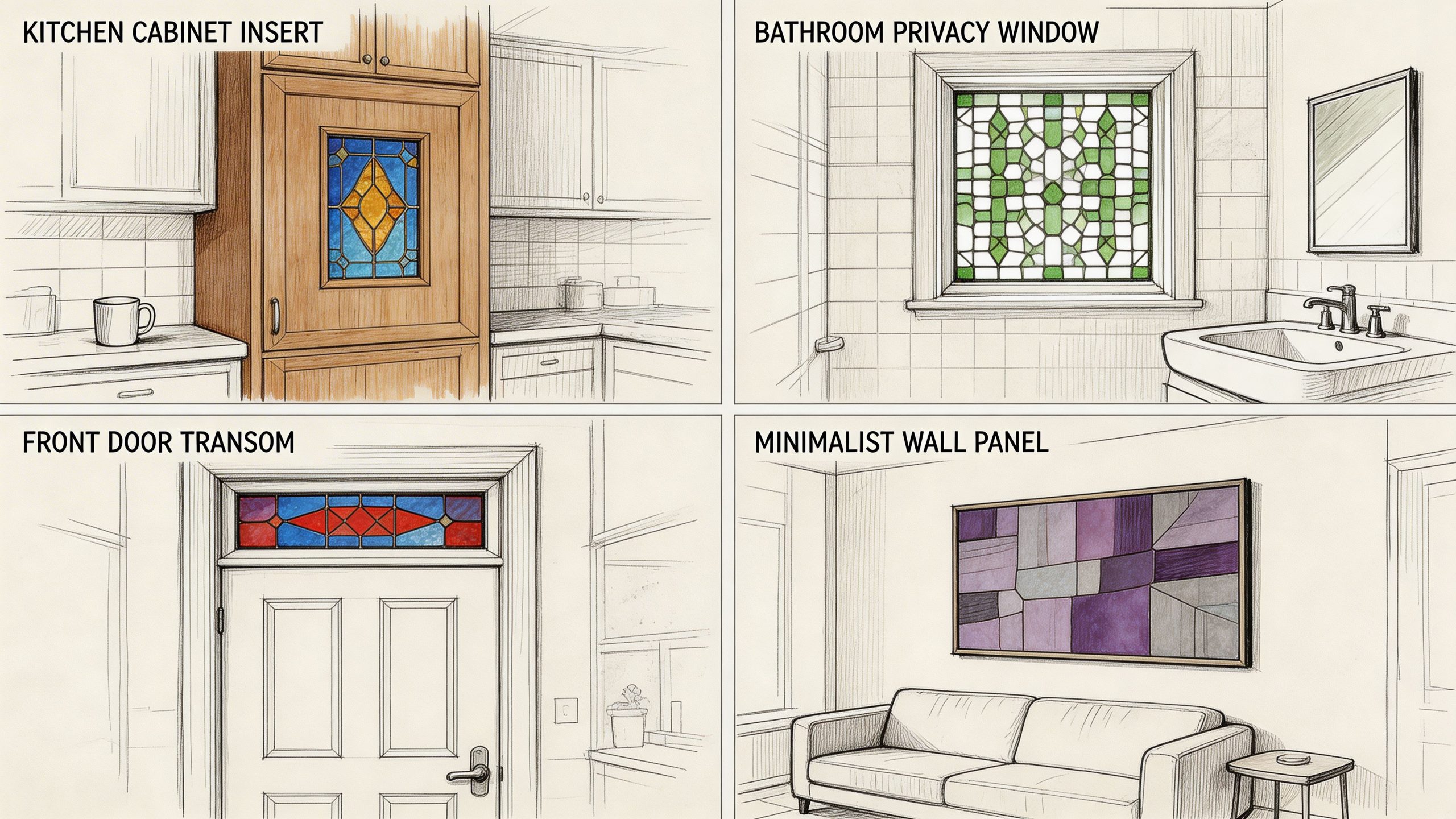
Entrance glazing is often the strongest place to start.
A front door with patterned stained glass does three jobs at once. It lifts kerb appeal, protects privacy and improves the quality of light in the hall. That matters in compact entrance spaces, especially on terraced streets where the front door opens straight into the main circulation route.
Good entrance glass usually has a clear hierarchy. The pattern should be readable from outside, but not so dense that the door looks heavy. Textured clear sections help. So do restrained colour accents instead of full saturation across the whole panel.
This is especially effective in period streets around York and Harrogate, where original proportions deserve more than plain obscured units.
Internal patterned glass is one of the most underused options in modern homes.
It works well where people want separation without complete shutdown. A pantry door, a utility room door, a study screen or a glazed partition between hall and kitchen all benefit from some obscurity and a bit of craft. You still borrow light from one room to another, but you lose the harshness of a plain transparent opening.
A few practical rules help here:
Bathrooms are an obvious fit, but the treatment needs restraint.
For a bathroom, privacy comes first. Pattern and texture should do the heavy lifting, with colour used sparingly unless the room has a strong design scheme built around it. A softly leaded panel with textured obscured glass can feel far more timeless than a novelty pattern or a heavily frosted unit.
This is also a sensible route for side windows in urban homes, especially where neighbours are close. Sheffield, Manchester and Newcastle homes often need light without exposure. Decorative glazing handles that much better than blinds left half-shut all day.
Patterned stained glass gains particular interest in staircases and landing features.
A staircase is a transitional space, but it shouldn’t feel like an afterthought. If the stairwell already has natural light, a decorative panel can turn that light source into the focal point of the entire circulation area. If the stair renovation includes contemporary glazing, the contrast can be even stronger. Traditional pattern language paired with modern glass detailing gives a result that feels layered rather than themed.
In practical terms, there are several ways this works:
| Location | What it adds | Best approach |
|---|---|---|
| Landing window | Colour, privacy, a strong focal point | Geometric or floral panel scaled to the opening |
| Side screen near stairs | Separation without darkening the hall | Textured patterned glazing with selective colour |
| Feature panel alongside modern stair detailing | Contrast between old craft and new materials | Cleaner pattern language with disciplined colour use |
For homeowners exploring staircase refurbishments, this is often where the design feels most personal. Clear structural glazing gives openness. Patterned stained glass gives identity.
A short visual example helps show how decorative glass can sit comfortably in a domestic setting:
Not every spot benefits from stained glass.
It’s usually a poor choice where a view is the whole point, such as full-width rear glazing facing a garden. It can also look forced if repeated too often around the house. One strong placement is memorable. Too many and the home starts to feel overdesigned.
Use patterned stained glass where you want filtered light and a moment of focus. Don’t use it where you need openness, long views or visual quiet.
That balance is especially important in homes already using frameless glazing or Glass Balustrades Newcastle style contemporary details. Decorative glass should complement the architecture, not compete with it.
The charm is obvious, but the practical case is just as strong. Well-designed patterned stained glass earns its keep in daily use. It improves privacy, changes the quality of incoming light and can support property appeal when handled with care.
Curtains and blinds block views, but they also block much of the light. Decorative glass does something better. It interrupts direct sightlines while still allowing daylight to move through the opening.
That’s why it suits front doors, side returns, stair windows and bathrooms effectively. In built-up areas, where houses sit close to the pavement or neighbouring walls, that balance matters more than people realise. You don’t have to choose between exposure and gloom.
A useful addition in some properties is secondary glazing. Where insulation or sound control is also a concern, secondary glazing options can sit alongside decorative panels in the wider design strategy.
Light through patterned glass isn’t flat. It becomes gentler and more atmospheric.
Textured and coloured sections break up sharp daylight, especially when the sun hits at an angle. That can make entrance halls feel warmer and stair landings feel less stark. It also helps rooms that suffer from glare at certain times of day.
For homeowners thinking about broader glazing comfort, it’s also worth understanding how UV protection window treatments can help in rooms where fabrics, flooring or artwork need extra shielding. Patterned stained glass changes the feel of light, while other treatments can address sun management in a more targeted way.
Decorative architectural details still matter in the housing market. A generic interior is easy to forget. A house with well-judged original or bespoke features tends to stay in the mind.
Historic England notes in its guidance on adding value to your historic home that a 2025 UK heritage property report found homes retaining or thoughtfully restoring original features such as stained glass panels can command a higher valuation, up to 15% in some cases, especially in conservation areas common in places like York and Harrogate.
That doesn’t mean every coloured panel adds value automatically. Poor design can do the opposite. But considered work, suited to the architecture, can make a property more distinctive and more desirable.
Patterned glass isn’t a shortcut. It needs proper design judgement.
If the panel is too dark, the room can feel heavy. If the pattern is too busy, it dates quickly. If the colours fight the rest of the house, it becomes the wrong focal point. The practical perk comes from restraint. Good patterned stained glass improves the way a house works. Great patterned stained glass does that while looking effortless.
The most useful way to judge patterned stained glass is to see how different styles behave in real homes. The right answer for a Victorian terrace in York won’t be the right answer for a sharp-edged renovation in Newcastle. That variety is exactly what makes the material so versatile.
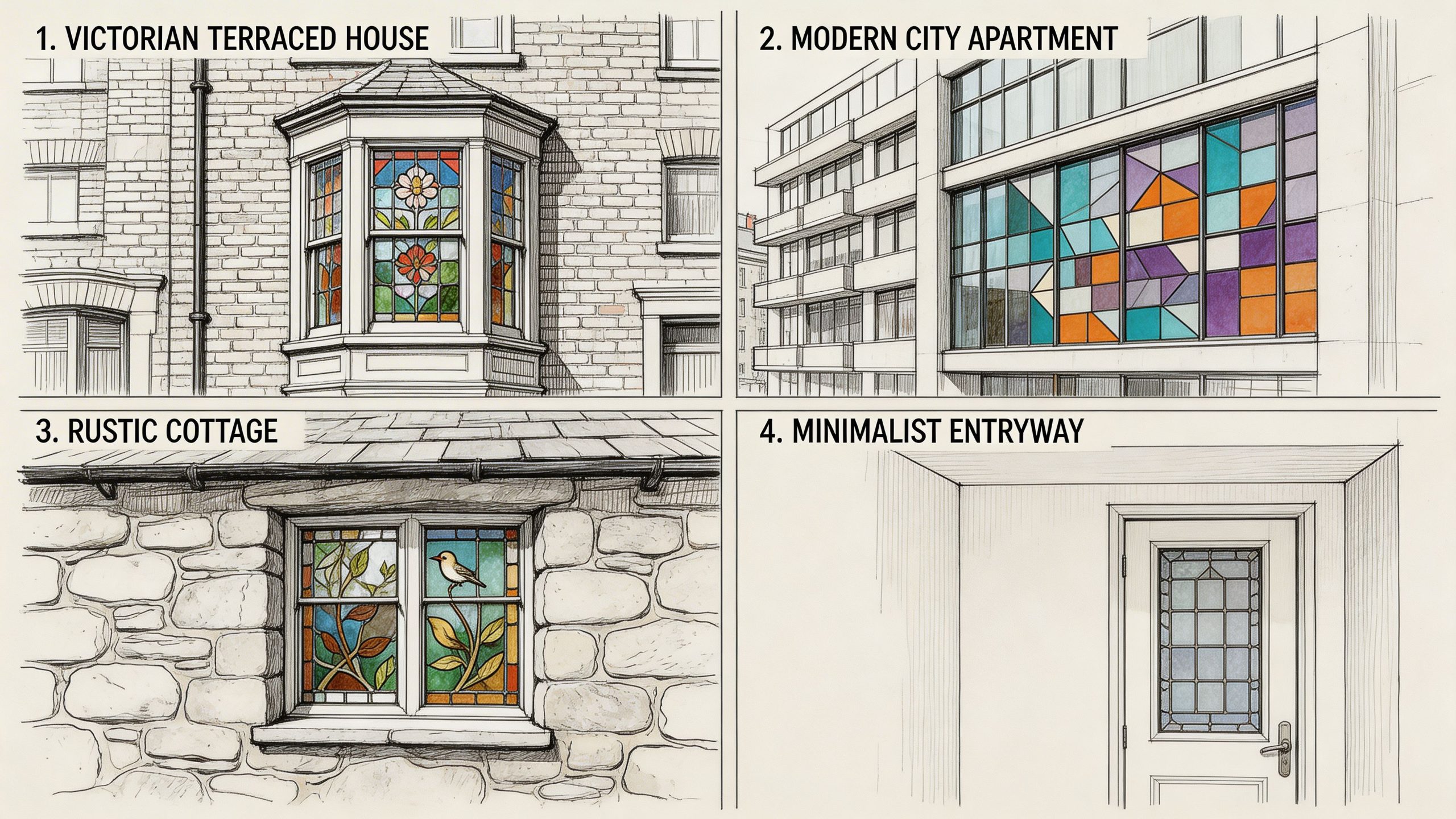
One of the most satisfying project types is the Victorian or Edwardian entrance where original character has been stripped out over time. The house still has its proportions, mouldings and brickwork, but the glazing has been replaced with something flat and forgettable.
In that setting, a floral leaded design works because it restores balance. Not fussiness. Balance.
The best versions usually rely on muted textured glass with controlled accents in green, amber or blue. That keeps the hall bright, gives privacy from the street and reconnects the entrance to the age of the property without tipping into pastiche.
A very different approach suits newer homes in the North East.
For a contemporary staircase, geometric patterned stained glass can act as a counterpoint to modern materials. Think clean oak treads, slim metal details and light walls, then a landing panel with strong repeated shapes and selective colour. It doesn’t imitate a period feature. It introduces craft into a sleek setting.
That combination works particularly well where homeowners already favour modern glazing and are looking at staircase upgrades or Glass Balustrades Newcastle style installations. Decorative glass gives the stair volume something to hold onto visually.
A staircase often needs one disciplined focal point. Decorative glazing can provide it without adding bulk.
Barn conversions need a different hand again.
The risk in these spaces is over-polishing them. Too much hard glazing and the building can lose its warmth. Patterned stained glass can soften that, especially in a gable end, entrance screen or high-level feature opening where privacy isn’t the issue but atmosphere is.
Nature-led patterns tend to work well here. Not literal scenes. More abstract references to stems, horizons, field lines or water movement. The glass should feel connected to the natural surroundings without trying to illustrate them.
For homeowners looking through completed examples of bespoke decorative and architectural glazing, a well-curated bespoke glass projects gallery is often the quickest way to judge what scale, linework and colour restraint look right in a Northern home.
In denser urban homes, internal patterned glass can be just as effective as external work.
A townhouse in Hull, for example, might use a glazed screen between hallway and kitchen to borrow light from the rear while giving the entrance more depth. In that setting, a looser geometric or semi-abstract pattern can stop the divide feeling too formal. The house stays open, but the rooms gain identity.
The common thread across all of these homes is judgement. The pattern must answer the building. Once it does, the panel stops feeling like an add-on and starts feeling inevitable.
Commissioning patterned stained glass should feel clear, not mysterious. Most homeowners don’t need a lecture on studio methods. They need a sensible process, honest advice and a design that suits the house rather than someone else’s portfolio.
The best commissions start with the opening itself. The size, location, light direction and surrounding materials all matter before anyone starts talking about colour.
People often arrive with a reference image or a style they’ve saved online. That’s useful, but it shouldn’t drive the whole job.
A panel for a front door has different demands from one for a landing. An internal screen may need obscurity without heaviness. A stair feature may need to tie into oak, steel or frameless glazing nearby. All of that affects line thickness, glass texture and how much colour the design can carry.
A sound early brief usually covers:
Many projects are won or lost at this point.
A strong design usually looks simpler than people expect. Lead lines need purpose. Repetition should feel intentional. Colour should be placed where the light will use it, not just where it looks nice on a sketch.
Design check: if every segment is trying to be the star, the finished panel will feel noisy.
At this stage, samples are valuable. Texture reads differently in person. So does colour density. A glass that looks subtle on a bench can become dominant once daylight pours through it. This is also when practical construction questions get resolved, especially if the decorative panel needs to work within a wider glazed assembly.
For homeowners exploring one-off pieces, feature stair glazing or integrated architectural details, bespoke glass projects give a useful sense of how custom work can be adapted to very different homes.
There isn’t a single standard price for patterned stained glass, and anyone pretending there is probably isn’t taking the job seriously.
Cost normally shifts with these factors:
| Factor | Why it changes the price |
|---|---|
| Size | Larger panels require more material, handling and support |
| Complexity of pattern | More pieces mean more cutting, fitting and soldering |
| Glass choice | Some textures and colours are more specialist than others |
| Installation context | Doors, protected units and awkward access all add complexity |
| Condition of existing joinery or opening | Surrounding repairs or adjustments may be needed |
What doesn’t help is chasing complexity for its own sake. A disciplined design with fewer, better shapes often looks more expensive than an overworked panel full of tiny sections.
Installation deserves as much attention as design.
A decorative panel has to sit properly in its frame or assembly. It must be supported correctly, protected where needed and finished neatly against adjoining materials. In front doors especially, security, weathering and everyday durability all need to be considered as part of the wider glazing and joinery package.
Traditional stained glass is also rooted in durable material science. The same stained glass data sheet referenced earlier notes traditional formulations built around silica, alkali and stabilisers, and references BS 952 glass durability in humid climates with water absorption below 0.5%. That’s a technical reminder of something homeowners care about in simpler terms. Properly made decorative glass is built to last.
Maintenance is usually simpler than people expect.
Use a soft cloth. Use a mild cleaner. Don’t scrub lead lines aggressively. Don’t use abrasive pads. If the panel is part of a wider glazed unit, treat it with the same care you’d give any finished architectural glass.
A few habits are enough:
The biggest reassurance is this. Once a bespoke panel is properly designed, fabricated and installed, it doesn’t become a fragile ornament. It becomes part of the architecture.
Yes, it can be incorporated within a broader modern glazing approach, depending on the design and the specification needed for the opening. This is often the right route where homeowners want decorative character without giving up modern practical performance.
It can be, provided the panel is designed for that location and integrated properly into the door and glazing build-up. Front entrance glazing should never be treated as decoration alone. Security and durability need to be considered from the start.
Often, yes. Cracks, loose sections and tired leadwork can sometimes be repaired or restored rather than replaced. The right answer depends on the panel’s condition, how much original material remains and whether the surrounding frame is also part of the problem.
Lead time varies with design complexity, material choices, workshop scheduling and installation requirements. Smaller, simpler pieces move faster. Larger or more specialised commissions need more planning and a proper approval process.
Gently. Use a soft cloth and mild cleaner. Avoid abrasive products and anything that puts unnecessary pressure on lead joints or delicate detailing.
Not at all. It suits period houses beautifully, but it can also work in modern homes when the pattern language is right. Geometric, restrained and texture-led designs often pair especially well with contemporary interiors, staircase upgrades and modern glazing schemes.
If you’re planning a staircase renovation, entrance upgrade or one-off decorative glazing feature, Glass Tech can help you shape it properly. As a family-run Yorkshire business, we design, supply and install bespoke glass features across Harrogate, Leeds, York, Hull, Newcastle and beyond, with a strong focus on quality, practicality and design that fits the home.

A professional team of experts providing glass and glazing solutions covering the whole of Yorkshire & more...
Whether it's Leeds, York, North Yorkshire, Birmingham, Hull, Liverpool, Machester, Newcastle or Nottingham, get in touch to find out how we can help you with your bespoke glass project.